
OpenAI releases powerful new AI model that anyone can run on their devices

OpenAI, the creator of ChatGPT, is launching a new, powerful open-source AI model.
- OpenAI is launching an open-source AI model, gpt-oss
- gpt-oss will have similar capabilities to o3-mini and o4-mini
- This model enables developers to run their own applications locally
The race for dominance in artificial intelligence has resulted in another major win for small developers and consumers. On Tuesday, August 5, OpenAI released a new open-source large language model, gpt-oss—the first since GPT-2. Notably, the new model is expected to have performance on par with some of OpenAI’s latest releases.
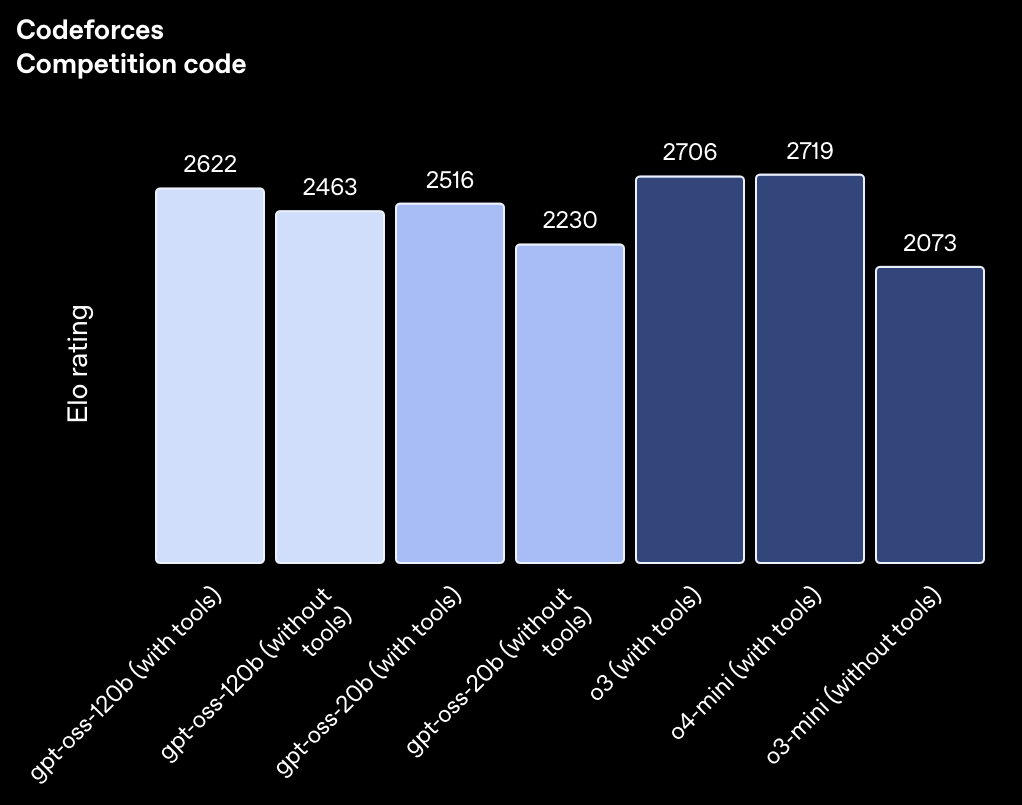 OpenAI’s cloud and open-source models benchmarked against a coding questionnaire | Source: OpenAI
“The gpt-oss-120b model achieves near-parity with OpenAI o4-mini on core reasoning benchmarks, while running efficiently on a single 80 GB GPU,” OpenAI statement wrote. “The gpt-oss-20b model delivers similar results to OpenAI o3‑mini on common benchmarks and can run on edge devices with just 16 GB of memory.”
This launch enables anyone to run the model on their own devices for free. However, its implications are even more significant for developers, who will be able to integrate these models into their own apps and platforms. Use cases include crypto trading bots, analytics platforms, and more.
What OpenAI’s open-source model means for developers
Until now, developers who wanted to use AI features had to rely on OpenAI’s API. Because they were using OpenAI’s cloud, costs could escalate quickly. Additionally, developers had limited control over these models and were required to use them as-is.
In contrast, an open-source AI model enables developers to modify and fine-tune the models for specific use cases. Moreover, developers can use their own data, allowing custom models to potentially perform more accurately than OpenAI’s cloud-based versions.
gpt-oss is not the first advanced LLM to launch in recent years. One of the most popular alternatives is DeepSeek, developed by a Chinese startup.
Disclaimer: The content of this article solely reflects the author's opinion and does not represent the platform in any capacity. This article is not intended to serve as a reference for making investment decisions.
You may also like
How much CPO demand will Nvidia Rubin Ultra generate? Bernstein: Optical value per Pod will increase fivefold
Bernstein believes that the co-packaged optics (CPO) and fiber demand driven by Nvidia's Rubin Ultra architecture will surge significantly, with the optical content per Pod rising from $1 million to $5.4 million. This will propel the size of Nvidia's optical ecosystem market to $46.8 billion by 2028 (a 91% annual increase). Although the industry faces supply bottlenecks with InP substrates, the outlook remains positive. The institution reiterates its “outperform” rating for Lumentum, Coherent, and Ciena.

UBS Q3 implements a two-way strategy with gold options, heavily invests in technology stocks, and builds positions in SK Hynix (SKHY.US)
UBS Group (UBS.US) has submitted its Q3 holdings report (13F) as of September 30, 2026.

SpaceX (SPCX.US) reportedly attempts “de-Nvidiaization” at the rack level: developing Kessel cabinets to bypass L6 compute boards, purchasing only chips
SemiAnalysis: SpaceX has developed its own Kessel cabinet, bypassing Nvidia's L6 cards to provide more options for manufacturing its own hardware.

$3.7 billion “data center power equipment prepayments” abandoned! What did "the most active buyer of gas turbines", SoftBank, see?
In the second quarter of fiscal year 2026, SoftBank reported a net loss of $7.1 billion, primarily due to a $3.7 billion impairment charge from a $9.5 billion advance payment for power generation equipment for US data centers—of which about $2.9 billion was non-refundable and effectively lost. The CFO admitted that SoftBank placed orders before the project plan was finalized, and is now conducting a comprehensive review of its procurement strategy. "The most aggressive purchaser of gas turbines has now written off the deposit in this way."
Crypto prices
More


