
Banks Face Fines if They Drop Crypto or Conservative Clients

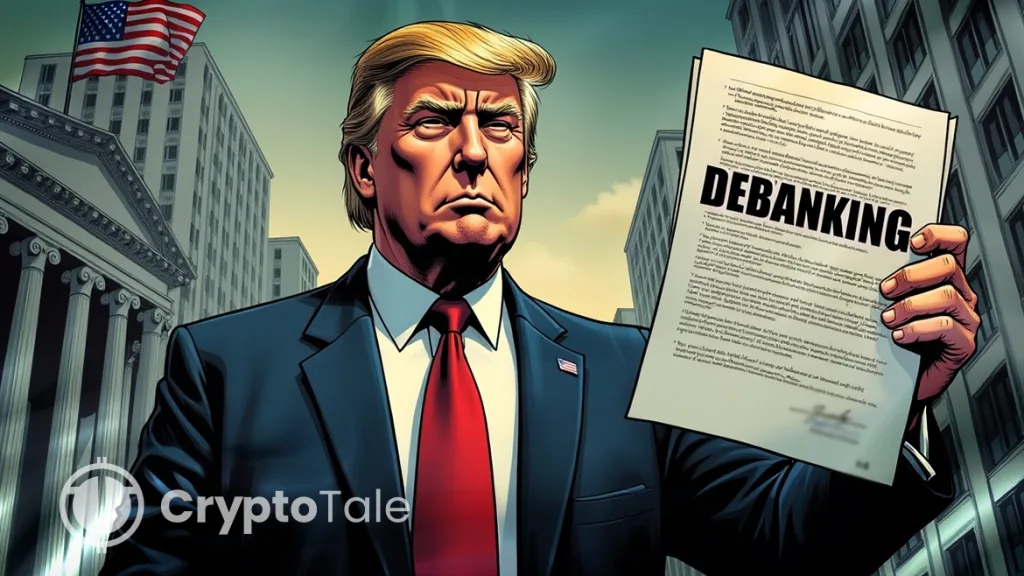
- The new order allows regulators to act when banks drop cryptocurrencies or group accounts.
- Cryptocurrency firms cite that banks are non-compliant, which affects their operations.
- The Order could help give fair access, though some fear it may lead to more control.
The White House is finalizing an executive order aimed at scrutinizing banks that cut ties with crypto firms or conservative-aligned clients. The Order seeks to eliminate what officials describe as “debanking,” where institutions deny services based on political or industry views. Regulators will investigate whether financial laws such as the Equal Credit Opportunity Act or antitrust statutes have been violated.
Penalties could include fines, consent decrees, or legal action for banks found engaging in unlawful service denials. A Wall Street Journal report confirms that the draft order could be signed this week, though delays remain possible.
Regulators to Probe Banking Bias
The draft instructs regulators to identify whether institutions used ideology or reputation as grounds for terminating client relationships.Further, the Order directly references instances where customer accounts were allegedly closed over political or religious affiliations. Notably, an incident took place in 2023, wherein, the Bank of America reportedly shut down a Christian charity’s account in Uganda.
The Bank of America claimed the closure was due to its global policy on overseas small businesses, not the group’s religious ties. Still, the case drew political backlash and raised new concerns about covert banking discrimination against certain organizations. In addition, the draft raises concerns about how banks may have cooperated in federal probes surrounding the January 6 Capitol events.
The Order instructs financial agencies to review internal bank policies to ensure they do not restrict access based on reputational concerns. It also draws comparisons to Operation Choke Point, a past initiative targeting controversial industries through indirect financial pressure. That policy, discontinued years ago, had been criticized for bypassing due process by limiting lawful businesses’ access to financial systems.
Crypto Sector and Conservatives
The crypto industry and conservative groups voiced concerns over sudden account closures without warning or explanation. Many blockchain startups allege they were quietly dropped by banks following federal scrutiny of digital assets and DeFi platforms. These moves intensified after the collapses of crypto-friendly banks like Silvergate and Signature, which triggered industry-wide fears of financial isolation.
In response, President Donald Trump’s administration launched initiatives to ensure crypto firms retain access to financial services. In January, an earlier executive order directed agencies to remove regulatory obstacles for blockchain businesses. The current draft expands this effort, pushing for fair banking access across both technological and ideological lines.
GOP lawmakers have also introduced legislation to prevent regulators from considering reputational risk in bank supervision. According to The Wall Street Journal, the Trump-aligned crypto working group, led by David Sacks, has called for broader support of DeFi and stablecoins. The new order reflects this stance and seeks to protect lawful but politically charged entities from service denials.
Related: Australia’s New Crypto Rules Aim to End Debanking for Firms
Can the Policy Safeguard Access?
Banks, on the other hand, claim their decisions are based on risk and not politics, especially when operating within federal laws on money laundering and compliance regulations. Moreover, according to sources, these institutions cite rigorous KYC and transaction monitoring requirements, which deter them from dealing with high-risk clients and make it nearly impossible to even onboard businesses linked to cryptocurrencies or politically sensitive entities.
Critics state that the executive order may bring in fresh clashes between political interests and financial oversight, reinstating that if ideology were to be considered a protected class, then the policy could change the way banks conduct their client risk assessment.
This raises a critical question: Would protecting crypto and political groups from debanking promise financial liberty or politicalization of capital access? While this draft Order awaits approval, its outcome could have far-reaching implications, not just for crypto regulation, but for the broader intersection of finance and ideology.
The post Banks Face Fines if They Drop Crypto or Conservative Clients appeared first on Cryptotale.
Disclaimer: The content of this article solely reflects the author's opinion and does not represent the platform in any capacity. This article is not intended to serve as a reference for making investment decisions.
You may also like
How much CPO demand will Nvidia Rubin Ultra generate? Bernstein: Optical value per Pod will increase fivefold
Bernstein believes that the co-packaged optics (CPO) and fiber demand driven by Nvidia's Rubin Ultra architecture will surge significantly, with the optical content per Pod rising from $1 million to $5.4 million. This will propel the size of Nvidia's optical ecosystem market to $46.8 billion by 2028 (a 91% annual increase). Although the industry faces supply bottlenecks with InP substrates, the outlook remains positive. The institution reiterates its “outperform” rating for Lumentum, Coherent, and Ciena.

UBS Q3 implements a two-way strategy with gold options, heavily invests in technology stocks, and builds positions in SK Hynix (SKHY.US)
UBS Group (UBS.US) has submitted its Q3 holdings report (13F) as of September 30, 2026.

SpaceX (SPCX.US) reportedly attempts “de-Nvidiaization” at the rack level: developing Kessel cabinets to bypass L6 compute boards, purchasing only chips
SemiAnalysis: SpaceX has developed its own Kessel cabinet, bypassing Nvidia's L6 cards to provide more options for manufacturing its own hardware.

$3.7 billion “data center power equipment prepayments” abandoned! What did "the most active buyer of gas turbines", SoftBank, see?
In the second quarter of fiscal year 2026, SoftBank reported a net loss of $7.1 billion, primarily due to a $3.7 billion impairment charge from a $9.5 billion advance payment for power generation equipment for US data centers—of which about $2.9 billion was non-refundable and effectively lost. The CFO admitted that SoftBank placed orders before the project plan was finalized, and is now conducting a comprehensive review of its procurement strategy. "The most aggressive purchaser of gas turbines has now written off the deposit in this way."
Crypto prices
More


