
Russia and Saudi Arabia to Boost Oil Production Starting October

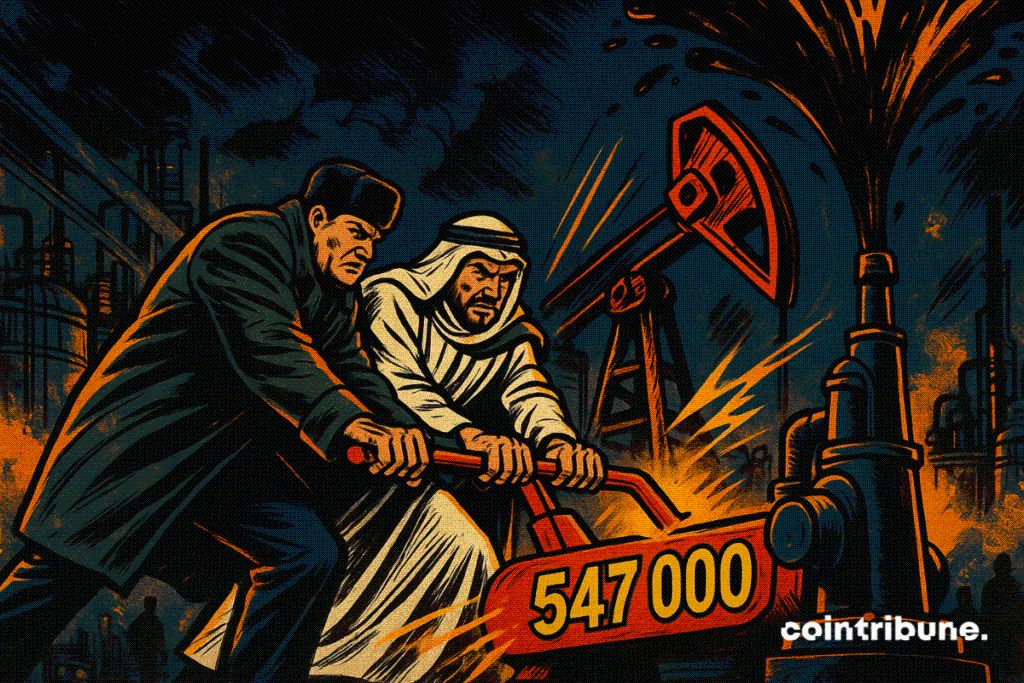
Saudi Arabia, Russia and their partners within OPEC+ announce a coordinated increase in oil production of 547,000 barrels per day. A strategic decision that disrupts the fragile balance of the global market and could reignite geopolitical tensions, as the standoff between Washington and Moscow intensifies.
In Brief
- OPEC+ increases its production by 547,000 barrels per day, or 0.6% of global consumption.
- Saudi Arabia and Russia lead this market share recovery initiative.
- Trump threatens new sanctions against Russia and its trading partners.
- India maintains its Russian imports despite American pressures.
Russia and Saudi Arabia want to regain control
On Sunday, August 3, eight producing countries gathered within OPEC+ officially agreed to increase their daily production by 547,000 barrels.
This decision, jointly led by Saudi Arabia and Russia , is part of a long-term strategy aimed at recovering market shares lost during previous restrictive policies.
This increase certainly represents a modest fraction of the 100 million barrels consumed daily worldwide. However, it signals a major paradigm shift. After years of drastic cuts aimed at keeping prices high, oil giants now prioritize volume over prices.
The immediate impact is already felt in the markets. Brent, the international benchmark, hovers around 70 dollars per barrel. A level that strongly contrasts with the peaks of 120 dollars reached in spring 2022, during the Russian invasion of Ukraine.
For French consumers, this stabilization could keep pump prices at their current levels: 1.62 euros per liter of diesel and 1.66 euros for gasoline.
The forward-looking vision of OPEC+ relies on growing demand until the middle of the century. This forecast directly contradicts the projections of the International Energy Agency, which expects stabilization by 2030, notably due to the widespread adoption of electric vehicles.
Geopolitical tensions redraw the energy chessboard
The OPEC+ announcement comes in a particularly volatile geopolitical context. Donald Trump recently hardened his tone towards Moscow, giving “ten days” to Russia to resolve the Ukrainian conflict.
This ultimatum comes with concrete threats: “We will impose tariffs and other things“, stated the American president.
Among the measures considered is an indirect surcharge of 100% on imports of Russian products, including hydrocarbons. This move targets India directly, which by 2025 became the world’s second largest importer of Russian oil, with 1.6 million barrels per day.
But New Delhi does not bow to pressure. The Indian government has clearly expressed its determination to maintain its energy relations with Moscow, asserting the primacy of its strategic interests over American injunctions.
This stance illustrates the growing fragmentation of the global trading system, marked by the emergence of rival economic blocs such as the BRICS and the erosion of Western unilateralism.
In this context of rapid recomposition, oil market outlooks are becoming increasingly opaque. Reversals in American trade policy, combined with persistent geopolitical instability, plunge the energy industry into a prolonged turbulence zone.
It is in this tense atmosphere that OPEC+ undertakes a major strategic shift. The production increase decided by the cartel goes beyond simple cyclical adjustment: it marks a political and economic offensive.
In this new game of influence, every barrel becomes a diplomatic lever, every energy alliance, a declaration of sovereignty.
In sum, Russia, Saudi Arabia and their allies want to preserve their central role in a shifting global energy order. For them, it is no longer just about regulating the market, but redefining the rules of power in a deeply multipolar world.
Disclaimer: The content of this article solely reflects the author's opinion and does not represent the platform in any capacity. This article is not intended to serve as a reference for making investment decisions.
You may also like
How much CPO demand will Nvidia Rubin Ultra generate? Bernstein: Optical value per Pod will increase fivefold
Bernstein believes that the co-packaged optics (CPO) and fiber demand driven by Nvidia's Rubin Ultra architecture will surge significantly, with the optical content per Pod rising from $1 million to $5.4 million. This will propel the size of Nvidia's optical ecosystem market to $46.8 billion by 2028 (a 91% annual increase). Although the industry faces supply bottlenecks with InP substrates, the outlook remains positive. The institution reiterates its “outperform” rating for Lumentum, Coherent, and Ciena.

UBS Q3 implements a two-way strategy with gold options, heavily invests in technology stocks, and builds positions in SK Hynix (SKHY.US)
UBS Group (UBS.US) has submitted its Q3 holdings report (13F) as of September 30, 2026.

SpaceX (SPCX.US) reportedly attempts “de-Nvidiaization” at the rack level: developing Kessel cabinets to bypass L6 compute boards, purchasing only chips
SemiAnalysis: SpaceX has developed its own Kessel cabinet, bypassing Nvidia's L6 cards to provide more options for manufacturing its own hardware.

$3.7 billion “data center power equipment prepayments” abandoned! What did "the most active buyer of gas turbines", SoftBank, see?
In the second quarter of fiscal year 2026, SoftBank reported a net loss of $7.1 billion, primarily due to a $3.7 billion impairment charge from a $9.5 billion advance payment for power generation equipment for US data centers—of which about $2.9 billion was non-refundable and effectively lost. The CFO admitted that SoftBank placed orders before the project plan was finalized, and is now conducting a comprehensive review of its procurement strategy. "The most aggressive purchaser of gas turbines has now written off the deposit in this way."
Crypto prices
More


