
Bitcoin Miners Earn $1.66 Billion in July, a Post-Halving Record

July marks a turning point for Bitcoin mining: revenues explode to $1.66 billion, a post-halving high. This boom hides persistent tensions on profitability. Between rising fees and technical adjustments, the sector adapts. But can this momentum last amid the uncertainties looming over August?

In Brief
- Bitcoin miners’ revenues reached $1.66 billion in July, a record since the 2024 halving.
- Despite this rebound, profitability remains 43 to 50% lower than pre-halving levels.
- August will be decisive with an expected difficulty adjustment and geopolitical uncertainties in the background.
Bitcoin miners hit a historic record in July
In July 2025, Bitcoin miners’ total revenue reached $1.66 billion, combining block rewards and transaction fees. This is the highest amount since the 2024 Bitcoin halving. The recovery comes amid rising difficulty and intense competition across the network.
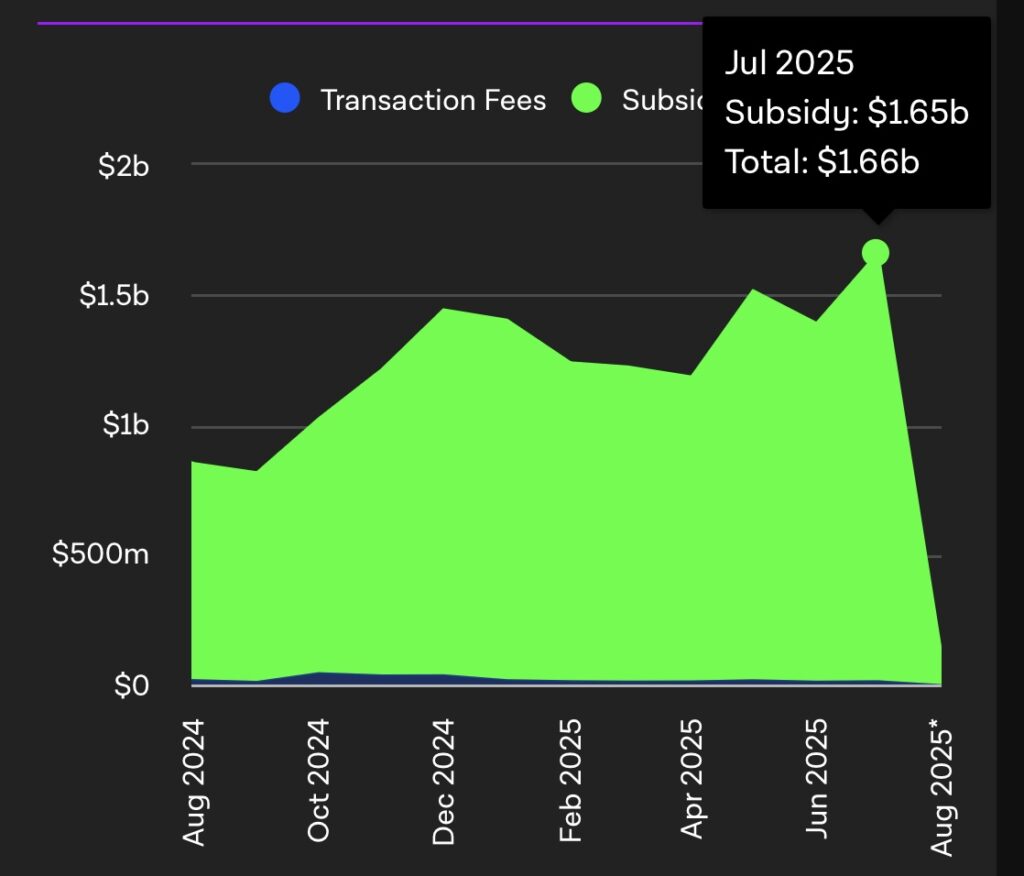 Bitcoin miners’ revenues at $1.66 billion in July 2025.
The average daily income per exahash per second (EH/s) was $57,400, 4% higher than in June. However, these revenues remain 43% lower than those observed before the 2024 halving, when daily income was around $100,700 per EH/s. Gross margins remain 50% lower compared to levels before April 2024.
Mining under pressure: how players adapt to survive
To remain competitive, many Bitcoin miners have adjusted their operational model. This includes searching for low-energy-cost areas, automating operations, and pooling computational power in mining pools.
Profitability now depends on a trio of variables:
- BTC price;
- Difficulty level;
- Regulatory environment.
In addition to the $1.66 billion Bitcoin miners’ revenue in July , the average hashrate increased by 4% to 899 EH/s, while difficulty jumped 9% over the month, further pressuring less efficient miners.
Decisive August for Bitcoin mining: between hopes and uncertainties
A negative difficulty adjustment is expected early August, with a correction estimated around –3%. This readjustment is part of Bitcoin’s automatic mechanism, which balances difficulty based on the average observed computing power. This potential relief, combined with a BTC price stable around $113,000 at the end of July, could temporarily improve margins.
However, geopolitical uncertainty, energy volatility, and tax constraints in certain jurisdictions could quickly reshuffle the cards.
The resurgence of Bitcoin miners’ revenues in July hides a more nuanced reality: profitability remains under pressure. Between difficulty adjustment and macroeconomic uncertainties, August promises to be decisive. Is the current BTC mining model sustainable in the long term?
Disclaimer: The content of this article solely reflects the author's opinion and does not represent the platform in any capacity. This article is not intended to serve as a reference for making investment decisions.
You may also like
How much CPO demand will Nvidia Rubin Ultra generate? Bernstein: Optical value per Pod will increase fivefold
Bernstein believes that the co-packaged optics (CPO) and fiber demand driven by Nvidia's Rubin Ultra architecture will surge significantly, with the optical content per Pod rising from $1 million to $5.4 million. This will propel the size of Nvidia's optical ecosystem market to $46.8 billion by 2028 (a 91% annual increase). Although the industry faces supply bottlenecks with InP substrates, the outlook remains positive. The institution reiterates its “outperform” rating for Lumentum, Coherent, and Ciena.

UBS Q3 implements a two-way strategy with gold options, heavily invests in technology stocks, and builds positions in SK Hynix (SKHY.US)
UBS Group (UBS.US) has submitted its Q3 holdings report (13F) as of September 30, 2026.

SpaceX (SPCX.US) reportedly attempts “de-Nvidiaization” at the rack level: developing Kessel cabinets to bypass L6 compute boards, purchasing only chips
SemiAnalysis: SpaceX has developed its own Kessel cabinet, bypassing Nvidia's L6 cards to provide more options for manufacturing its own hardware.

$3.7 billion “data center power equipment prepayments” abandoned! What did "the most active buyer of gas turbines", SoftBank, see?
In the second quarter of fiscal year 2026, SoftBank reported a net loss of $7.1 billion, primarily due to a $3.7 billion impairment charge from a $9.5 billion advance payment for power generation equipment for US data centers—of which about $2.9 billion was non-refundable and effectively lost. The CFO admitted that SoftBank placed orders before the project plan was finalized, and is now conducting a comprehensive review of its procurement strategy. "The most aggressive purchaser of gas turbines has now written off the deposit in this way."
Crypto prices
More


