
Crypto victim loses $908K in sophisticated phishing attack

A crypto user lost $908,551 to a wallet-draining scam 458 days after unknowingly signing a malicious approval transaction, onchain data shows.
The attack originated from an ERC-20 approval transaction — likely signed via a phishing site or fake airdrop — that gave the scammer’s wallet, “0x67E5Ae,” ongoing permission to access the victim’s funds.
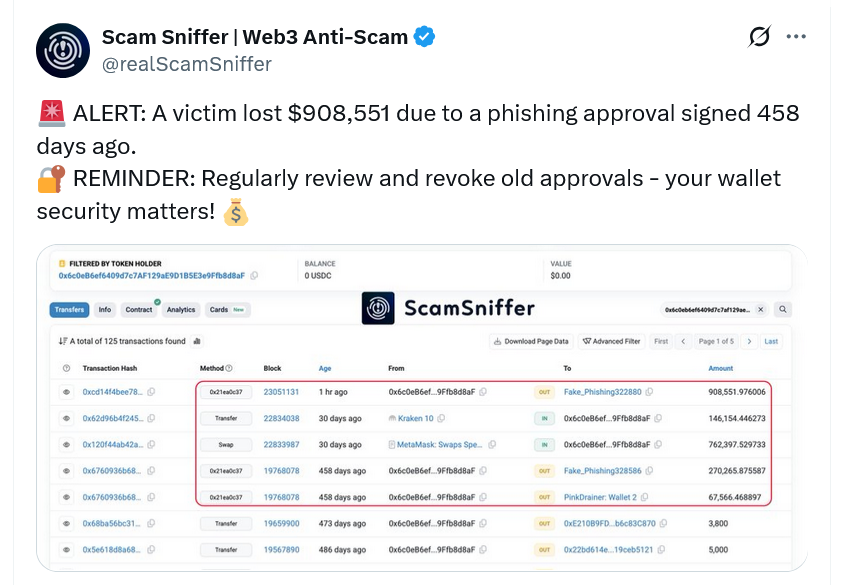
The scammer — linked to the notorious pink-drainer.eth wallet address — executed the theft on Aug. 2 at 4:57am UTC, stealing $908,551 worth of the USDC (USDC) stablecoin, Scam Sniffer pointed out on X. The theft came 458 days after the victim signed the phishing approval transaction on April 30, 2024.
The security incident prompted Scam Sniffer to remind crypto users to “regularly review and revoke old approvals,” or else, hard-earned funds may be at risk.
“Your wallet security matters,” it added.
The scammer’s patience paid off
Until a month ago, the victim’s compromised wallet had seen minimal transaction activity and held little value — giving the attacker no incentive to act.
That changed on July 2, when the victim deposited $762,397 into the tainted wallet address, “0x6c0eB6,” from a MetaMask wallet at 8:41pm UTC.
Ten minutes later, another $146,154 in USDC was transferred into the same wallet from a Kraken wallet.
Related: $3.5B Bitcoin heist from 2020 retroactively uncovered — Arkham Intel
The scammer likely monitored the wallet over the next month, waiting to see if more funds would flow into it before deciding to drain the funds in a single transaction on Aug. 2.
This delayed strike is a defining trait of phishing approval attacks: scammers wait around for months, striking only when the victim’s wallet balance makes it worthwhile.
Tools already exist to prevent these attacks
To help prevent such attacks, Ethereum users can use Etherscan’s Token Approval Checker to review and revoke unnecessary token approvals — though each revocation requires a gas fee.
Bad actors and scammers stole over $142 million from the crypto space in July across at least 17 separate attacks, with the exploit of crypto exchange CoinDCX accounting for the most significant loss.
Magazine: Inside a 30,000 phone bot farm stealing crypto airdrops from real users
Disclaimer: The content of this article solely reflects the author's opinion and does not represent the platform in any capacity. This article is not intended to serve as a reference for making investment decisions.
You may also like
How much CPO demand will Nvidia Rubin Ultra generate? Bernstein: Optical value per Pod will increase fivefold
Bernstein believes that the co-packaged optics (CPO) and fiber demand driven by Nvidia's Rubin Ultra architecture will surge significantly, with the optical content per Pod rising from $1 million to $5.4 million. This will propel the size of Nvidia's optical ecosystem market to $46.8 billion by 2028 (a 91% annual increase). Although the industry faces supply bottlenecks with InP substrates, the outlook remains positive. The institution reiterates its “outperform” rating for Lumentum, Coherent, and Ciena.

UBS Q3 implements a two-way strategy with gold options, heavily invests in technology stocks, and builds positions in SK Hynix (SKHY.US)
UBS Group (UBS.US) has submitted its Q3 holdings report (13F) as of September 30, 2026.

SpaceX (SPCX.US) reportedly attempts “de-Nvidiaization” at the rack level: developing Kessel cabinets to bypass L6 compute boards, purchasing only chips
SemiAnalysis: SpaceX has developed its own Kessel cabinet, bypassing Nvidia's L6 cards to provide more options for manufacturing its own hardware.

$3.7 billion “data center power equipment prepayments” abandoned! What did "the most active buyer of gas turbines", SoftBank, see?
In the second quarter of fiscal year 2026, SoftBank reported a net loss of $7.1 billion, primarily due to a $3.7 billion impairment charge from a $9.5 billion advance payment for power generation equipment for US data centers—of which about $2.9 billion was non-refundable and effectively lost. The CFO admitted that SoftBank placed orders before the project plan was finalized, and is now conducting a comprehensive review of its procurement strategy. "The most aggressive purchaser of gas turbines has now written off the deposit in this way."
Crypto prices
More


