Bitget App
Trade smarter
Buy cryptoMarketsTradeFuturesStocksEarnInstitutionAI & More
VISA, Mastercard Snub Stablecoin Threat, But Competition Is Rising

VISA, Mastercard Snub Stablecoin Threat, But Competition Is Rising

CoinspeakerCoinspeaker2025/08/01 16:00
By:By Bhushan Akolkar Editor Kirsten Thijssen

Despite the growing popularity of stablecoins, VISA and Mastercard downplayed any competitive risk during recent earnings calls.

Key Notes

  • Executives at VISA cited minimal crypto usage compared to Visa’s $15 trillion annual transaction volume.
  • But data shows stablecoin transaction volume reached over $6 trillion in Q1 2025, nearly double Visa’s.
  • To stay competitive, Visa has partnered with Paxos to support additional USD-backed stablecoins - USDG and PYUSD.

With stablecoins getting all the attention currently with the passing of the GENIUS Act last month, VISA and Mastercard executives have denied any imminent threat from the fiat-pegged cryptocurrencies during their earnings call this week. They stated that use of stablecoins is still insufficient or negligible to challenge their market dominance.

VISA, Mastercard Deny Competition From Stablecoins

Both Visa and Mastercard acknowledge that crypto usage remains minimal compared to the approximately $15 trillion processed annually on Visa’s network alone. They added that such digital assets are mostly useful in countries with unstable fiat systems.
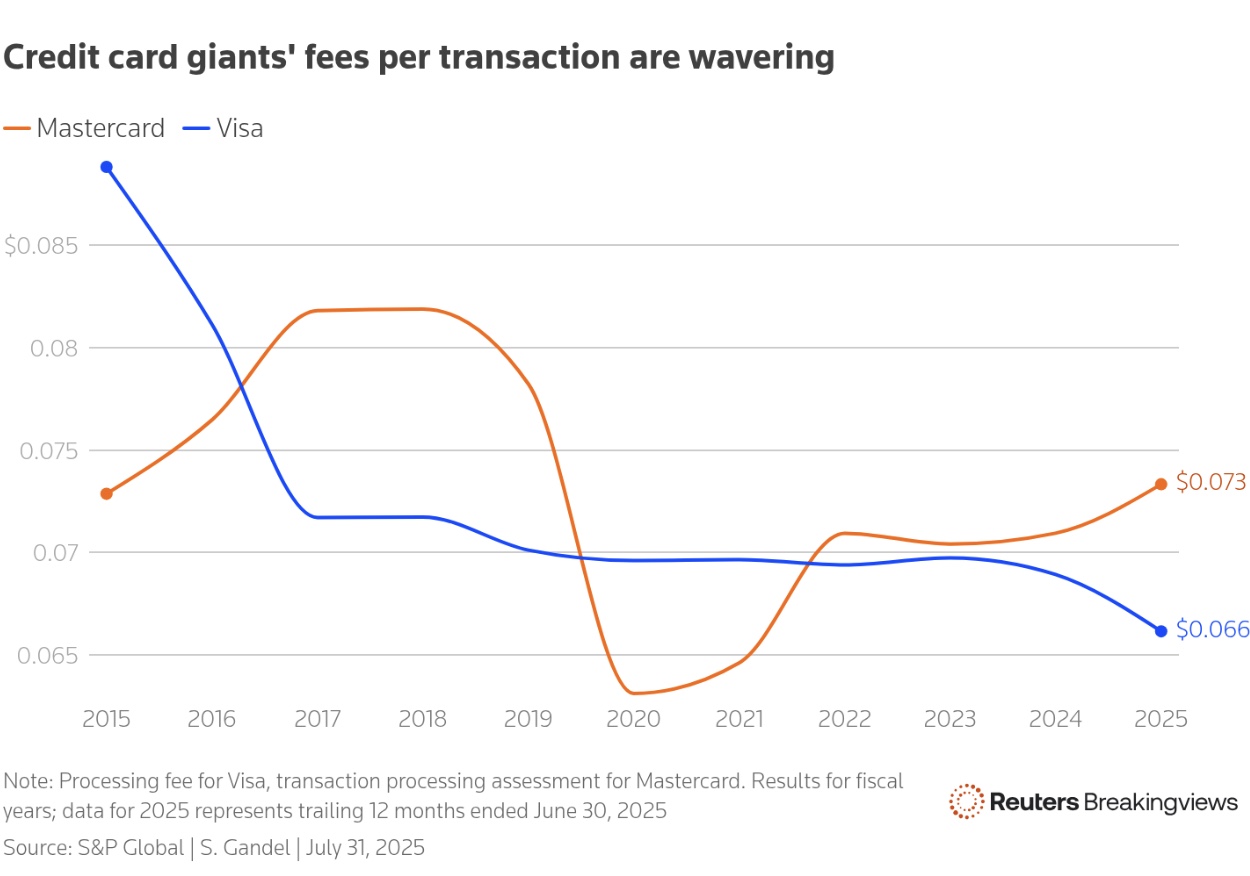
VISA, Mastercard Snub Stablecoin Threat, But Competition Is Rising image 0

VISA, Mastercard Transaction Fees – Source: Reuters

However, stablecoins still face the challenge of low transaction fees. Although both the card processing companies remain resilient with strong earnings for the past quarter, they have faced pressure to reduce the credit card transaction fees, reported Reuters .

Visa and Mastercard together collected around $95 billion in swipe fees from merchants in their most recent fiscal years. However, their share of these fees is shrinking. Visa earned 6.6 cents per transaction in processing fees last quarter, down from nearly 9 cents a decade ago. Similarly, Mastercard’s transaction fees have averaged to 7.3 cents per transaction, down from nearly 8 cents the year before.

On the other hand, stablecoins led by players like Circle (NASDAQ: CRCL) have started to eat into the market share of these big giants. During the first quarter of 2025, stablecoin transaction volume exceeded Visa’s, reaching over $6 trillion, nearly double Visa’s total, according to data from Bitwise.

📊 UPDATE: Stablecoin transaction volume surpasses Visa's in Q1 2025, nearly doubled Visa’s volume with over $6T, per Bitwise data. pic.twitter.com/Af2PZu8r5m

— Cointelegraph (@Cointelegraph) July 30, 2025

VISA Makes Key Stablecoin Partnerships

On the other hand, VISA has continued to make key partnerships to keep its footing in the stablecoin market. Visa has expanded its stablecoin initiative by adding support for two new USD-backed stablecoins, Global Dollar (USDG) and PayPal USD (PYUSD), in its recent partnership with Paxos.

The company is also broadening its blockchain integrations to include Stellar and Avalanche, alongside its existing support for Ethereum and Solana. Additionally, Visa now supports Circle’s euro-backed stablecoin, EURC, further diversifying its digital currency offerings.

Visa has already facilitated hundreds of millions of dollars in stablecoin payments, and the addition of USDG marks a further step in expanding its on-chain settlement infrastructure. The move also builds on Visa’s earlier collaboration with Circle, the issuer of USDC.


0
0

Disclaimer: The content of this article solely reflects the author's opinion and does not represent the platform in any capacity. This article is not intended to serve as a reference for making investment decisions.

Understand the market, then trade.
Bitget offers one-stop trading for cryptocurrencies, stocks, and gold.
Trade now!

You may also like

How much CPO demand will Nvidia Rubin Ultra generate? Bernstein: Optical value per Pod will increase fivefold

Bernstein believes that the co-packaged optics (CPO) and fiber demand driven by Nvidia's Rubin Ultra architecture will surge significantly, with the optical content per Pod rising from $1 million to $5.4 million. This will propel the size of Nvidia's optical ecosystem market to $46.8 billion by 2028 (a 91% annual increase). Although the industry faces supply bottlenecks with InP substrates, the outlook remains positive. The institution reiterates its “outperform” rating for Lumentum, Coherent, and Ciena.

华尔街见闻•2026/11/11 08:47
How much CPO demand will Nvidia Rubin Ultra generate? Bernstein: Optical value per Pod will increase fivefold

UBS Q3 implements a two-way strategy with gold options, heavily invests in technology stocks, and builds positions in SK Hynix (SKHY.US)

UBS Group (UBS.US) has submitted its Q3 holdings report (13F) as of September 30, 2026.

智通财经•2026/11/11 08:22
UBS Q3 implements a two-way strategy with gold options, heavily invests in technology stocks, and builds positions in SK Hynix (SKHY.US)

SpaceX (SPCX.US) reportedly attempts “de-Nvidiaization” at the rack level: developing Kessel cabinets to bypass L6 compute boards, purchasing only chips

SemiAnalysis: SpaceX has developed its own Kessel cabinet, bypassing Nvidia's L6 cards to provide more options for manufacturing its own hardware.

智通财经•2026/11/11 08:20
SpaceX (SPCX.US) reportedly attempts “de-Nvidiaization” at the rack level: developing Kessel cabinets to bypass L6 compute boards, purchasing only chips

$3.7 billion “data center power equipment prepayments” abandoned! What did "the most active buyer of gas turbines", SoftBank, see?

In the second quarter of fiscal year 2026, SoftBank reported a net loss of $7.1 billion, primarily due to a $3.7 billion impairment charge from a $9.5 billion advance payment for power generation equipment for US data centers—of which about $2.9 billion was non-refundable and effectively lost. The CFO admitted that SoftBank placed orders before the project plan was finalized, and is now conducting a comprehensive review of its procurement strategy. "The most aggressive purchaser of gas turbines has now written off the deposit in this way."

华尔街见闻•2026/11/11 08:19
