
Bitcoin Hits Third Profit-Taking Wave—Here’s What It Signals for the Market

Bitcoin faces a new wave of profit-taking led by whales, yet on-chain data signals continued strength in this bull cycle. Analysts expect short-term consolidation but maintain a bullish long-term outlook.
After Bitcoin (BTC) surpassed the $120,000 mark in July, on-chain data revealed a series of notable profit-taking activities by whales.
In this context, closely monitoring whale behavior and capital flows in and out of major platforms will remain key to determining the market’s next moves.
The Market in a Short-Term Distribution Phase
Following the recent market correction, Bitcoin trades around the $115,000 zone. According to CryptoQuant, Bitcoin is entering its “third major profit-taking wave” of this bull cycle.
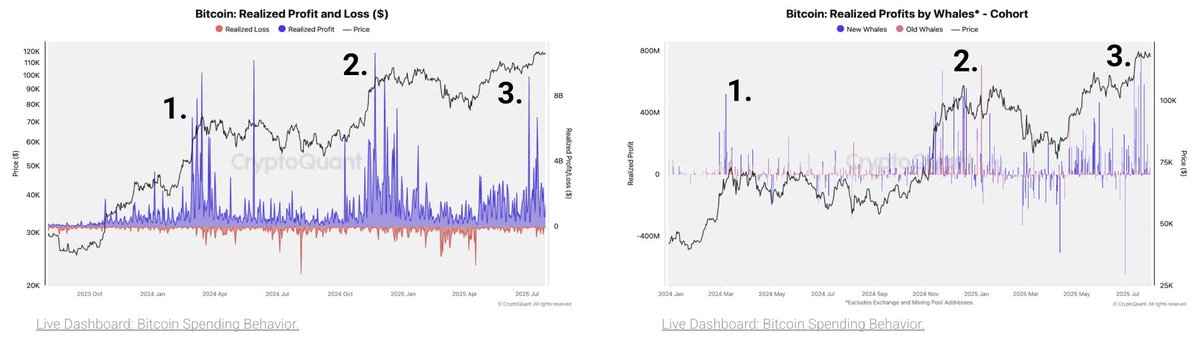 Bitcoin just saw its third major profit-taking wave of this bull run. Source:
CryptoQuant noted that the primary profit-takers are new whales who have accumulated recently and are now sitting on significant gains.
In addition, the market continues to see some early-era whales from the Satoshi timeline selling off. The account ai_9684xtpa on X confirmed that several old wallets from Bitcoin’s early days are again moving BTC and selling after years of dormancy.
These wallets often draw attention due to their potential psychological impact on the market, even though their size remains small relative to the total circulating supply.
Long-Term Sentiment Remains Positive
Alongside the short-term wave of profit-taking, the market still presents several noteworthy bullish indicators. Data from Glassnode shows that Bitcoin’s current price is above the short-term holder (STH) cost basis range—a key factor in forming strong support zones if the market pulls back.
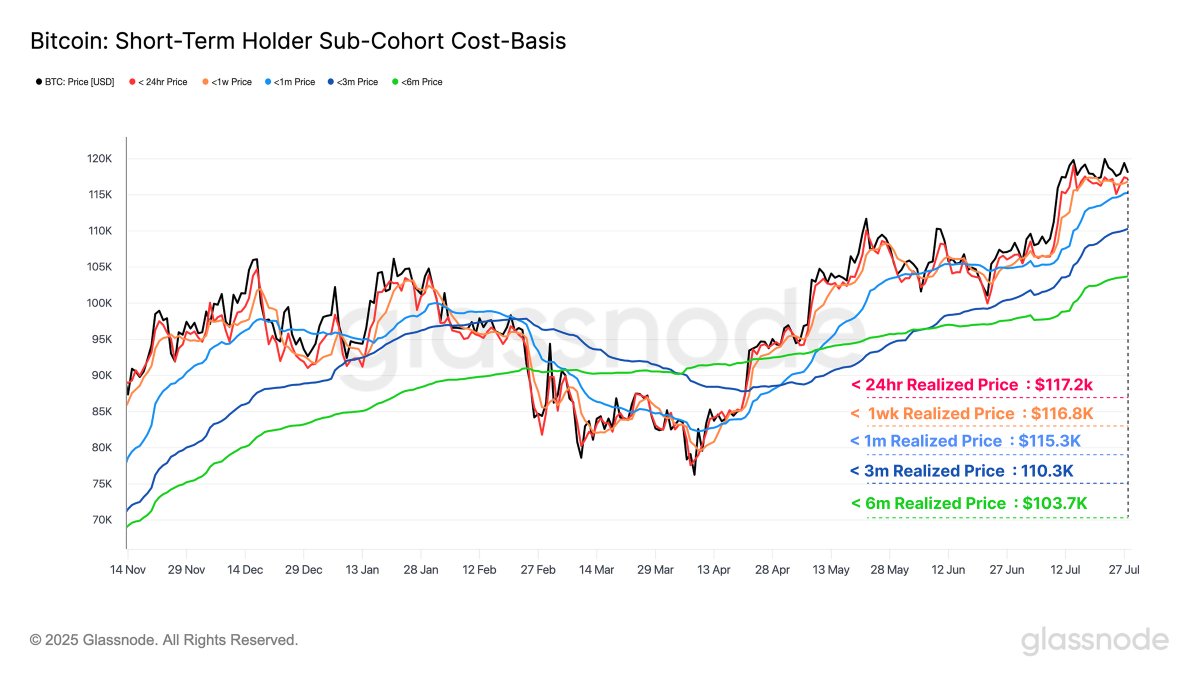 STH sub-cohort cost bases. Source:
Meanwhile, Coin Bureau quoted Bernstein’s analysis, saying that the crypto bull run is still early. This perspective reinforces the confidence of long-term investors, especially as institutional capital continues to flow into the market through ETFs and platforms like Coinbase and Robinhood.
CryptoQuant also noted that new investor dominance is rising but still has room before reaching extreme levels. This indicates that the current cycle attracts a large influx of new participants, rather than revolving solely around veteran holders like in previous cycles.
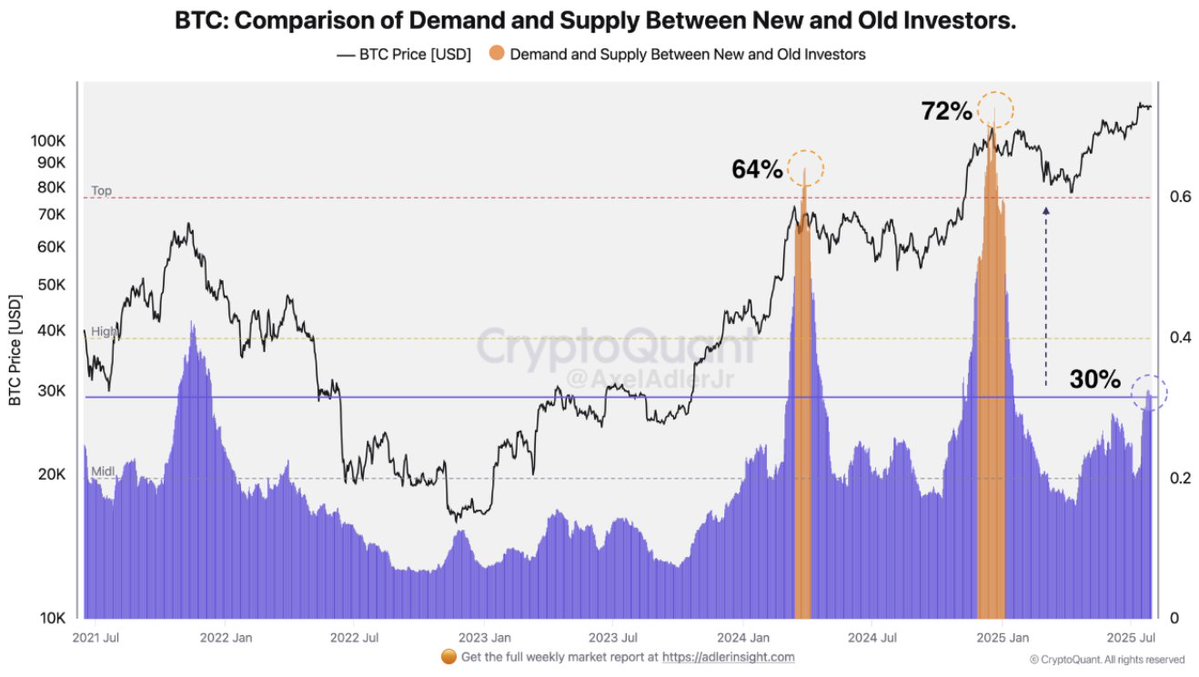 New investor dominance is growing. Source:
Given the strong price increases over recent months, some analysts warn that Bitcoin may require a correction period to rebuild buying momentum.
“July marked a transition from trend to consolidation. Elevated speculation and profit-taking are dragging on momentum, signaling that BTC may need a reset or sideways grind before the next breakout attempt,” said analyst Willy Woo.
Additionally, on-chain data from Santiment showed that whales have accumulated around 0.9% of Bitcoin’s total circulating supply in just the past four months. This suggests that long-term confidence remains intact despite technical pullbacks.
Disclaimer: The content of this article solely reflects the author's opinion and does not represent the platform in any capacity. This article is not intended to serve as a reference for making investment decisions.
You may also like
How much CPO demand will Nvidia Rubin Ultra generate? Bernstein: Optical value per Pod will increase fivefold
Bernstein believes that the co-packaged optics (CPO) and fiber demand driven by Nvidia's Rubin Ultra architecture will surge significantly, with the optical content per Pod rising from $1 million to $5.4 million. This will propel the size of Nvidia's optical ecosystem market to $46.8 billion by 2028 (a 91% annual increase). Although the industry faces supply bottlenecks with InP substrates, the outlook remains positive. The institution reiterates its “outperform” rating for Lumentum, Coherent, and Ciena.

UBS Q3 implements a two-way strategy with gold options, heavily invests in technology stocks, and builds positions in SK Hynix (SKHY.US)
UBS Group (UBS.US) has submitted its Q3 holdings report (13F) as of September 30, 2026.

SpaceX (SPCX.US) reportedly attempts “de-Nvidiaization” at the rack level: developing Kessel cabinets to bypass L6 compute boards, purchasing only chips
SemiAnalysis: SpaceX has developed its own Kessel cabinet, bypassing Nvidia's L6 cards to provide more options for manufacturing its own hardware.

$3.7 billion “data center power equipment prepayments” abandoned! What did "the most active buyer of gas turbines", SoftBank, see?
In the second quarter of fiscal year 2026, SoftBank reported a net loss of $7.1 billion, primarily due to a $3.7 billion impairment charge from a $9.5 billion advance payment for power generation equipment for US data centers—of which about $2.9 billion was non-refundable and effectively lost. The CFO admitted that SoftBank placed orders before the project plan was finalized, and is now conducting a comprehensive review of its procurement strategy. "The most aggressive purchaser of gas turbines has now written off the deposit in this way."
Crypto prices
More


