
Is Tether Dropping Its US Market Ambition for USDT?

Tether’s latest report highlights a shift in its investment strategy, with a notable decrease in US Treasury purchases, sparking questions about its future regulatory compliance.
Tether released its Attestation Report for Q2 2025, showing a dramatic decrease in US Treasury bond purchases. The firm spent $7 billion on them last quarter, compared to $65 billion in Q1.
Although the company is buying Bitcoin and gold and making corporate investments, all its “cash equivalents”, like bond repurchase agreements and non-US Treasuries, barely rose or fell outright. This may complicate GENIUS Act compliance.
Why Doesn’t Tether Want US Treasuries?
Tether, the world’s largest stablecoin issuer, has been making some very diversified investments lately. According to a recent report, interest from the firm’s US Treasury bonds allowed it to invest in over 120 companies.
Today, Tether released its Q2 2025 Attestation Report, confirming a slight increase in Treasuries holdings.
Tether just released its quarterly attestation for Q2 2025.Highlights as of 30th June 2025:* 157.1B total issued USDt, end of Q2 2025.* 162.5B total assets/reserves, end of Q2 2025.* 5.47B excess reserves, on top of the 100% reserves in liquid assets that back all issued… https://t.co/bejhVFkMYt pic.twitter.com/XYVmueWZ0G
— Paolo Ardoino(@paoloardoino) July 31, 2025
According to the report, Tether currently holds $105.5 billion in US Treasuries and another $24.4 billion in indirect exposure. This includes Overnight Reverse Repurchase Agreements and non-US Treasuries, which may refer to EU bonds for MiCA compliance.
There’s a simple reason why Tether has been buying so many Treasury bonds: stablecoin regulations. The GENIUS Act mandates that stablecoin issuers hold asset reserves in Treasuries, which may cause problems for the firm.
Still, Tether lobbied hard to pass this legislation, so it seems likely that it’s prepared to reach compliance.
However, there is an interesting piece of data here. Since MiCA first took effect, Tether has bought astronomical quantities of Treasury bonds.
In Q4 2024, it purchased $33 billion, and added a whopping $65 billion in Q1 2025.
Today’s report, however, shows less than a $7 billion increase in direct Treasuries holdings throughout all of Q2.
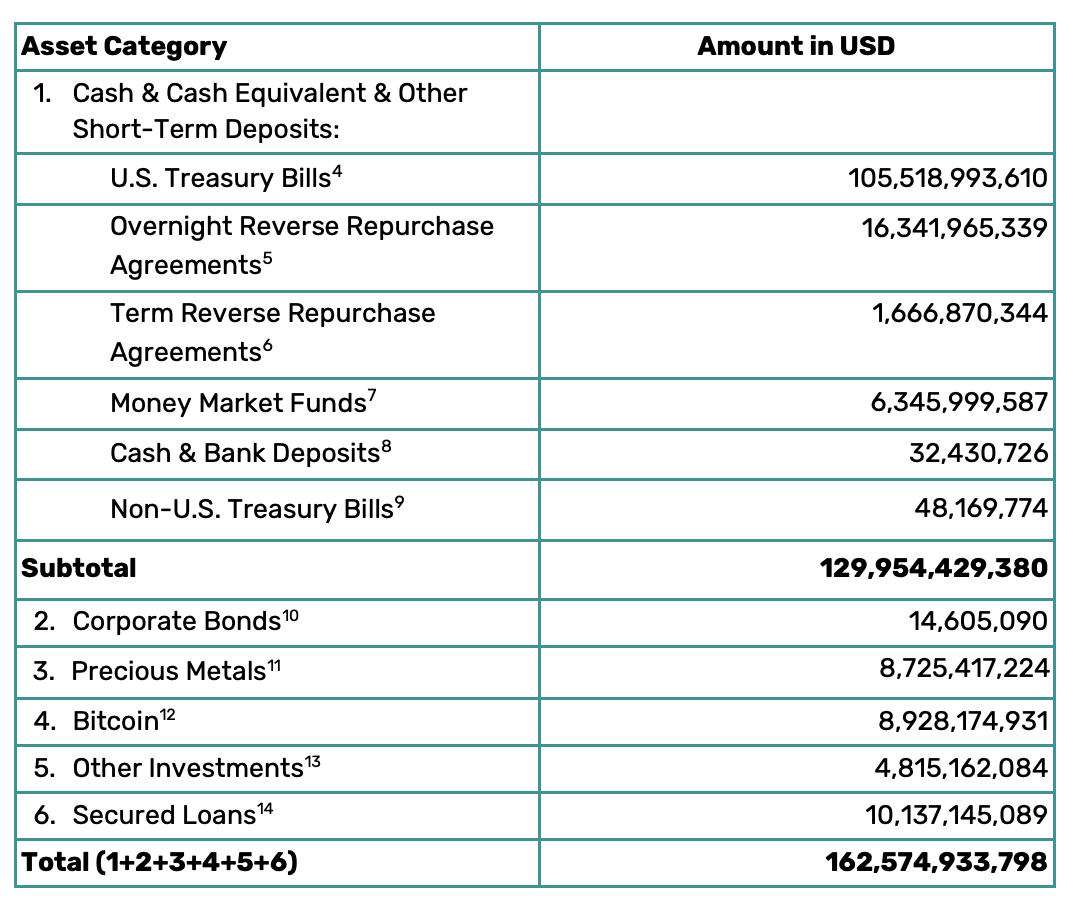 Tether’s Reserves by Asset. Source:
Tether’s non-US Treasury holdings decreased by around $17 billion, and all other “cash equivalents” either fell or rose by less than $1 billion.
Sure, the firm has been buying gold, Bitcoin, and these diverse corporate investments, but its rampant hunger for Treasuries seems to be tapering off. Tether’s holdings are growing, but its strategy is changing.
It’s unclear what to make of all this. According to CEO Paolo Ardoino’s post, Tether has issued over $50 billion more USDT tokens than corresponding US Treasuries. Couldn’t this cause problems for future GENIUS Act compliance?
Ultimately, it’s hard to say whether potential bond market issues caused this change in tactics. It could be very significant, though.
Disclaimer: The content of this article solely reflects the author's opinion and does not represent the platform in any capacity. This article is not intended to serve as a reference for making investment decisions.
You may also like
UBS Q3 implements a two-way strategy with gold options, heavily invests in technology stocks, and builds positions in SK Hynix (SKHY.US)
UBS Group (UBS.US) has submitted its Q3 holdings report (13F) as of September 30, 2026.

SpaceX (SPCX.US) reportedly attempts “de-Nvidiaization” at the rack level: developing Kessel cabinets to bypass L6 compute boards, purchasing only chips
SemiAnalysis: SpaceX has developed its own Kessel cabinet, bypassing Nvidia's L6 cards to provide more options for manufacturing its own hardware.

$3.7 billion “data center power equipment prepayments” abandoned! What did "the most active buyer of gas turbines", SoftBank, see?
In the second quarter of fiscal year 2026, SoftBank reported a net loss of $7.1 billion, primarily due to a $3.7 billion impairment charge from a $9.5 billion advance payment for power generation equipment for US data centers—of which about $2.9 billion was non-refundable and effectively lost. The CFO admitted that SoftBank placed orders before the project plan was finalized, and is now conducting a comprehensive review of its procurement strategy. "The most aggressive purchaser of gas turbines has now written off the deposit in this way."
Wall Street tech mogul Dan Ives: SpaceX (SPCX.US) shares have a 20%-25% "political discount"; merger with Tesla (TSLA.US) still possible
Dan Ives believes that SpaceX's stock currently has a "political discount" of 20% to 25%. At the same time, he still expects SpaceX to merge with Tesla, but this deal will face more obstacles.
Crypto prices
More


