
Pi Coin Nears a New All-Time Low, But the Real Bottom Could Go Deeper

Pi Coin has already lost over 50% year-on-year, and new chart patterns suggest the worst may not be over. ATR shows fading momentum while money flow dries up, raising fears of a deeper drop below current support.
Pi Coin has been one of the worst-hit tokens over the past year, sliding more than 50%. Many traders were hoping that PI would catch a bigger bullish wave with the rest of the altcoin market.
But the latest charts show a different picture; not only is PI price close to setting a new all-time low, but the real bottom could be even deeper than most expect.
ATR Shows Falling Volatility, But Not the Kind Bulls Want
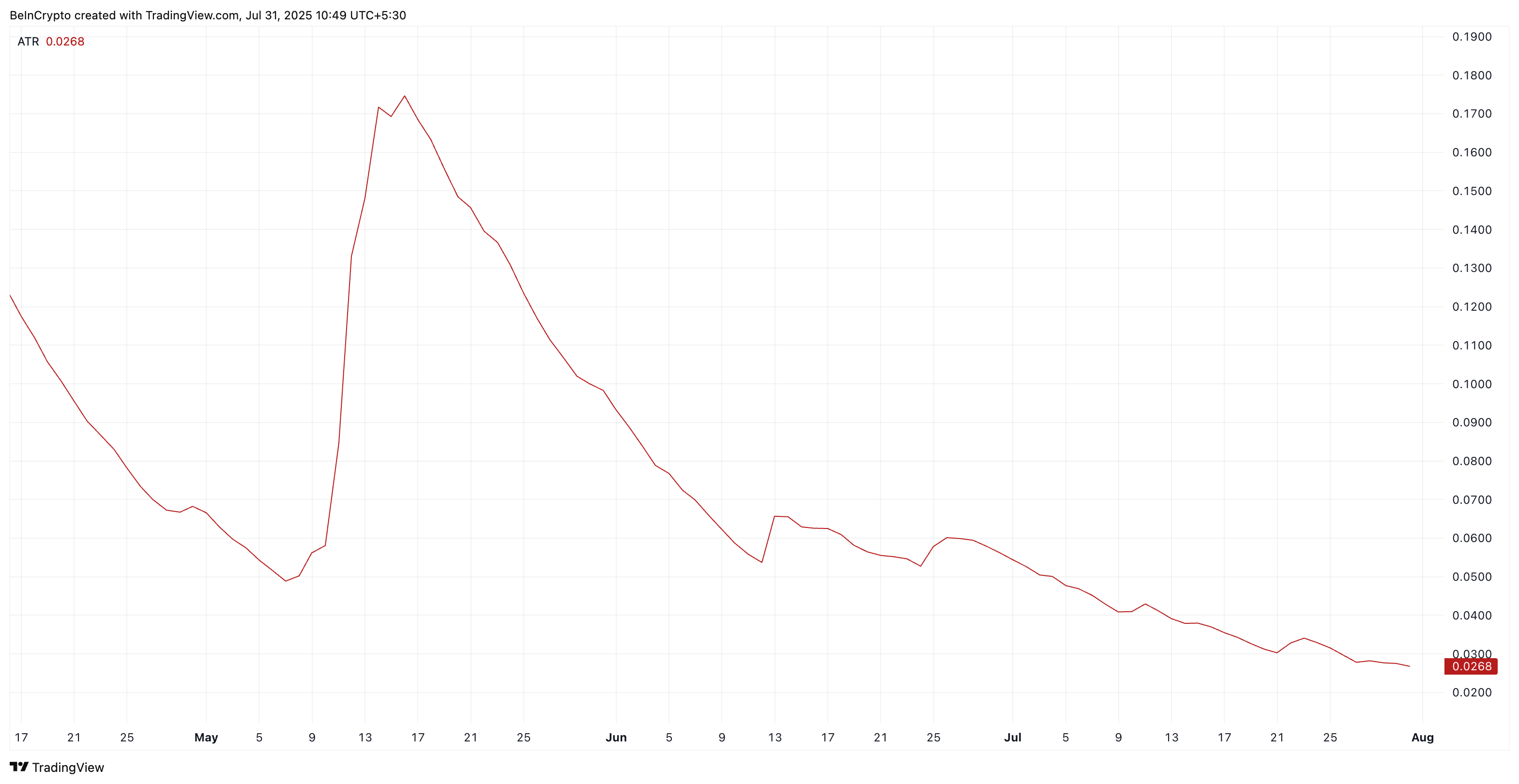
The first warning sign comes from the Average True Range (ATR), a tool that measures how big price moves are. When Pi Coin hit highs near $1.66 in May, ATR was at 0.17, signaling strong momentum and active trading.
For token TA and market updates: Want more token insights like this? Sign up for Editor Harsh Notariya’s Daily Crypto Newsletter .
 Pi Coin and ATR:
TradingView
Today, ATR has collapsed to just 0.0268. This sharp decline means price moves have become small and weak. Instead of a fight between buyers and sellers, the market feels like a slow bleed, with sellers still in control.
Low ATR during a downtrend usually means there’s no energy for a bounce; just quiet selling pressure grinding the price lower.
Money Flow Index Shows Buyers Losing Interest
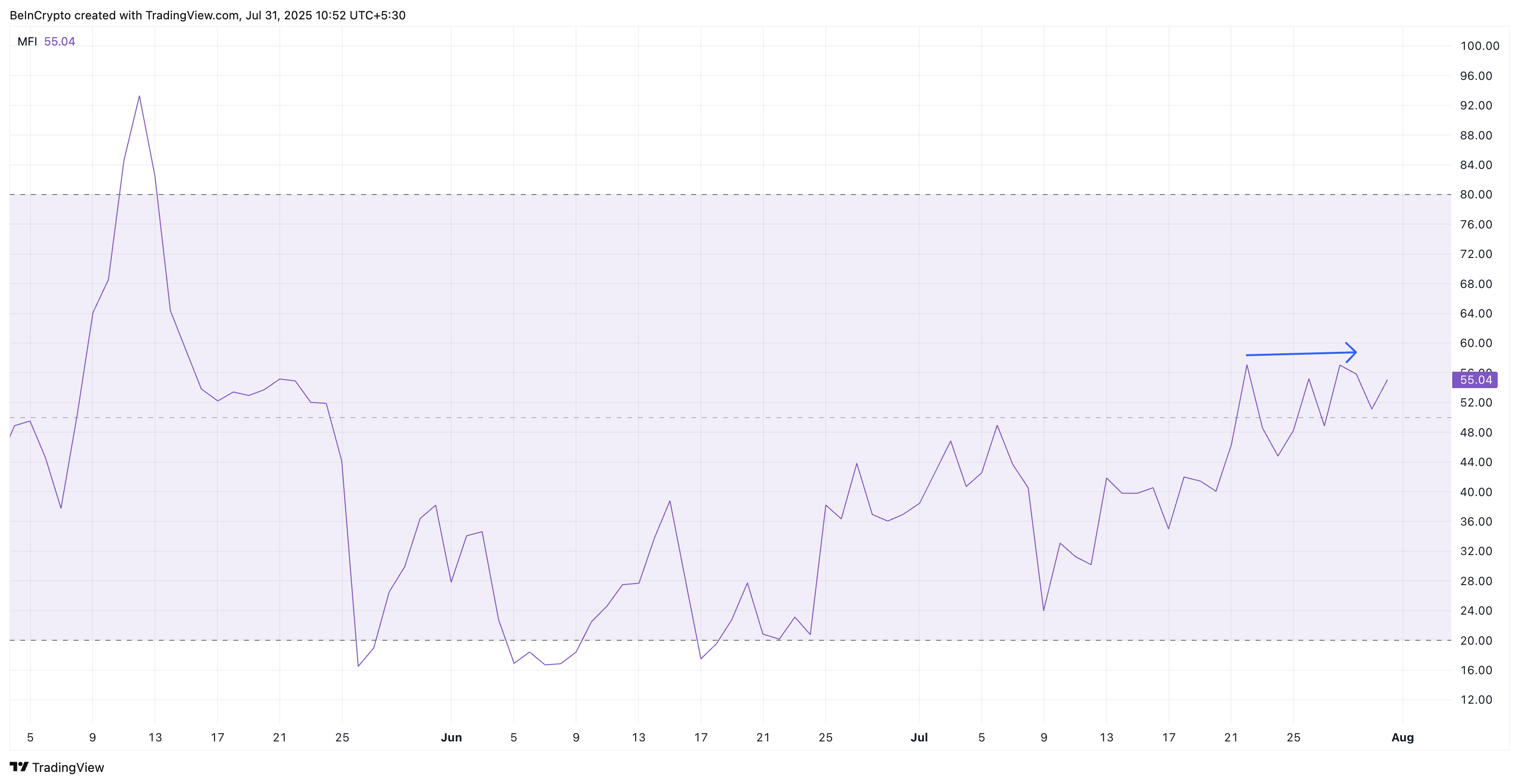
The Money Flow Index (MFI) tells a similar story. This indicator combines price and volume to show whether money is flowing in or out of a token.
 Money Flow Index for Pi Coin:
TradingView
Over the past 10 days, MFI has been stuck near 55. That’s not high enough to show real demand and not low enough to suggest panic selling either.
Earlier in July, when Pi Coin hovered around $0.47, there were signs of new money stepping in to defend the Support. That was the reason why PI always managed to bounce back after flirting with a swing low.
But that money flow has stalled now. Fewer buyers are taking interest, even at lower prices, making it harder for Pi Coin to bounce back in the short term.
Bearish Pattern Points to a Deeper Pi Coin Price Bottom
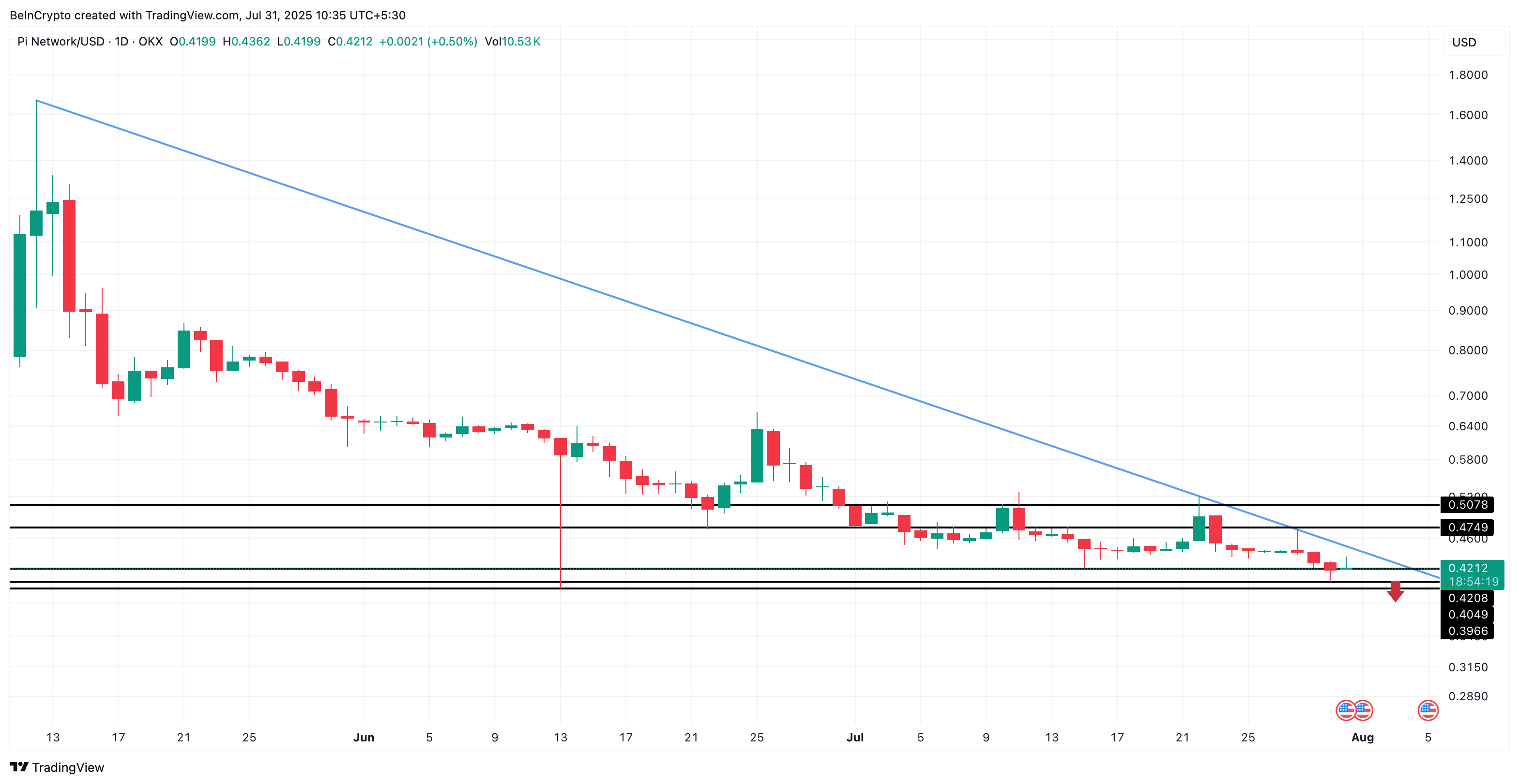
On the chart, Pi Coin is trapped in a descending triangle, a bearish pattern where lower highs continue to press against a fragile support level. For now, the immediate support lies at $0.42 and $0.40, breaking which looks all the more likely with not much capital being deployed.
 Pi Coin price and bearish pattern:
TradingView
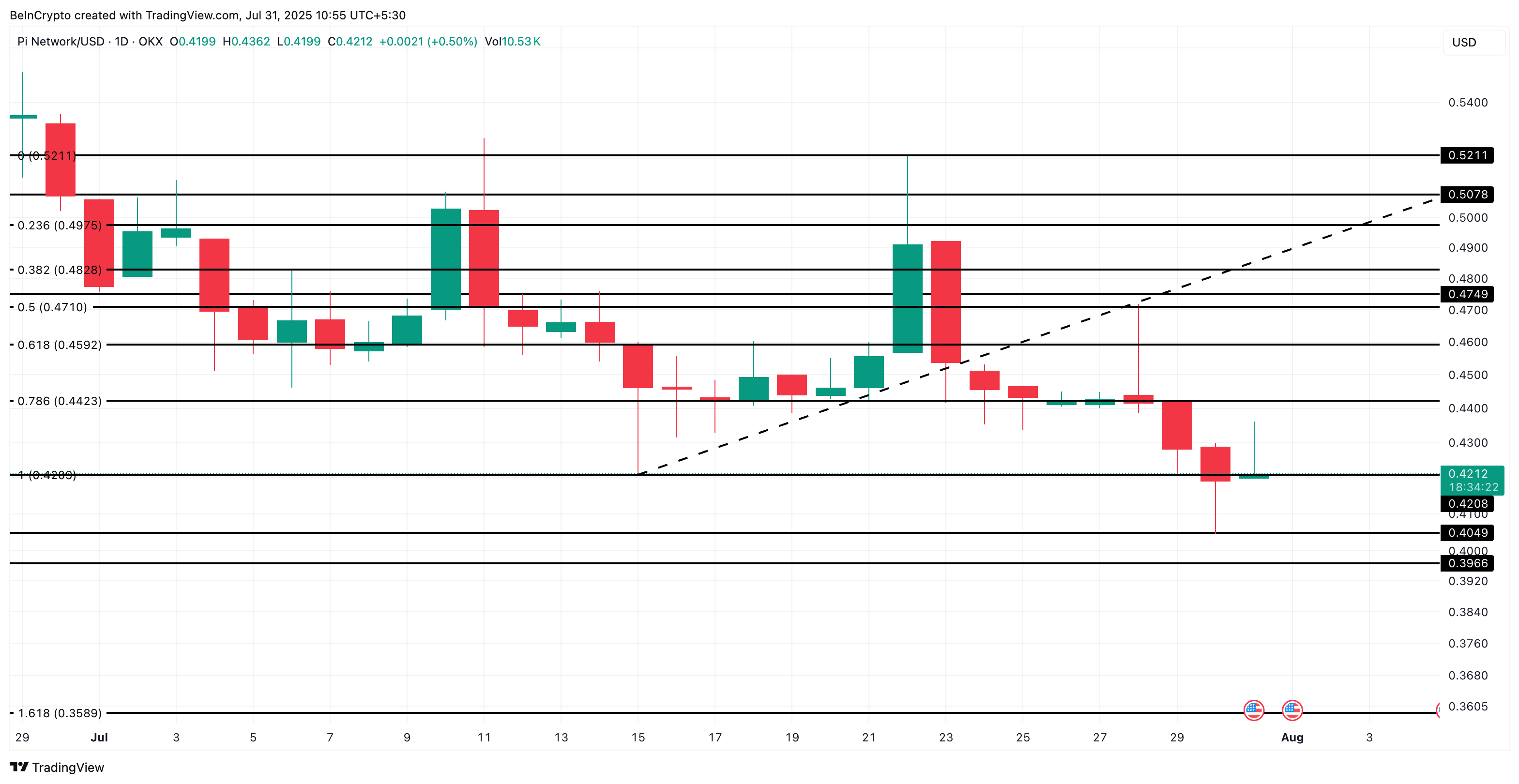
If the $0.40 floor gives way, key support and Fibonnaci retracement levels point to $0.39 and even $0.35 as the next potential bottoms, both below the current all-time low.
 Pi Coin price analysis:
TradingView
For a recovery, Pi Coin would need to break above $0.44 and $0.45 to invalidate this near-term bearish setup. However, that kind of invalidation would require the ATR and MFI levels to rise.
Disclaimer: The content of this article solely reflects the author's opinion and does not represent the platform in any capacity. This article is not intended to serve as a reference for making investment decisions.
You may also like
How much CPO demand will Nvidia Rubin Ultra generate? Bernstein: Optical value per Pod will increase fivefold
Bernstein believes that the co-packaged optics (CPO) and fiber demand driven by Nvidia's Rubin Ultra architecture will surge significantly, with the optical content per Pod rising from $1 million to $5.4 million. This will propel the size of Nvidia's optical ecosystem market to $46.8 billion by 2028 (a 91% annual increase). Although the industry faces supply bottlenecks with InP substrates, the outlook remains positive. The institution reiterates its “outperform” rating for Lumentum, Coherent, and Ciena.

UBS Q3 implements a two-way strategy with gold options, heavily invests in technology stocks, and builds positions in SK Hynix (SKHY.US)
UBS Group (UBS.US) has submitted its Q3 holdings report (13F) as of September 30, 2026.

SpaceX (SPCX.US) reportedly attempts “de-Nvidiaization” at the rack level: developing Kessel cabinets to bypass L6 compute boards, purchasing only chips
SemiAnalysis: SpaceX has developed its own Kessel cabinet, bypassing Nvidia's L6 cards to provide more options for manufacturing its own hardware.

$3.7 billion “data center power equipment prepayments” abandoned! What did "the most active buyer of gas turbines", SoftBank, see?
In the second quarter of fiscal year 2026, SoftBank reported a net loss of $7.1 billion, primarily due to a $3.7 billion impairment charge from a $9.5 billion advance payment for power generation equipment for US data centers—of which about $2.9 billion was non-refundable and effectively lost. The CFO admitted that SoftBank placed orders before the project plan was finalized, and is now conducting a comprehensive review of its procurement strategy. "The most aggressive purchaser of gas turbines has now written off the deposit in this way."
Crypto prices
More


