
NFT Sales Surge to $574 Million in July as Ethereum Collections Lead Market Rally

Non-fungible token (NFT) sales climbed to more than 574 million dollars in July, marking the second-highest monthly volume this year, according to data from CryptoSlam.
Non-fungible token (NFT) sales climbed to more than 574 million dollars in July, marking the second-highest monthly volume this year, according to data from CryptoSlam.
The figure represents a 47.6 percent increase from June’s 388.9 million dollars, though it remains below January’s peak of 678.9 million dollars.
While total transactions fell 9 percent from 5.5 million to five million, the average sale value rose to 113.08 dollars, the highest in six months. This indicates growing demand for higher-value digital assets . The number of unique buyers declined 17 percent to 713,085, while unique sellers increased 9 percent to 405,505, suggesting a market shift toward fewer but larger purchases.
 Source
:
NFT Price Floor
.
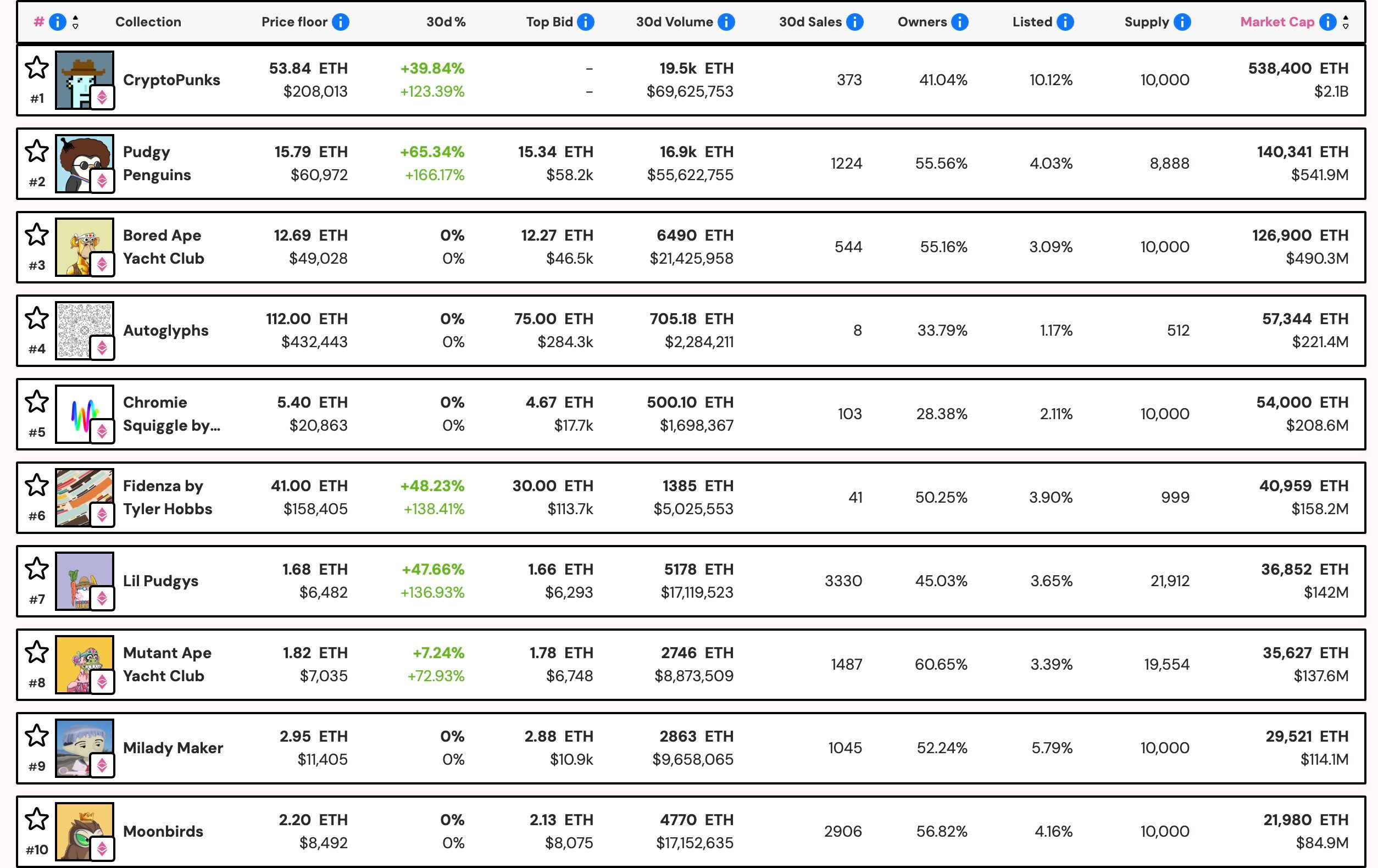
NFT Price Floor data shows the sector’s total market capitalization has surged 21 percent since late July, reaching more than 8 billion dollars. Ethereum’s price rally has played a key role, with the asset trading above 3,800 dollars after jumping 62 percent from early August levels of around 2,400 dollars.
Ethereum-based collections dominated the market in July. CryptoPunks led trading with more than 69.2 million dollars, followed by Pudgy Penguins with 55.5 million dollars. Polygon’s Courtyard NFTs ranked third with 23.8 million dollars. Pudgy Penguins also posted the strongest growth, with floor prices rising 65.44 percent, outpacing other top collections such as Bored Ape Yacht Club and Mutant Ape Yacht Club.
Ethereum maintained its dominance in blockchain-based NFT sales with 275.6 million dollars in July, a 56 percent increase over the previous month. Bitcoin followed with 74.3 million dollars, while Polygon recorded 71.6 million dollars. Polygon’s sales volume dropped by 51.1 percent from June, while BNB Chain recorded a 54 percent decline, reflecting a growing consolidation of activity on Ethereum and a narrowing focus on premium NFT collections. Meanwhile, CoinGecko reported a 20% daily jump in total NFT market cap, from $5.1 billion to $6.3 billion, further signaling renewed interest in the space.
Disclaimer: The content of this article solely reflects the author's opinion and does not represent the platform in any capacity. This article is not intended to serve as a reference for making investment decisions.
You may also like
How much CPO demand will Nvidia Rubin Ultra generate? Bernstein: Optical value per Pod will increase fivefold
Bernstein believes that the co-packaged optics (CPO) and fiber demand driven by Nvidia's Rubin Ultra architecture will surge significantly, with the optical content per Pod rising from $1 million to $5.4 million. This will propel the size of Nvidia's optical ecosystem market to $46.8 billion by 2028 (a 91% annual increase). Although the industry faces supply bottlenecks with InP substrates, the outlook remains positive. The institution reiterates its “outperform” rating for Lumentum, Coherent, and Ciena.

UBS Q3 implements a two-way strategy with gold options, heavily invests in technology stocks, and builds positions in SK Hynix (SKHY.US)
UBS Group (UBS.US) has submitted its Q3 holdings report (13F) as of September 30, 2026.

SpaceX (SPCX.US) reportedly attempts “de-Nvidiaization” at the rack level: developing Kessel cabinets to bypass L6 compute boards, purchasing only chips
SemiAnalysis: SpaceX has developed its own Kessel cabinet, bypassing Nvidia's L6 cards to provide more options for manufacturing its own hardware.

$3.7 billion “data center power equipment prepayments” abandoned! What did "the most active buyer of gas turbines", SoftBank, see?
In the second quarter of fiscal year 2026, SoftBank reported a net loss of $7.1 billion, primarily due to a $3.7 billion impairment charge from a $9.5 billion advance payment for power generation equipment for US data centers—of which about $2.9 billion was non-refundable and effectively lost. The CFO admitted that SoftBank placed orders before the project plan was finalized, and is now conducting a comprehensive review of its procurement strategy. "The most aggressive purchaser of gas turbines has now written off the deposit in this way."
Crypto prices
More


