
Fundamental Global sinks 13% following Ether treasury news

Shares of Fundamental Global plunged today on the Nasdaq after the company announced a major strategic shift toward Ether (ETH) as its primary treasury asset. The firm revealed plans to allocate $200 million to ETH, funded through a private placement of 40 million common stock warrants priced at $5 each.
The move aligns Fundamental Global with other corporates building ETH treasuries. According to an announcement, the company aims to offer “multiple value drivers beyond ETH price appreciation,” including staking rewards and exposure to tokenized real-world assets.
Strategic investors backing the pivot include Galaxy Digital, which will manage the company's ETH treasury; Kraken, which will assist with staking and treasury operations; and Hivemind Capital. As part of the pivot, Fundamental Global is changing its name to “FG Nexus.”
Despite the high-profile backing, markets reacted negatively to the announcement, with shares sliding 13.7% on the day, according to Google Finance.
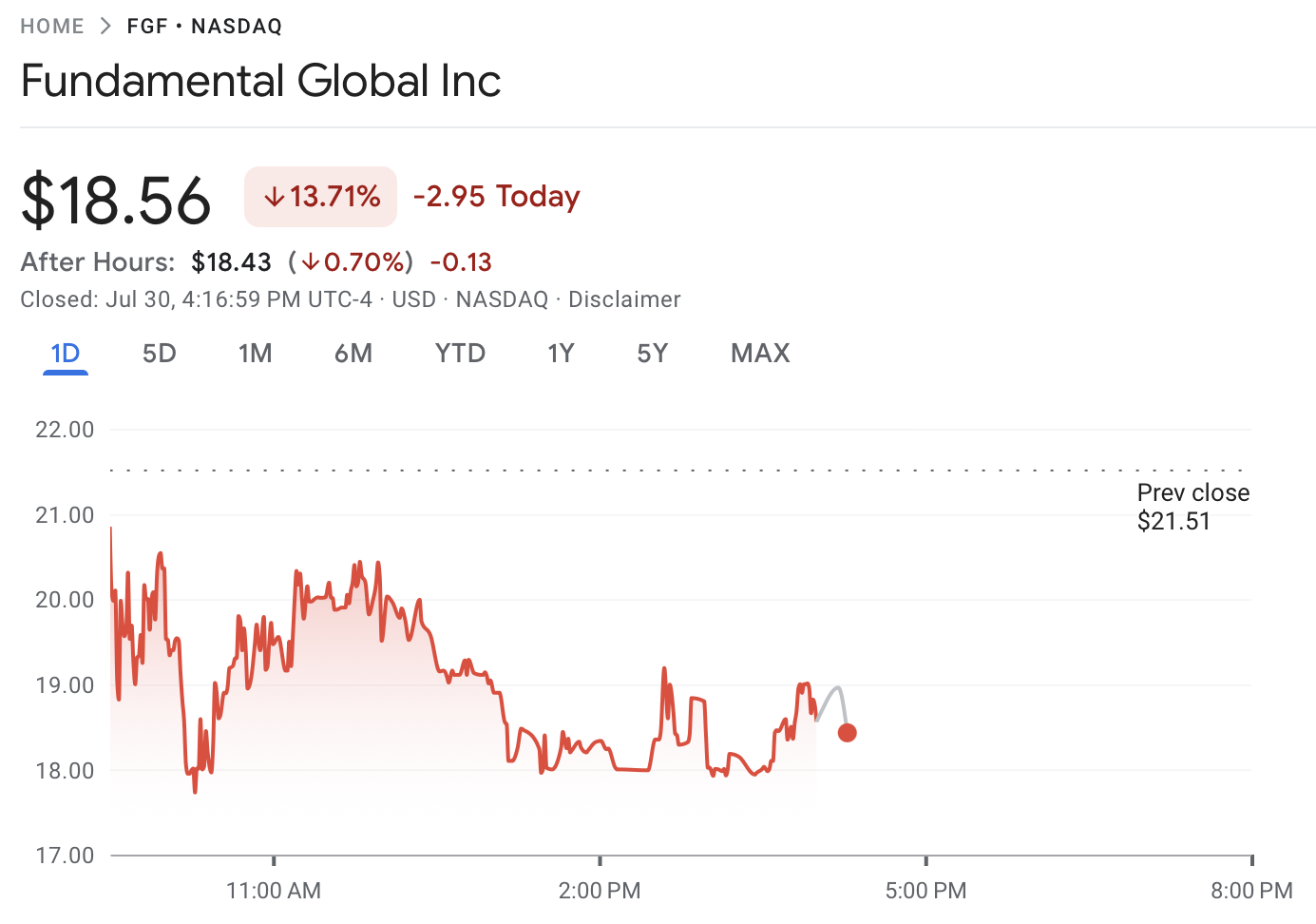
The company joins a growing list of firms adopting Ether treasury strategies, following the path paved by early adopters of Bitcoin (BTC). According to Standard Chartered, crypto treasury firms have bought 1% of all circulating ETH since the beginning of June, a figure the bank projects could rise to 10%.
BitMine Immersion Technologies, a Bitcoin mining company, is currently the largest corporate holder of Ether, disclosing on Monday that it holds 625,000 ETH valued at roughly $2.35 billion. SharpLink, a Nasdaq-listed company, is the second-largest known holder. Between July 21 and 27, it accumulated $290 million worth of ETH at an average price of $3,756 per token.
Ether Machine makes $56.9M ETH purchase on Ethereum anniversary
Ether Machine, a company focused on providing institutional-grade exposure to Ethereum infrastructure and yield strategies, also disclosed a major ETH purchase on Wednesday. The firm announced it had acquired nearly 15,000 ETH for a total of $56.9 million.
“With the regulatory clarity we've just started to get from DC, large institutions are finally able to build production ready systems on Ethereum and all of the use cases we've been discussing for the better part of a decade can finally become a reality," Ether Machine co-founder and CEO David Merin told Cointelegraph. “I've never been more optimistic about the medium term prospects for Ethereum.”
The company's announcements coincides with Ethereum's 10-year anniversary on Wednesday.
Disclaimer: The content of this article solely reflects the author's opinion and does not represent the platform in any capacity. This article is not intended to serve as a reference for making investment decisions.
You may also like
How much CPO demand will Nvidia Rubin Ultra generate? Bernstein: Optical value per Pod will increase fivefold
Bernstein believes that the co-packaged optics (CPO) and fiber demand driven by Nvidia's Rubin Ultra architecture will surge significantly, with the optical content per Pod rising from $1 million to $5.4 million. This will propel the size of Nvidia's optical ecosystem market to $46.8 billion by 2028 (a 91% annual increase). Although the industry faces supply bottlenecks with InP substrates, the outlook remains positive. The institution reiterates its “outperform” rating for Lumentum, Coherent, and Ciena.

UBS Q3 implements a two-way strategy with gold options, heavily invests in technology stocks, and builds positions in SK Hynix (SKHY.US)
UBS Group (UBS.US) has submitted its Q3 holdings report (13F) as of September 30, 2026.

SpaceX (SPCX.US) reportedly attempts “de-Nvidiaization” at the rack level: developing Kessel cabinets to bypass L6 compute boards, purchasing only chips
SemiAnalysis: SpaceX has developed its own Kessel cabinet, bypassing Nvidia's L6 cards to provide more options for manufacturing its own hardware.

$3.7 billion “data center power equipment prepayments” abandoned! What did "the most active buyer of gas turbines", SoftBank, see?
In the second quarter of fiscal year 2026, SoftBank reported a net loss of $7.1 billion, primarily due to a $3.7 billion impairment charge from a $9.5 billion advance payment for power generation equipment for US data centers—of which about $2.9 billion was non-refundable and effectively lost. The CFO admitted that SoftBank placed orders before the project plan was finalized, and is now conducting a comprehensive review of its procurement strategy. "The most aggressive purchaser of gas turbines has now written off the deposit in this way."
Crypto prices
More


