
Linea releases tokenomics: ETH used for gas, LINEA neither gas nor governance token

Linea, the Ethereum layer 2 network developed by ConsenSys, has officially released its LINEA tokenomics framework, revealing a unique Ethereum-aligned model.
- Linea released tokenomics showing ETH as gas and no governance role for LINEA.
- 85% of LINEA’s 72B supply goes to ecosystem incentives while 15% is reserved for ConsenSys.
- Fee structure burns ETH and LINEA to link usage with long-term value.
The update was shared in a July 29 blog post and arrives ahead of Linea’s anticipated Token Generation Event. ETH will serve as the sole gas token, while the new LINEA token will function as an incentive and funding mechanism.
LINEA not for gas or governance
Unlike typical L2 models, Linea separates utility and value capture by using ETH exclusively for gas while burning both ETH and LINEA from network fees. 20% of layer 2 ETH revenue is burned, with the remaining 80% used to buy and burn LINEA. This dual-burn mechanism is designed to reinforce ETH’s monetary premium while linking LINEA’s value to real usage.
LINEA will not serve as a governance token, and the protocol will not be governed by a DAO. Strategic decisions will instead be managed by the Linea Consortium, a council of Ethereum-native projects including ENS Labs, Eigen Labs, and SharpLink, under a U.S.-based nonprofit entity.
LINEA tokenomics
The total supply of LINEA is fixed at 72 billion tokens, with 85% allocated to ecosystem growth and 15% reserved for ConsenSys treasury. At launch , 22% of the total supply will be circulating, largely through early user airdrops and liquidity programs. No tokens have been sold to investors or employees.
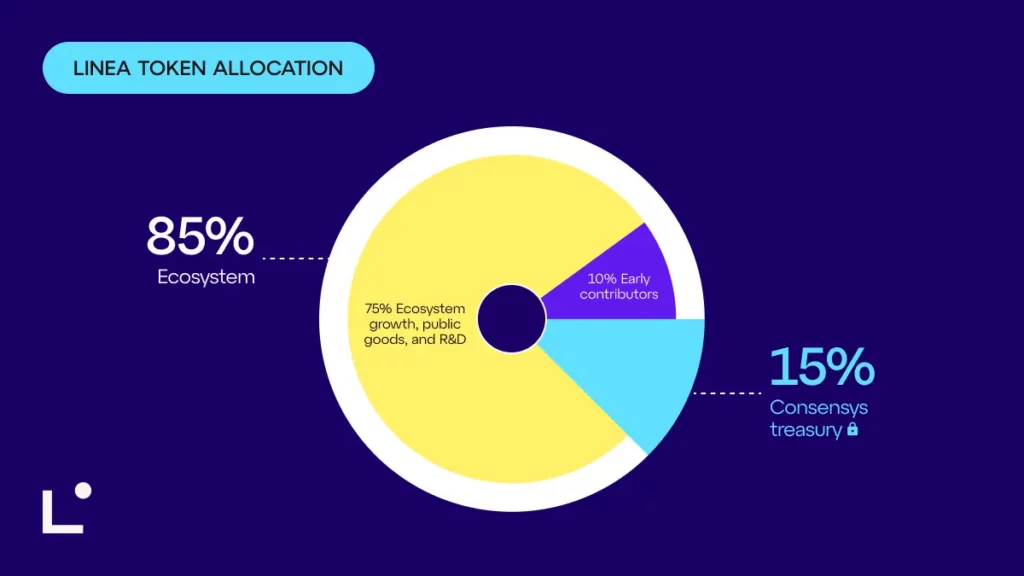 Linea token allocation. Credit: Linea
The Ecosystem Fund, comprising 75% of the total supply, will be deployed over a 10-year period. In the first 12 to 18 months, about 25% will go toward community development, builder support, exchange readiness, and liquidity provisioning. The remaining 50% will go toward ecosystem infrastructure, public goods, and protocol research and development.
9% of the supply will be distributed to early users via airdrops and will be fully unlocked at TGE. Eligibility is based on Linea XP and onchain activity that reflects authentic usage and ecosystem engagement.
Another 1% will go to strategic builders, such as key decentralized applications and infrastructure partners, chosen through a curated selection process focused on long-term alignment.
Focused on Ethereum alignment
Instead of framing the LINEA token as a governance tool, Linea positions it as an “economic coordination tool.” Participation, not capital, will determine how it is allocated to users, builders, and ecosystem contributors. The model, which emphasizes decentralized growth and long-term public goods funding, echoes Ethereum’s ( ETH ) 2015 launch.
Currently, Linea has $155 million in total value locked, as per DefiLlama data , and hosts more than 350 applications. Two major updates that were recently rolled out include native USD Coin ( USDC ) integration and a fee subsidy partnership with Layerswap to reduce the cost of bridging into Linea.
Disclaimer: The content of this article solely reflects the author's opinion and does not represent the platform in any capacity. This article is not intended to serve as a reference for making investment decisions.
You may also like
UBS Q3 implements a two-way strategy with gold options, heavily invests in technology stocks, and builds positions in SK Hynix (SKHY.US)
UBS Group (UBS.US) has submitted its Q3 holdings report (13F) as of September 30, 2026.

SpaceX (SPCX.US) reportedly attempts “de-Nvidiaization” at the rack level: developing Kessel cabinets to bypass L6 compute boards, purchasing only chips
SemiAnalysis: SpaceX has developed its own Kessel cabinet, bypassing Nvidia's L6 cards to provide more options for manufacturing its own hardware.

$3.7 billion “data center power equipment prepayments” abandoned! What did "the most active buyer of gas turbines", SoftBank, see?
In the second quarter of fiscal year 2026, SoftBank reported a net loss of $7.1 billion, primarily due to a $3.7 billion impairment charge from a $9.5 billion advance payment for power generation equipment for US data centers—of which about $2.9 billion was non-refundable and effectively lost. The CFO admitted that SoftBank placed orders before the project plan was finalized, and is now conducting a comprehensive review of its procurement strategy. "The most aggressive purchaser of gas turbines has now written off the deposit in this way."
Wall Street tech mogul Dan Ives: SpaceX (SPCX.US) shares have a 20%-25% "political discount"; merger with Tesla (TSLA.US) still possible
Dan Ives believes that SpaceX's stock currently has a "political discount" of 20% to 25%. At the same time, he still expects SpaceX to merge with Tesla, but this deal will face more obstacles.
Crypto prices
More


