
ECB Warns: Europe’s Monetary Sovereignty Threatened by Crypto

The European Central Bank no longer harbors illusions: the digital euro alone will not be enough to preserve the Union’s monetary sovereignty in the face of the rise of dollar stablecoins. In a statement both clear-sighted and concerning, advisor Jürgen Schaaf suggests a strategic shift. The solution may not come from the ECB itself, but rather from the private crypto ecosystem, which is much more responsive.
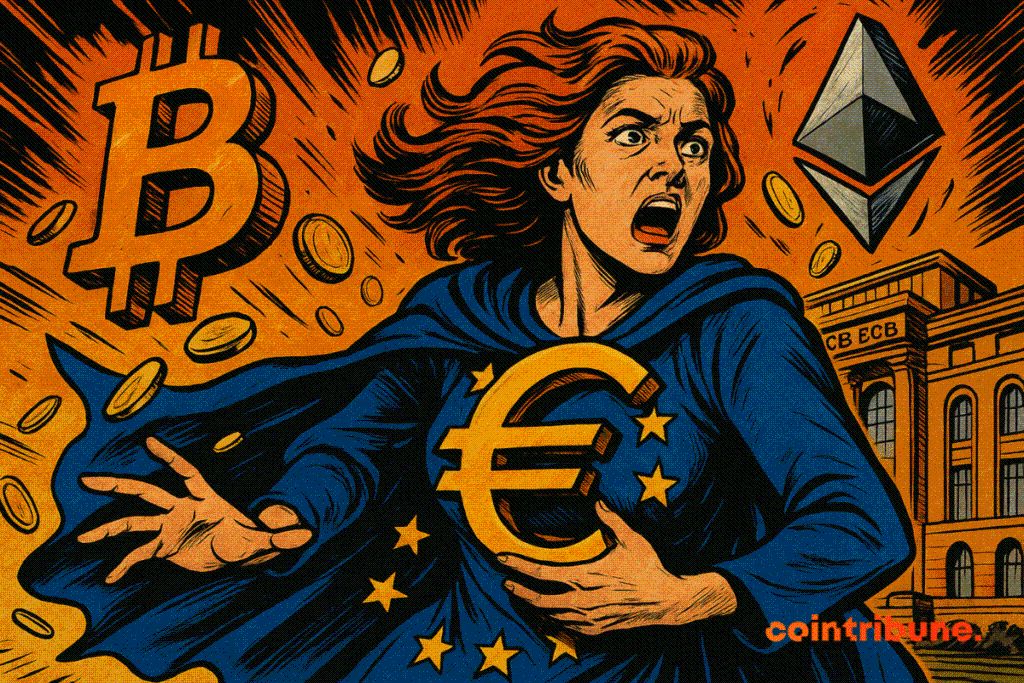
In Brief
- The ECB warns: the rise of cryptos threatens Europe’s monetary control.
- Bitcoin and Ethereum challenge the euro’s authority on the continent.
- Towards a loss of financial sovereignty? Europe under pressure from cryptos.
Dollar stablecoins, a tidal wave ignored for too long
The numbers speak for themselves: the majority of global crypto transactions rely on dollar-backed stablecoins, such as USDT, which has just hit a new record , or USDC. This phenomenon grants disproportionate monetary influence to the United States, well beyond its borders. Europe, on its side, is slow to impose credible alternatives denominated in euros.
Jürgen Schaaf does not mince words: despite the existence of a regulatory framework like MiCA (Markets in Crypto-Assets), euro stablecoins are struggling to take off. Their adoption remains marginal, hindered by a lack of technological attractiveness and the absence of a truly structured ecosystem. European crypto, too cautious, too slow, too institutional, struggles to establish itself.
Even worse, American regulation, embodied by the GENIUS Act, seems to have taken a clear lead. While Europe is still adjusting its texts, the United States is exporting its currency on a large scale thanks to blockchain . The result is unequivocal: a real loss of monetary influence for the European Union.
A broader crypto strategy: between digital euro, DLT and private innovation
Faced with this observation, Schaaf does not advocate a technocratic retreat. He rather calls for a profound rethinking of European strategy. Crypto can no longer rely solely on a central bank digital currency. A more open, more flexible, more collaborative vision must be adopted.
In an article published on the ECB’s website and taken up by Cointelegraph, the advisor emphasizes that the digital euro alone will not be enough to contain the rise of stablecoins backed by the dollar.
In this broader approach, euro stablecoins, provided they are well regulated, become a primary strategic lever. Driven by private initiative but subjected to strict regulation, these assets could meet market needs while restoring weight to the euro in the crypto universe.
The second pillar of this strategy rests on leveraging Distributed Ledger Technology (DLT), capable of modernizing large-value payments and optimizing cross-border transfers. At this stage, innovation at the infrastructure level becomes as crucial as monetary issuance itself.
The urgency of a coordinated and ambitious response
But this strategy will only work if it moves beyond a fragmented approach. Jürgen Schaaf stresses the necessity of international coordination to avoid disparities in rules and practices.
Europe must speak with one voice, not only towards the United States, which has just adopted three major laws likely to reshuffle the deck, but also towards the private giants of Web3.
Monetary sovereignty, long considered strictly a state issue, is now closely linked to the evolution of the crypto sector. Ignoring this would mean eventually accepting the gradual disappearance of the euro in digital use.
In this perspective, the ECB finally seems willing to consider what many actors in the crypto ecosystem have been calling for years: cooperation between the public sector and private innovation, within a framework that is both strict and open. Because in the era of decentralized currency, sovereignty is no longer written only in treaties; it is also inscribed in code.
Disclaimer: The content of this article solely reflects the author's opinion and does not represent the platform in any capacity. This article is not intended to serve as a reference for making investment decisions.
You may also like
UBS Q3 implements a two-way strategy with gold options, heavily invests in technology stocks, and builds positions in SK Hynix (SKHY.US)
UBS Group (UBS.US) has submitted its Q3 holdings report (13F) as of September 30, 2026.

SpaceX (SPCX.US) reportedly attempts “de-Nvidiaization” at the rack level: developing Kessel cabinets to bypass L6 compute boards, purchasing only chips
SemiAnalysis: SpaceX has developed its own Kessel cabinet, bypassing Nvidia's L6 cards to provide more options for manufacturing its own hardware.

$3.7 billion “data center power equipment prepayments” abandoned! What did "the most active buyer of gas turbines", SoftBank, see?
In the second quarter of fiscal year 2026, SoftBank reported a net loss of $7.1 billion, primarily due to a $3.7 billion impairment charge from a $9.5 billion advance payment for power generation equipment for US data centers—of which about $2.9 billion was non-refundable and effectively lost. The CFO admitted that SoftBank placed orders before the project plan was finalized, and is now conducting a comprehensive review of its procurement strategy. "The most aggressive purchaser of gas turbines has now written off the deposit in this way."
Wall Street tech mogul Dan Ives: SpaceX (SPCX.US) shares have a 20%-25% "political discount"; merger with Tesla (TSLA.US) still possible
Dan Ives believes that SpaceX's stock currently has a "political discount" of 20% to 25%. At the same time, he still expects SpaceX to merge with Tesla, but this deal will face more obstacles.
Crypto prices
More


