
What You Say to ChatGPT Could Be Used Against You in Court

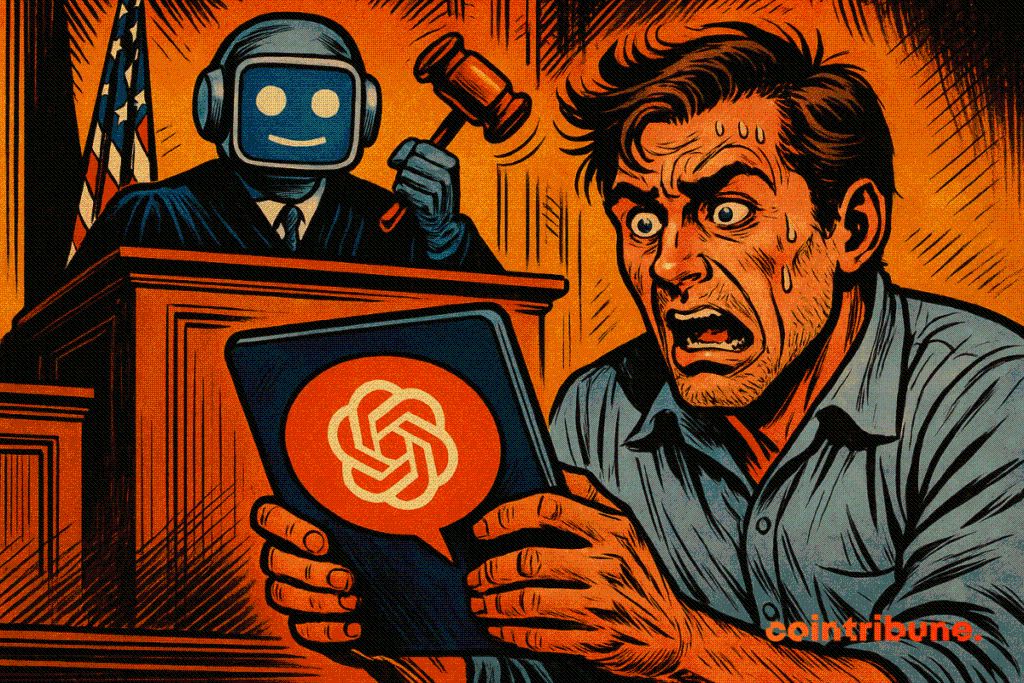
The rise of AI raises a question that many avoid: what happens to our words once entrusted to the machine? Sam Altman, CEO of OpenAI, warns that conversations with ChatGPT, far from being confidential, could be used as evidence in court.
In Brief
- Conversations with ChatGPT are not confidential and could be used as legal evidence.
- Unlike a professional, AI offers no legal protection for your personal information.
- Without a clear legal framework, talking to an AI is like exposing your private life to potential exploitation.
Talking to an AI is not the same as talking to a professional
Entrusting your thoughts to an AI leaves a trace. As long as the law does not protect this data as professional secrets, it can be turned against you.
Sam Altman himself admitted it: if you discuss your personal problems with AI and a lawsuit later arises, OpenAI could be compelled to provide that data. Altman has already demonstrated this stance by publicly distancing himself from Robinhood’s tokenized shares when they threatened the company’s image or principles.
This legal loophole is all the more concerning as AI is increasingly sought for psychological, medical, or financial advice.
For now, legislation remains unclear. No clear framework protects AI users, as is the case in the patient-doctor relationship. While awaiting regulation, caution remains your only defense, even with trading bots.
Surveillance advancing in disguise
Beyond the judicial risk, Altman raises another concern: the more AI spreads, the more states will want to monitor its use. The argument is security: to prevent these technologies from being abused for malicious purposes. But the price to pay is an increasingly fragile private life. And don’t forget that what you say to ChatGPT could one day be turned against you.
According to Altman, a compromise will need to be found between individual freedom and collective security. He says he is ready to sacrifice some confidentiality in the name of safety. A statement that says a lot about the direction major tech companies are taking.
Entrusting your thoughts to a rapidly evolving AI leaves a trace. And as long as the law does not protect this data as professional secrets, this trace can one day be used against you.
Disclaimer: The content of this article solely reflects the author's opinion and does not represent the platform in any capacity. This article is not intended to serve as a reference for making investment decisions.
You may also like
UBS Q3 implements a two-way strategy with gold options, heavily invests in technology stocks, and builds positions in SK Hynix (SKHY.US)
UBS Group (UBS.US) has submitted its Q3 holdings report (13F) as of September 30, 2026.

SpaceX (SPCX.US) reportedly attempts “de-Nvidiaization” at the rack level: developing Kessel cabinets to bypass L6 compute boards, purchasing only chips
SemiAnalysis: SpaceX has developed its own Kessel cabinet, bypassing Nvidia's L6 cards to provide more options for manufacturing its own hardware.

$3.7 billion “data center power equipment prepayments” abandoned! What did "the most active buyer of gas turbines", SoftBank, see?
In the second quarter of fiscal year 2026, SoftBank reported a net loss of $7.1 billion, primarily due to a $3.7 billion impairment charge from a $9.5 billion advance payment for power generation equipment for US data centers—of which about $2.9 billion was non-refundable and effectively lost. The CFO admitted that SoftBank placed orders before the project plan was finalized, and is now conducting a comprehensive review of its procurement strategy. "The most aggressive purchaser of gas turbines has now written off the deposit in this way."
Wall Street tech mogul Dan Ives: SpaceX (SPCX.US) shares have a 20%-25% "political discount"; merger with Tesla (TSLA.US) still possible
Dan Ives believes that SpaceX's stock currently has a "political discount" of 20% to 25%. At the same time, he still expects SpaceX to merge with Tesla, but this deal will face more obstacles.
Crypto prices
More


