
Bitcoin's Bollinger Bands Tightest Since February; XRP, SOL Establish Lower Highs

This is a daily analysis of top tokens with CME futures by CoinDesk analyst and Chartered Market Technician Omkar Godbole.
Bitcoin: Bollinger bands tighten
BTC's continued consolidation between $116,000 and $120,000 calls for renewed focus on Bollinger bands, which have now tightened to levels last seen before the late February volatility explosion that saw prices drop from $95,000 to $80,000 within days.
Tighter bands indicate that the market is coiling up and building energy for a big move in either direction. Bollinger bands are volatility bands placed two standard deviations above and below the asset's 20-day simple moving average.
This view is consistent with the VIX's bullish August seasonality that suggests heightened price turbulence for stocks and bitcoin over the coming four weeks.
A break below $116,000 would imply downside volatility explosion, exposing the former resistance-turned-support at $111,965. Conversely, a quick move to new lifetime highs appears likely if tighter Bollinger bands resolve bullishly.
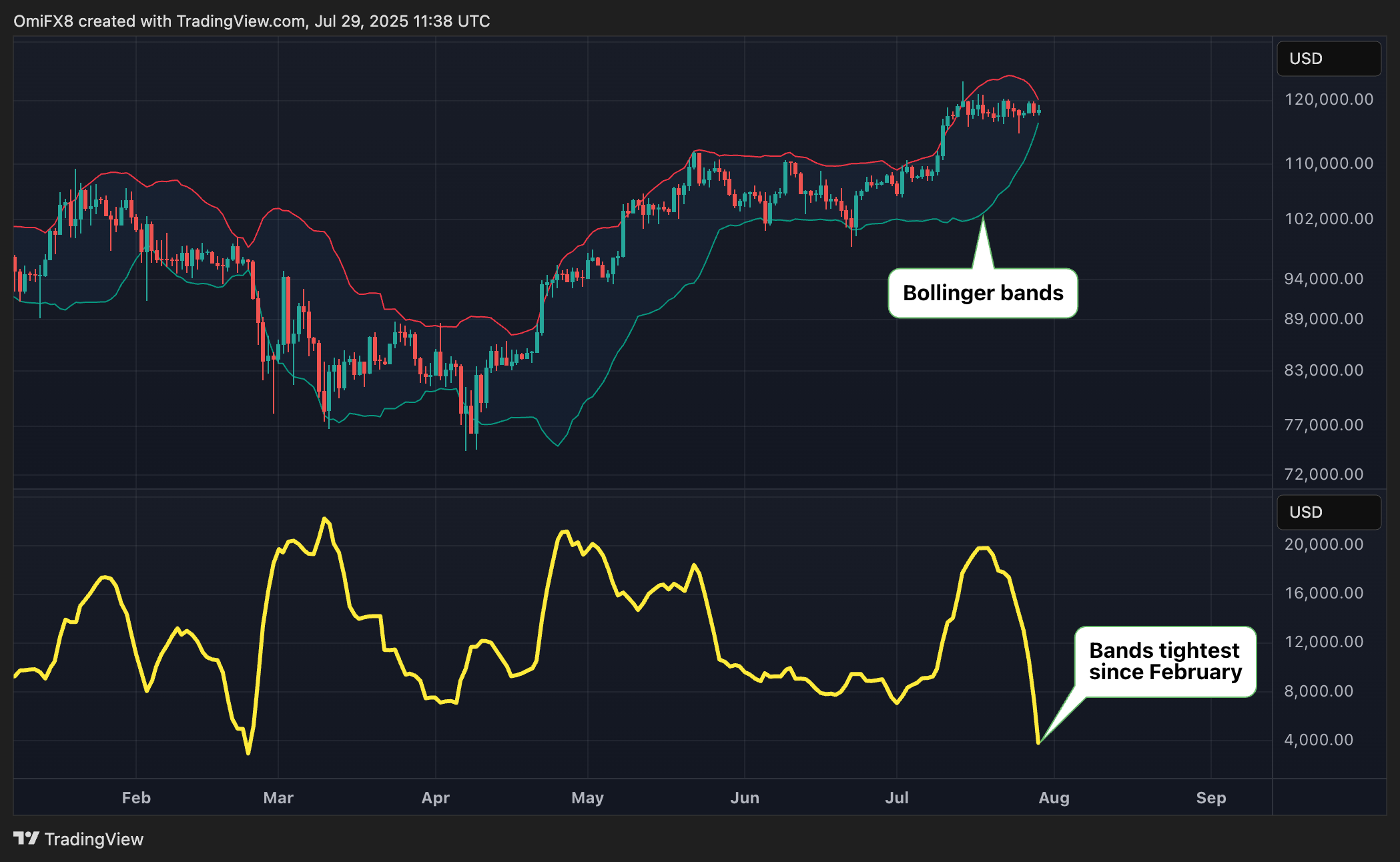
- AI's take: Thesignificant contraction of volatility, especially after a strong uptrend, often signals that the price is coiling up for a large and potentially explosive move in the near future.
- Resistance: $120,000, $123,181.
- Support: $116,000-$117,000, $114,700, $111,965.
XRP: Lower high established
XRP fell 3.59% on Monday, creating a red candle with a prominent upper wick, suggesting seller dominance. The cryptocurrency printed a lower high at $3.33, the first since peaking at $3.65 with a bearish tweezer top pattern, indicating a potential deeper pullback ahead. This suggests that it's only a matter of time before the mini-ascending channel seen on the hourly chart gives way, exposing the recent low of $2.95 and possibly the May high of $2.65. The hurdle at $3.35 must be overcome to negate the bearish bias.
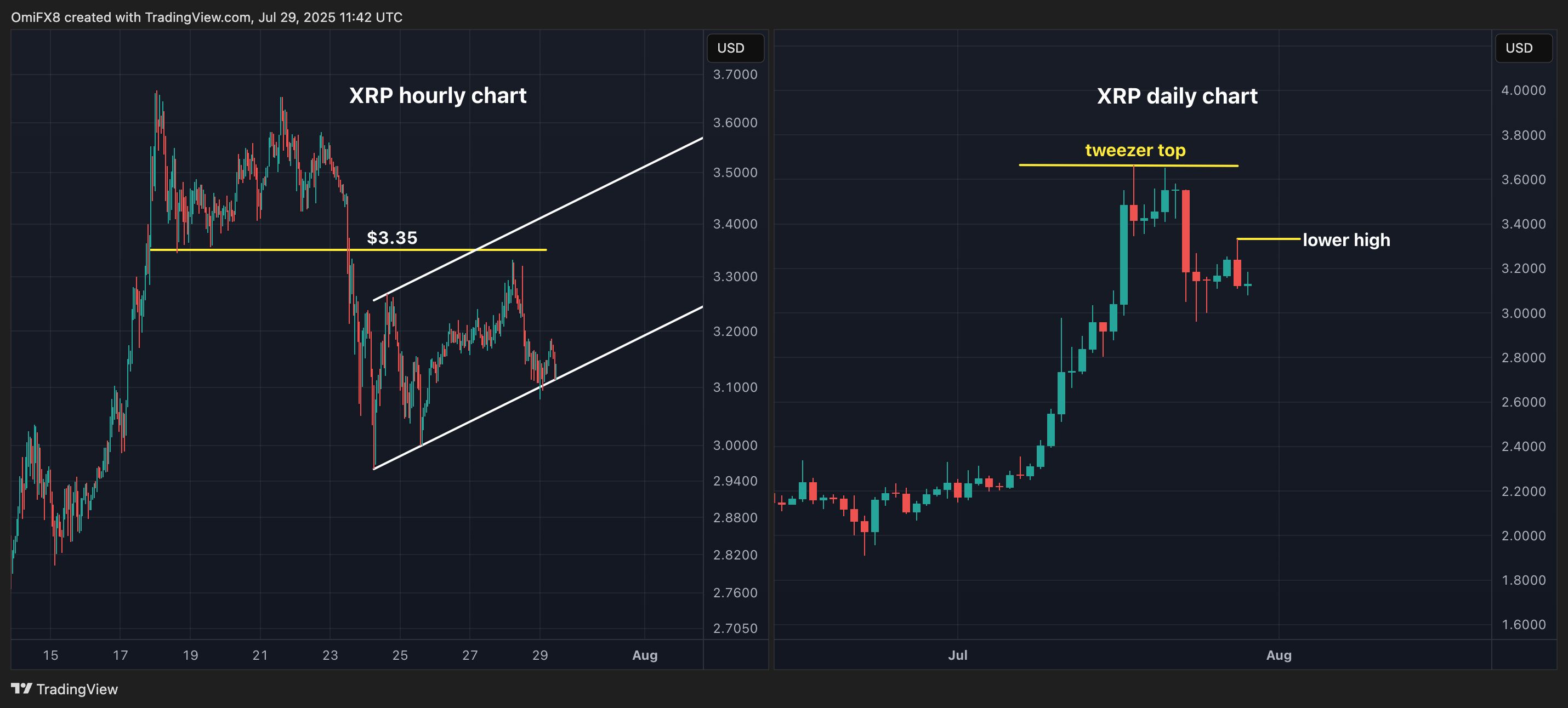
- AI's take: Traders should primarily focus on whether XRP can decisively reclaim and hold above the crucial $3.35 level, which now acts as immediate resistance. A failure to do so would reinforce the daily chart's bearish reversal signals (tweezer top, lower high), suggesting further downside,
- Resistance: $3.35, $3.65, $4.00.
- Support: $2.95, $2.65, $2.44 (the 200-day SMA).
Ether: RSI diverging bearishly
Ether's 14-day relative strength index (RSI) has diverged bearishly from the price, with the MACD histogram nearing a negative crossover confirmation. These developments suggest a potential pullback to the higher low of $3,510 registered on July 24. A violation there could extend the pullback toward $3,000.
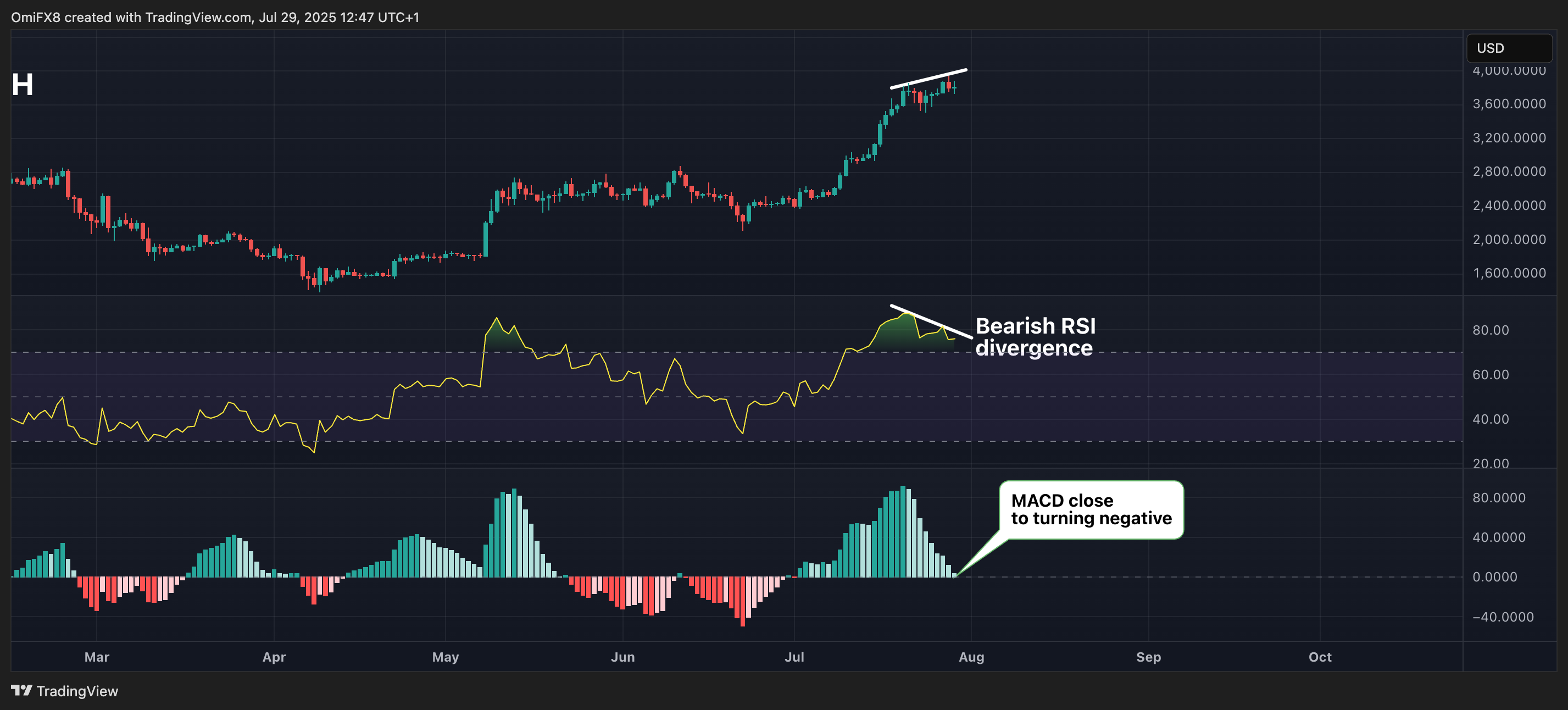
- AI's take: Traders should primarily focus on the bearish divergence displayed by the RSI, which signals weakening momentum despite Ether's recent price high.
- Resistance: $4,000, $4100, $4,382.
- Support: $3,731 (daily low), $3,510, $3,000.
Solana: XRP-like structure
SOL established a lower high at $195, reinforcing the bearish tweezer top pattern at $205-$206. Additionally, the cryptocurrency has dived out of a mini-ascending channel and the Ichimoku cloud on the hourly chart, suggesting the path of least resistance is to the downside. The resistance at $195 needs to be topped to invalidate the bearish bias.
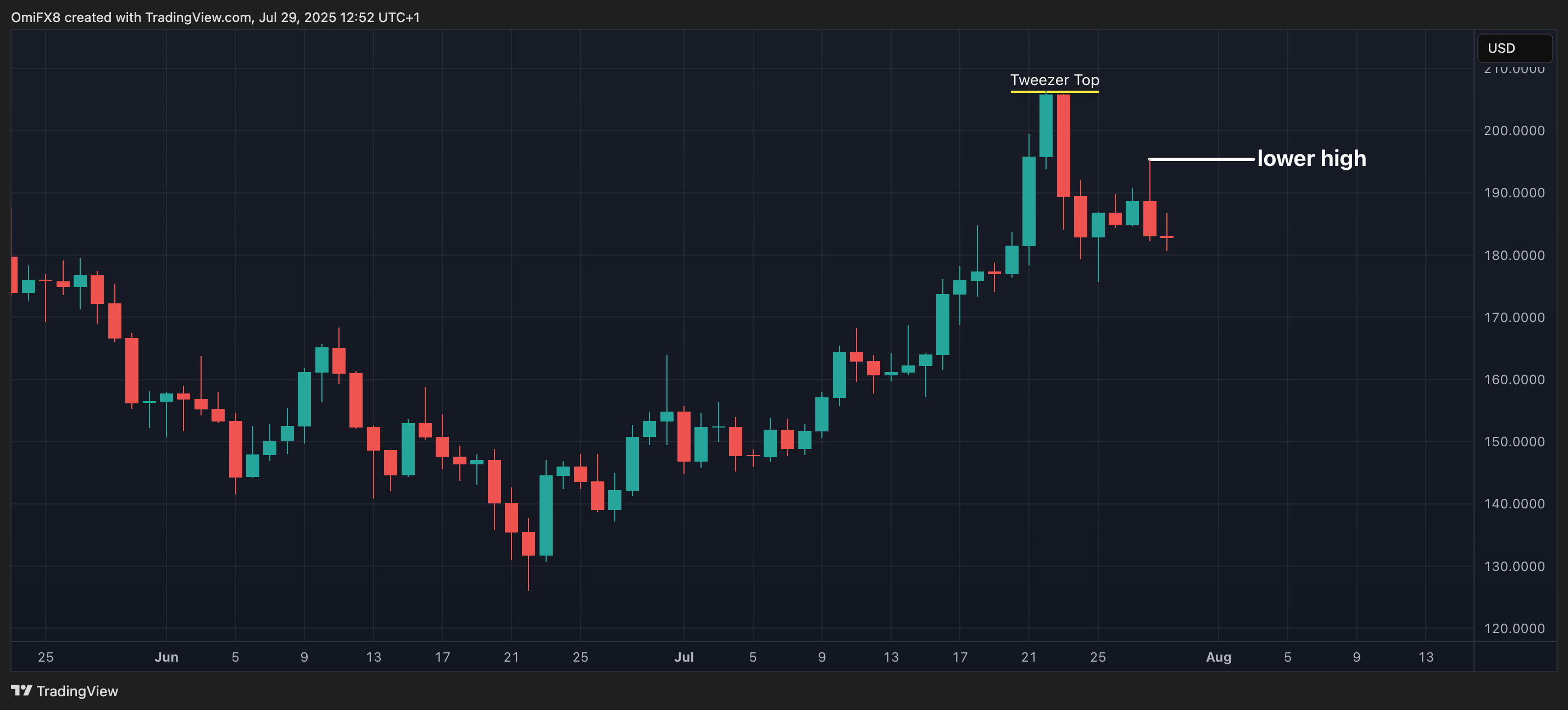
- AI's take: "Tweezer Top" candlestick pattern at the peak of the rally, immediately followed by the formation of a "lower high" is a powerful bearish reversal pattern, indicating that the strong upward momentum from July has likely ended
- Resistance: $195, $205-$206, $218.
- Support: $184, $163, $126.
Disclaimer: The content of this article solely reflects the author's opinion and does not represent the platform in any capacity. This article is not intended to serve as a reference for making investment decisions.
You may also like
UBS Q3 implements a two-way strategy with gold options, heavily invests in technology stocks, and builds positions in SK Hynix (SKHY.US)
UBS Group (UBS.US) has submitted its Q3 holdings report (13F) as of September 30, 2026.

SpaceX (SPCX.US) reportedly attempts “de-Nvidiaization” at the rack level: developing Kessel cabinets to bypass L6 compute boards, purchasing only chips
SemiAnalysis: SpaceX has developed its own Kessel cabinet, bypassing Nvidia's L6 cards to provide more options for manufacturing its own hardware.

$3.7 billion “data center power equipment prepayments” abandoned! What did "the most active buyer of gas turbines", SoftBank, see?
In the second quarter of fiscal year 2026, SoftBank reported a net loss of $7.1 billion, primarily due to a $3.7 billion impairment charge from a $9.5 billion advance payment for power generation equipment for US data centers—of which about $2.9 billion was non-refundable and effectively lost. The CFO admitted that SoftBank placed orders before the project plan was finalized, and is now conducting a comprehensive review of its procurement strategy. "The most aggressive purchaser of gas turbines has now written off the deposit in this way."
Wall Street tech mogul Dan Ives: SpaceX (SPCX.US) shares have a 20%-25% "political discount"; merger with Tesla (TSLA.US) still possible
Dan Ives believes that SpaceX's stock currently has a "political discount" of 20% to 25%. At the same time, he still expects SpaceX to merge with Tesla, but this deal will face more obstacles.
Crypto prices
More


