
Dow Jones down 300 points on Trump’s tariff threats, Bitcoin reaches new ATH

Dow Jones fell on Trump’s threats against more countries, tech stocks fared better, while the crypto market saw a bull run.
Stocks are down as Trump once again escalated trade tensions, while crypto is doing great. On Friday, July 11, the Dow Jones was down 286 points, or 0.64%, while the S&P 500 slipped 0.30%. The tech-heavy Nasdaq lost just 0.08% as crypto and tech stocks did relatively better.
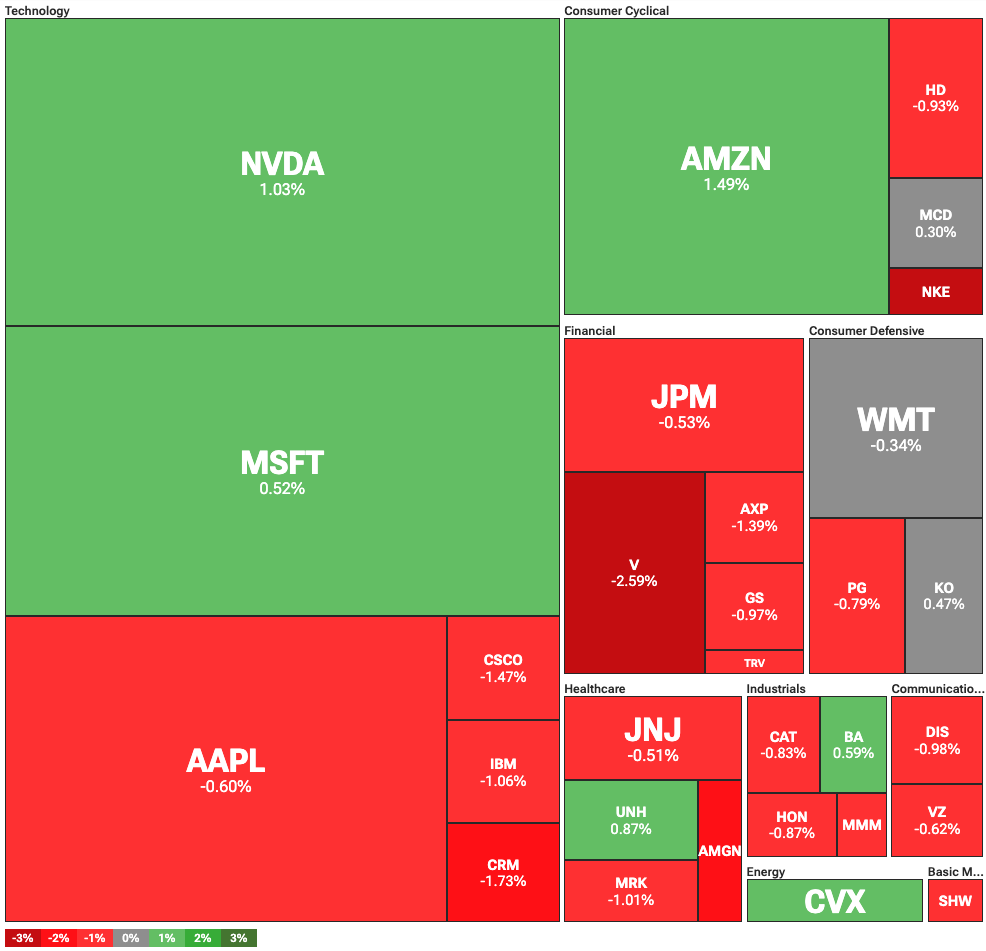 Dow Jones Industrial Average heatmap on July 11 | Source: TipRanks
Interestingly, Bitcoin (BTC) was much more resilient than the stock market. The token reached a new all-time high for a third day in a row at $118,856, and rallied 4% in 24 hours. Altcoins such as Ethereum (ETH) outperformed, with XRP (XRP) , Dogecoin (DOGE) , and Cardano (ADA) posting double-digit gains.
Trump threatens new tariffs on Canada
Investors were concerned about the effects of President Donald Trump’s latest threats against Canada. Trump announced a 35% tariff on Canadian goods, which currently face a 25% rate. Still, some goods will be exempt, including oil, gas, and potash.
These key industrial goods are currently regulated under the USMCA agreement and are subject to a 10% tariff. Canada is one of the largest U.S. trading partners and a key exporter of energy and raw materials to the country.
In other tariff news, reports surfaced that Vietnam’s government was surprised by Trump’s 20% tariff announcement against the country. According to Bloomberg , the country is hoping to bring the rate lower, possibly in the 10-15% range.
Vietnam is a major exporter to the U.S., with the third-largest trade surplus with the country. Over the years, it has taken over several export industries to the U.S. from China, with electronics, textiles, and footwear as major categories. Previous administrations saw this move as an advantage, as Vietnam is more geopolitically aligned with the U.S. than China.
Disclaimer: The content of this article solely reflects the author's opinion and does not represent the platform in any capacity. This article is not intended to serve as a reference for making investment decisions.
You may also like
Fear is the biggest short! Morgan Stanley calls for bottom-fishing in semiconductors: land and electricity shortages are not a problem, approved projects can't meet demand
Morgan Stanley believes that the recent sell-off in the semiconductor sector has been excessive, and that market panic rather than fundamentals is the biggest risk. Driven by demand for AI infrastructure, downstream orders continue to accelerate, with semiconductor supply remaining the core bottleneck. LPS constraints actually make growth more stable. The sector may fluctuate within a range in the short term and is currently near the bottom; prospects for the computing power and storage subsectors are favorable.

Indian Rupee extends rally amid continued FIIs buying, lower oil prices

Hashrate orders are booming, why is "AI trading" falling out of favor? JPMorgan reveals the time lag between AI investment and productivity realization
Joseph Lupton from the JP Morgan Global Economic Research Team pointed out in a research report on November 10 that recent improvements in labor productivity have been driven more by capital deepening and increased intensity of factor utilization. The broad efficiency gains from AI, resulting from process reconstruction, data integration, and organizational adjustments, will still take time to materialize. This means orders for chips, servers, and electrical equipment may grow first, but continuous investment returns for computing power operators and end users may not arrive at the same pace.
AI investment enters the "Trough of Disillusionment", the next 18 months will be a life-or-death test!
Goldman Sachs believes that the AI investment cycle is currently in the "trough of disillusionment," but this is not the first time. The core contradiction lies in the fact that the business models of new cloud computing providers are highly dependent on end-user returns from AI spending, while currently "there are basically zero companies that can attribute profits to AI." Social Capital founder Palihapitiya has clearly defined an 18-month key window, during which the market will decide which AI business models are sustainable and which are not.

Crypto prices
More


