
XRP hits 7-week high above $2.39 as whale accumulation rises — What’s next for XRP price?

XRP climbed to a seven-week high above $2.39 on July 10, buoyed by rising investor interest and growing momentum among large holders.
According to data shared by Santiment on July 9, XRP ( XRP ) crossed $2.39 for the first time since May 23. There are now 2,742 wallets with at least one million XRP, a significant increase. Together, these wallets currently hold 47.32 billion XRP, a figure that represents growing confidence among major holders and ongoing accumulation close to the top of the supply distribution for XRP.
As of this writing, XRP is trading at $2.42, up 4% over the previous day and 7% over the previous week. The move coincides with a significant jump in trading volume, which climbed 74.1% in the last 24 hours to $4.54 billion.
The same pattern was seen in the activity of the derivatives market. According to Coinglass data , XRP’s volume increased by 77.68% to $9.95 billion, and its open interest increased by 10.12% to $5.62 billion, indicating an increase in speculative activity.
On the technical side, XRP’s recent breakout above the $2.40 zone has pushed the price beyond the upper Bollinger Band, often a sign of strong near-term momentum. The price is also holding comfortably above all major short- and mid-term moving averages, including the 10, 20, 50, 100, and 200-day exponential and simple averages.
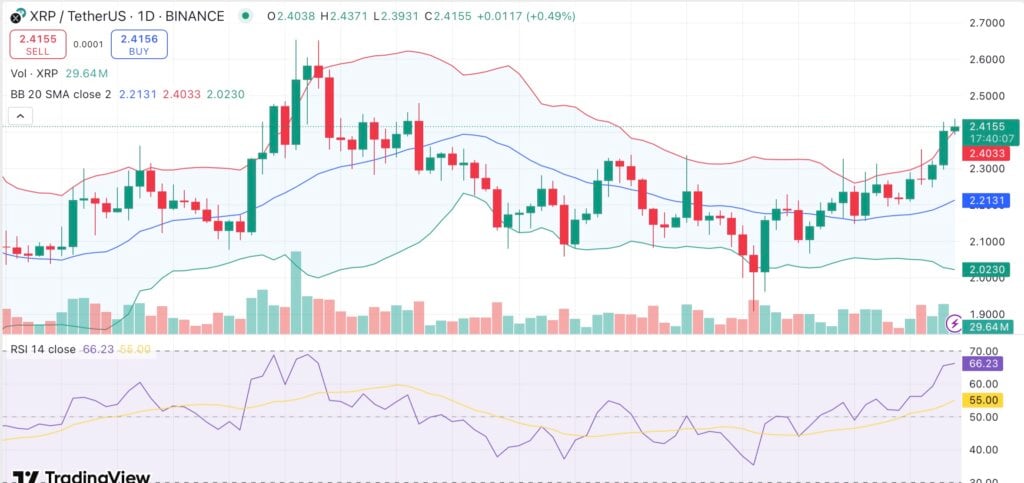 XRP price analysis. Credit: crypto.news
The relative strength index, at 66, shows significant momentum without yet reaching overbought territory. The MACD is still expanding and in positive territory, which is a sign of trend continuation rather than reversal. Volume has increased in tandem with the rally, supporting the validity of the breakout.
The Bollinger Bands width has widened, indicating increased volatility, often seen during the early stages of larger price moves. Nevertheless, since short-term oscillators such as the stochastic RSI are nearing their peak levels, it is impossible to rule out the possibility of a brief cooldown.
The next area to watch would be close to $2.50, followed by the May highs around $2.63, if bulls can keep XRP above the $2.40 breakout level. This scenario is supported by steady accumulation from large holders and increasing trading volume.
But if the price falls back below $2.30, it could be a sign of a failed breakout and signal a drop toward the 20-day moving average, which is near $2.21. This would probably raise doubts about the overall trend, particularly if volume begins to taper off.
Disclaimer: The content of this article solely reflects the author's opinion and does not represent the platform in any capacity. This article is not intended to serve as a reference for making investment decisions.
You may also like
Fear is the biggest short! Morgan Stanley calls for bottom-fishing in semiconductors: land and electricity shortages are not a problem, approved projects can't meet demand
Morgan Stanley believes that the recent sell-off in the semiconductor sector has been excessive, and that market panic rather than fundamentals is the biggest risk. Driven by demand for AI infrastructure, downstream orders continue to accelerate, with semiconductor supply remaining the core bottleneck. LPS constraints actually make growth more stable. The sector may fluctuate within a range in the short term and is currently near the bottom; prospects for the computing power and storage subsectors are favorable.

Indian Rupee extends rally amid continued FIIs buying, lower oil prices

Hashrate orders are booming, why is "AI trading" falling out of favor? JPMorgan reveals the time lag between AI investment and productivity realization
Joseph Lupton from the JP Morgan Global Economic Research Team pointed out in a research report on November 10 that recent improvements in labor productivity have been driven more by capital deepening and increased intensity of factor utilization. The broad efficiency gains from AI, resulting from process reconstruction, data integration, and organizational adjustments, will still take time to materialize. This means orders for chips, servers, and electrical equipment may grow first, but continuous investment returns for computing power operators and end users may not arrive at the same pace.
AI investment enters the "Trough of Disillusionment", the next 18 months will be a life-or-death test!
Goldman Sachs believes that the AI investment cycle is currently in the "trough of disillusionment," but this is not the first time. The core contradiction lies in the fact that the business models of new cloud computing providers are highly dependent on end-user returns from AI spending, while currently "there are basically zero companies that can attribute profits to AI." Social Capital founder Palihapitiya has clearly defined an 18-month key window, during which the market will decide which AI business models are sustainable and which are not.

Crypto prices
More


