
3 Made in USA Coins to Watch After Trump’s New EU Tariff

Three Made in USA coins—Worldcoin, Jupiter, and EOS—are seeing major moves as traders react to Trump’s EU tariff post. Market momentum and key price levels could define their next steps.
Three Made in USA coins—Worldcoin (WLD), Jupiter (JUP), and EOS—are drawing renewed attention following Donald Trump’s latest post suggesting a 50% tariff on the European Union starting June 1.
WLD is leading the pack with a 37% surge after a $135 million token sale to a16z and Bain Capital Crypto. JUP is also outperforming the market, gaining nearly 7% amid key ecosystem announcements. Meanwhile, EOS is struggling to hold recent gains after a controversial $3 million purchase by World Liberty Financial sparked speculation across the crypto community.
Worldcoin (WLD)
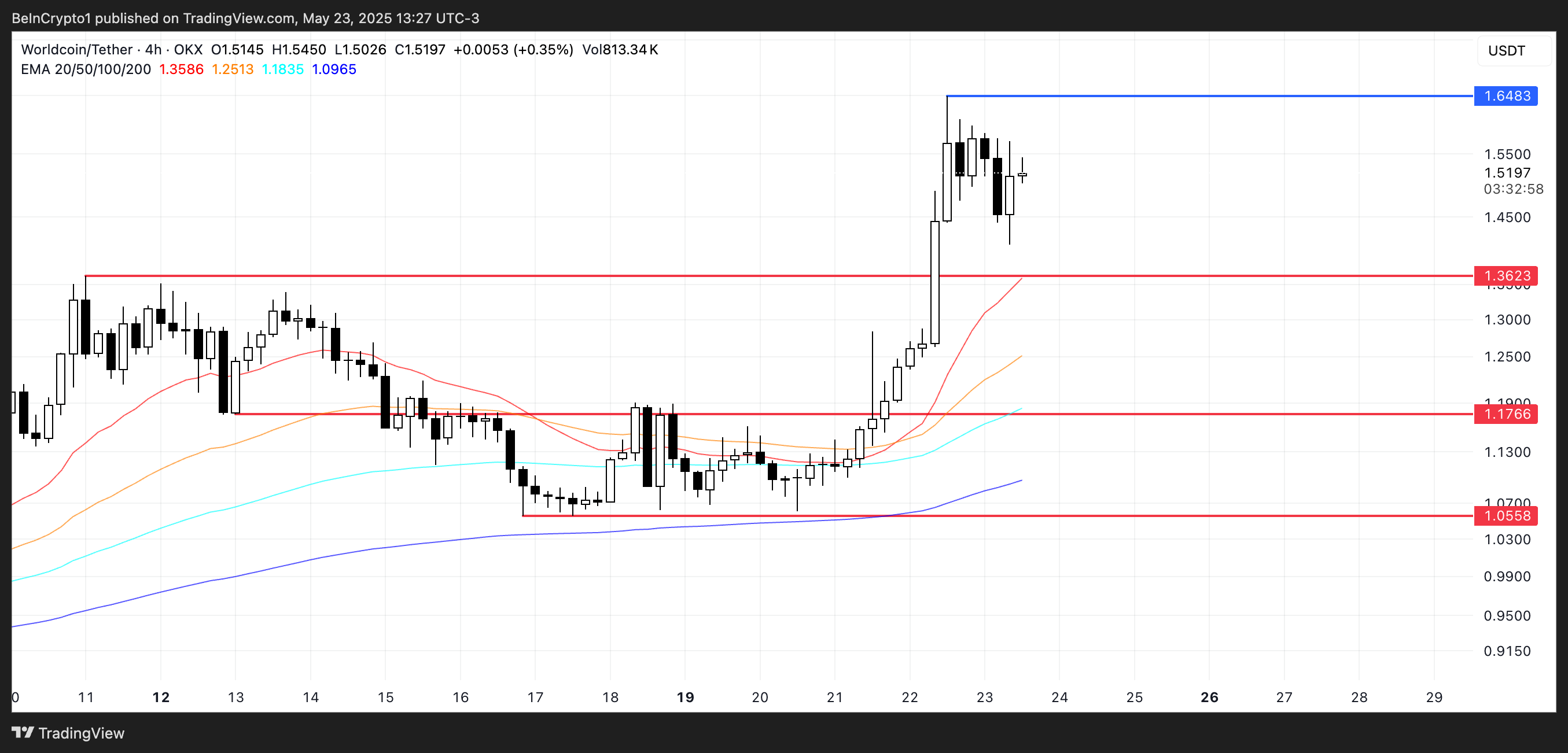
Worldcoin surged 37% in the last two days, hitting a three-month high after raising $135 million through a direct token sale to a16z and Bain Capital Crypto. WLD became the best-performing token among Made in USA coins in the last few days.
The funding, which was not a traditional venture round but a market-priced token purchase, instantly boosted WLD’s circulating supply—reflected in a sudden $135 million spike in market cap moments before the announcement. The capital will be used to expand biometric identity operations in the U.S., following regulatory setbacks in Europe and Africa.
 WLD Price Analysis. Source:
TradingView.
This suggests buying strength is present and accelerating, increasing the likelihood of WLD challenging the resistance at $1.64. If broken, WLD could push above $1.70 for the first time since late January.
However, traders should monitor the $1.36 support closely—if this floor fails, the token could retrace toward $1.17 or even $1.05 in a deeper correction.
Jupiter (JUP)
Jupiter is defying the broader market pullback, rising nearly 7% in the last 24 hours while most major tokens trend lower.
The rally comes during a high-activity week for the Jupiter ecosystem, marked by the launch of its mobile app, a strategic partnership with Moonpay, and the debut of Jupiter Lend.
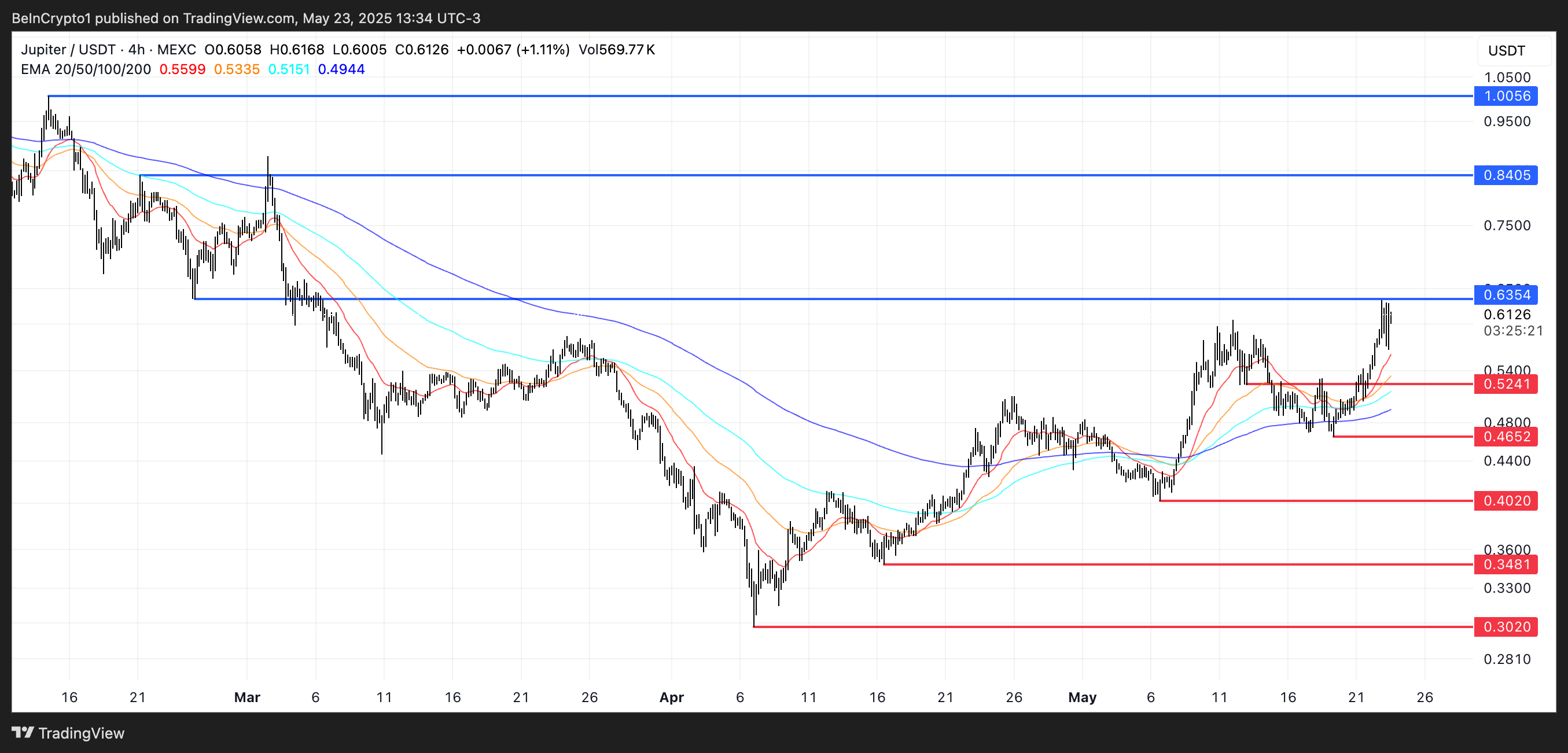
Technically, JUP remains below the key resistance at $0.635, which it recently failed to break.
 JUP Price Analysis. Source:
TradingView.
A successful retest and breakout above that level could pave the way for a move toward $0.84, with a strong uptrend potentially pushing it to challenge the $1 mark for the first time since February.
However, if momentum fades and Jupiter (JUP) drops to test support at $0.52, losing that level could trigger a sharper decline to $0.465. In a deeper downturn scenario, the token could slide to $0.40, $0.348, or even $0.30, making the current breakout attempt a critical moment for bulls.
EOS
One week ago, World Liberty Financial (WLFI) sparked controversy in the crypto community after purchasing $3 million worth of EOS tokens, a move that immediately raised eyebrows.
The timing of the buy—following WLFI’s alleged $125 million loss from selling ETH at a three-month low—fueled speculation of possible market manipulation.
Despite skepticism, no concrete evidence of misconduct or insider trading has emerged. Interestingly, EOS rallied over 9% shortly after the purchase, intensifying the debate over whether WLFI’s actions were strategic or coincidental, making it an interesting player among Made in USA coins to watch.
 EOS Price Analysis. Source:
TradingView.
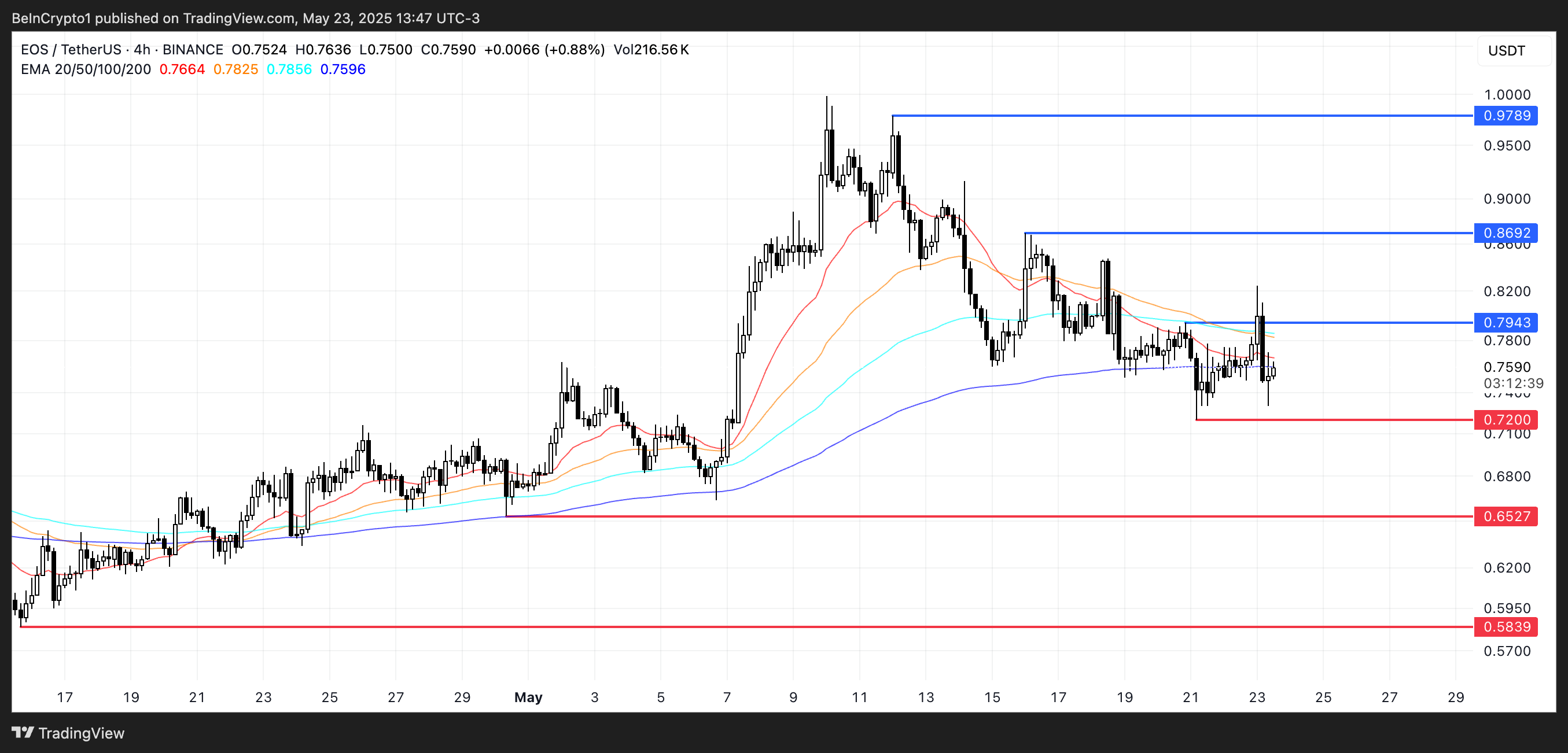
Since then, however, EOS has struggled to maintain momentum and is now down nearly 10.5% over the last seven days. The token recently failed to break resistance at $0.79 and is now at risk of extending its decline.
If bearish pressure persists, EOS could test the support at $0.72; a break below this level may lead to deeper drops toward $0.652 and $0.583.
On the flip side, if momentum returns and EOS can reclaim $0.79, it may target higher levels at $0.869 and potentially $0.97—though a strong market reversal would be needed to support such a move.
Disclaimer: The content of this article solely reflects the author's opinion and does not represent the platform in any capacity. This article is not intended to serve as a reference for making investment decisions.
You may also like
Just bet on AI and already faced a market blow! Berkshire reports earnings tonight, Abel faces a major test in his transformation
Greg Abel has been leading Berkshire Hathaway for less than a year, yet he has already made a bet of over $10.9 billion on the AI sector, marking a complete break from Buffett’s traditional avoidance of tech stocks. However, Alphabet’s stock price has fallen below their initial purchase cost, and Bending Spoons continues to decline, putting this bold AI gamble to the test. At the same time, third-quarter earnings per share are expected to drop 6% year-over-year, and the share repurchase program is likely to plummet from $4.5 billion to $1.6 billion. How to deploy $358 billion in cash will be a major challenge for the new leader’s capital allocation skills.

Has the AI bubble burst? Goldman Sachs: It's more like 1998 than 2000 right now
The Goldman Sachs trading desk stated that the current wave of sell-offs resembles the 1998 liquidity crisis more than the bursting of the 2000 bubble. It is a forced deleveraging rather than a refutation of business fundamentals. The market is drastically repricing construction financing and timeline expectations, rather than underlying demand. Moreover, the issues currently drawing the most attention from the market—electricity and licensing—are actually the least important, as limited supply does not equate to disappearing demand. The real question that needs to be answered is whether long-term revenues can ultimately justify the capital invested.

Pundit: XRP and XLM Holders, Do You Know How Big This Is?

Tesla Cybertruck: From Cracked Windows to Production Halt, a Three-and-a-Half Year Journey Ends
Since its launch in 2019, Cybertruck has been mired in controversy—ranging from a failed window demonstration on release day, a four-year delay in mass production, and its price rising from $39,900 to more than $100,000, along with a total of 11 recalls. The day before the halt of production was announced, Tesla raised the price once again, bringing a dramatic and intriguing end to the saga of this vehicle.
Crypto prices
More


