
Arthur Hayes Links US-China Trade War Fallout to Bitcoin’s Path Toward $1 Million

Arthur Hayes believes escalating US-China trade tensions are accelerating the collapse of traditional global financial systems.
Arthur Hayes, co-founder of BitMEX and CIO at Maelstrom, believes the global financial system is undergoing a major shift that could propel Bitcoin toward the $1 million mark.
According to Hayes, rising trade tensions between the US and China are accelerating the breakdown of long-standing economic norms, opening the door for neutral assets like Bitcoin to take center stage.
How US-China Standoff Could Drive Bitcoin Demand in Shifting Financial Order
In an April 5 X post, Hayes speculated that the exchange rate between the US dollar and Chinese Yuan (USDCNY) could climb to 10.00.
He attributed this to Chinese President Xi Jinping’s likely refusal to alter the country’s economic direction to appease US demands, especially under President Donald Trump’s aggressive trade stance.
“USDCNY is going to 10.00 bc there is no way that Xi Jinping will agree to change China in the ways necessary to placate Trump. This is the super bazooka BTC needs to ascend rapidly towards $1 million,” Hayes wrote on Twitter.
Over the past week, the global financial markets have been on edge following the Trump administration’s decision to impose a 10% blanket tariff on all imports. China, facing even higher levies of up to 34%, responded with its own round of retaliatory tariffs set to begin on April 10.
However, Trump doubled down on the confrontation, dismissing China’s reaction as a mistake.
“CHINA PLAYED IT WRONG, THEY PANICKED – THE ONE THING THEY CANNOT AFFORD TO DO!” Trump wrote on Truth Social.
While that political posturing continues, Hayes sees deeper risks brewing beneath the surface. According to him, the ongoing tariff war could undermine the global role of US Treasuries and equities.
For decades, the US has exported dollars by running trade deficits, while foreign nations recycled those dollars into American financial assets. That system, according to Hayes, may no longer be sustainable.
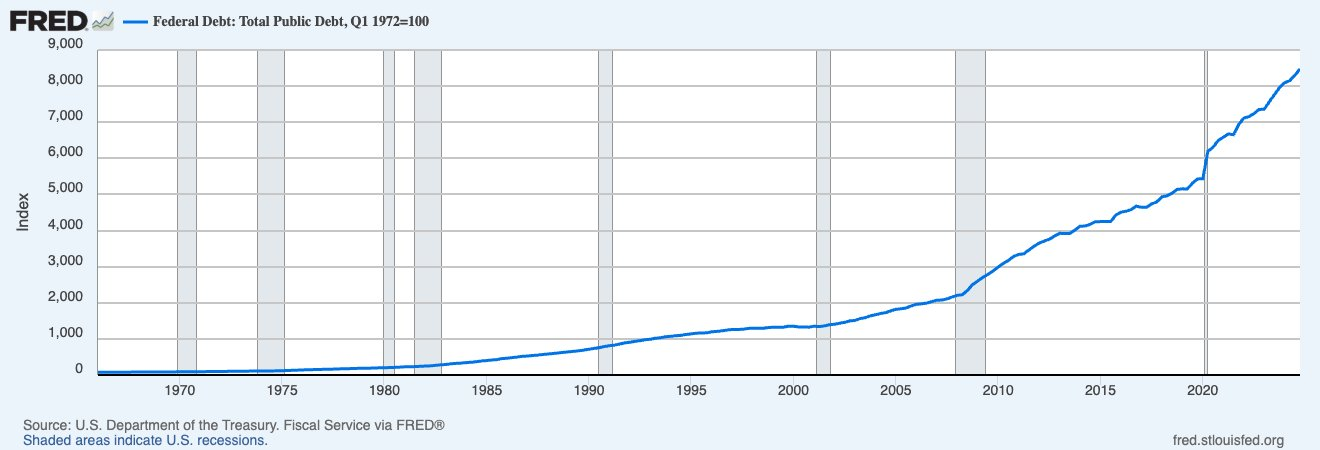 US Federal Debt. Source:
Hayes/X
If countries stop accumulating dollars, their demand for US bonds and stocks will shrink. Some may even start selling off reserves to protect their economies.
Hayes noted that even a Trump policy reversal wouldn’t restore confidence, as global leaders may no longer trust the stability of US trade policy.
“Even if Trump backtracks on the severity of the tariffs, no finance minister or world leader can risk Trump changing his mind again, and therefore things cannot return to the way they were. You must do what is best for your country,” Hayes wrote.
In this environment, Hayes sees a renewed role for assets that are not tied to any single government. According to him, gold, long regarded as a safe haven, would make a comeback.
“The dollar will still be the reserve currency, but nations will hold reserves in gold to settle global trade. Trump hinted at this because gold is tariff exempt! Gold must flow freely and cheaply in the new world monetary order,” Hayes stated.
However, Hayes says Bitcoin could be even more appealing in a world defined by decentralization, capital mobility, and reduced trust in traditional power structures.
“For those who want to adapt to a return to pre-1971 trade relationships, buy gold, gold miners and BTC,” he concluded.
Disclaimer: The content of this article solely reflects the author's opinion and does not represent the platform in any capacity. This article is not intended to serve as a reference for making investment decisions.
You may also like
SoftBank reports first quarterly loss in two years! $3.7 billion impairment in US data center project, AI investments face pressure
SoftBank Group reported a net loss of 1.12 trillion yen in its second fiscal quarter, marking its first quarterly loss in nearly two years. The main reasons are the write-off of nearly $3.7 billion in advance payments due to adjustments in the procurement of power supply equipment for its AI data center in Ohio, USA, a shift of the Vision Fund from profit to loss, and a surge in the cost of high-debt financing. Since the June peak, SoftBank's share price has fallen more than 50%.
Expanding computing power on one hand, grabbing spectrum on the other! Barclays optimistic about SpaceX (SPCX.US) acquiring T-Mobile: Complementary advantages of ground networks and Starlink
After Space's stock price rose for two consecutive days, Barclays stated that T-Mobile is the "cleanest" choice among SpaceX’s potential acquisition targets. Barclays considers Verizon a major unknown, while AT&T has the lowest strategic fit.
Will the Federal Reserve raise rates in December? Tonight's CPI will be the final verdict!
The October CPI data will be released tonight, with the market pricing in an 86% chance of a rate hike. Goldman Sachs predicts a core CPI month-on-month increase of only 0.16%, much lower than market expectations. However, statistical distortions in health insurance and declines in used car prices—these "soft factors"—are unlikely to be reflected in the core PCE, which the Federal Reserve places greater emphasis on. The data may trigger a relief rally, but it is unlikely to change the underlying hawkish sentiment.

A 14x PE is not a bargain! Renowned wealth management CEO warns: If Nvidia (NVDA.US) earnings are revised down by 5%, its stock price could drop by 40%.
Ritholtz Wealth Management CEO Josh Brown questioned the idea that a 14x P/E ratio is a bargain and issued a warning: "If Nvidia's earnings over the next 12 months are revised down by 5% from our expectations, the stock could potentially drop by 40%."
Crypto prices
More


