
Hyperliquid (HYPE) Slides 16% In One Week And Nears $11 Support

HYPE faces rising bearish pressure as technical signals deteriorate, raising the stakes at key support zones just above $11.
Hyperliquid (HYPE) is under pressure, down 16% over the past seven days as technical indicators increasingly point toward bearish control. Momentum has weakened sharply, with the Relative Strength Index (RSI) dropping below 40 and showing no signs of strong buying interest since late March.
At the same time, the Directional Movement Index (DMI) shows sellers gaining dominance, with a rising ADX suggesting a potential strengthening of the downtrend. As HYPE approaches key support levels, the market now waits to see if bulls can mount a recovery—or if further downside is ahead.
Hyperliquid DMI Shows Sellers Are In Control
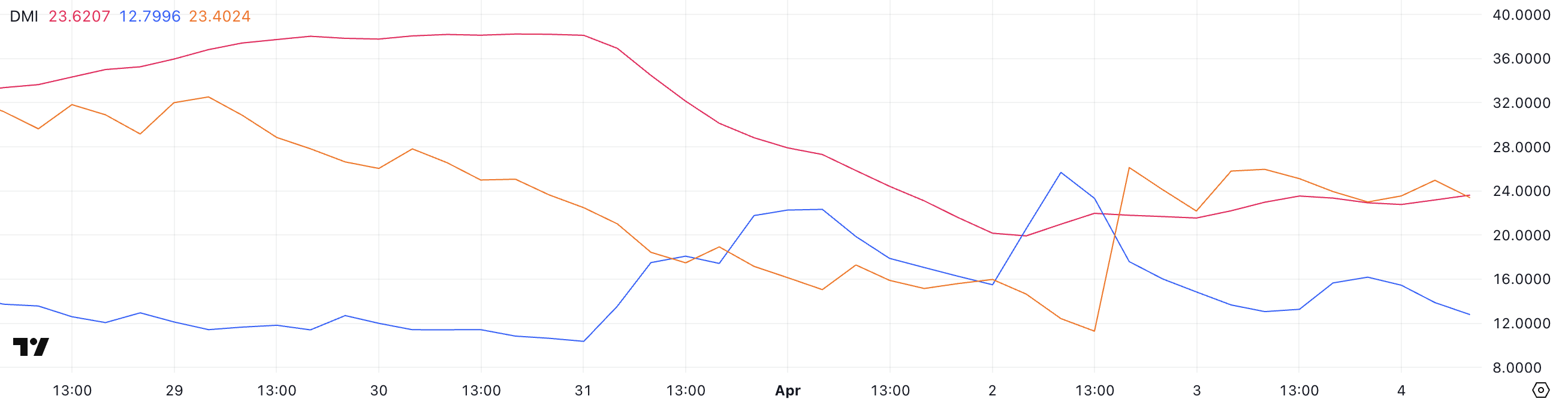
According to its Directional Movement Index (DMI), Hyperliquid is showing early signs of a developing trend, with the Average Directional Index (ADX) rising from 21.5 to 23.6.
The ADX measures the strength of a trend regardless of its direction. Readings below 20 typically indicate a weak or range-bound market, while values above 25 suggest the presence of a strong trend.
With the current ADX moving closer to that 25 threshold, it suggests that trend strength is building—but hasn’t fully confirmed yet—indicating that traders should be on alert for potential continuation in price action.
 HYPE DMI. Source:
TradingView.
Meanwhile, the +DI and -DI lines, which represent bullish and bearish directional movement, respectively, have shifted significantly.
The +DI has dropped sharply from 25.68 to 12.79, while the -DI has surged from 11.29 to 23.4, indicating that bearish momentum has clearly overtaken bullish pressure. This shift suggests that sellers are gaining control of the market, and unless the +DI line can reverse and regain ground, HYPE could be at risk of further downside.
If the current dynamics continue, this, combined with the rising ADX, could signal the start of a stronger bearish trend.
Hyperliquid RSI Shows The Lack Of Buying Momentum
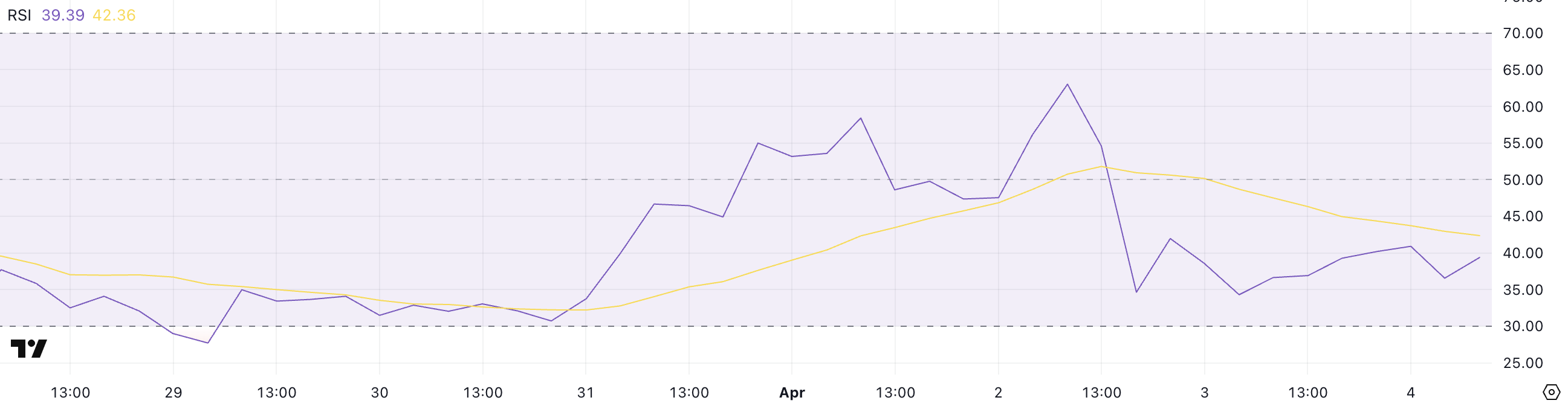
Hyperliquid has seen its Relative Strength Index (RSI) fall significantly over the past two days, dropping from 63.03 to 39.39.
The RSI is a momentum oscillator that measures the speed and magnitude of recent price changes, ranging from 0 to 100.
Readings above 70 typically indicate that an asset is overbought and may be due for a correction, while readings below 30 suggest it is oversold and could be primed for a rebound. Levels between 30 and 70 are considered neutral, but directional shifts within this range often reflect changing momentum.
 HYPE RSI. Source:
TradingView.
With HYPE’s RSI now sitting at 39.39, the indicator suggests weakening bullish momentum and growing bearish pressure. The fact that the RSI hasn’t touched or exceeded the 70 mark since March 24 signals a lack of strong buying conviction in recent weeks.
This downward trend in RSI may indicate that the market is cooling off. Unless buyers step in to reverse this trajectory, HYPE could continue to face selling pressure.
If the RSI continues to drift toward 30, it would raise the possibility of further downside or consolidation in the short term.
Will Hyperliquid Fall Below $11 Soon?
Hyperliquid price is currently at an important threshold, with action leaning bearish but potential for a rebound still on the table.
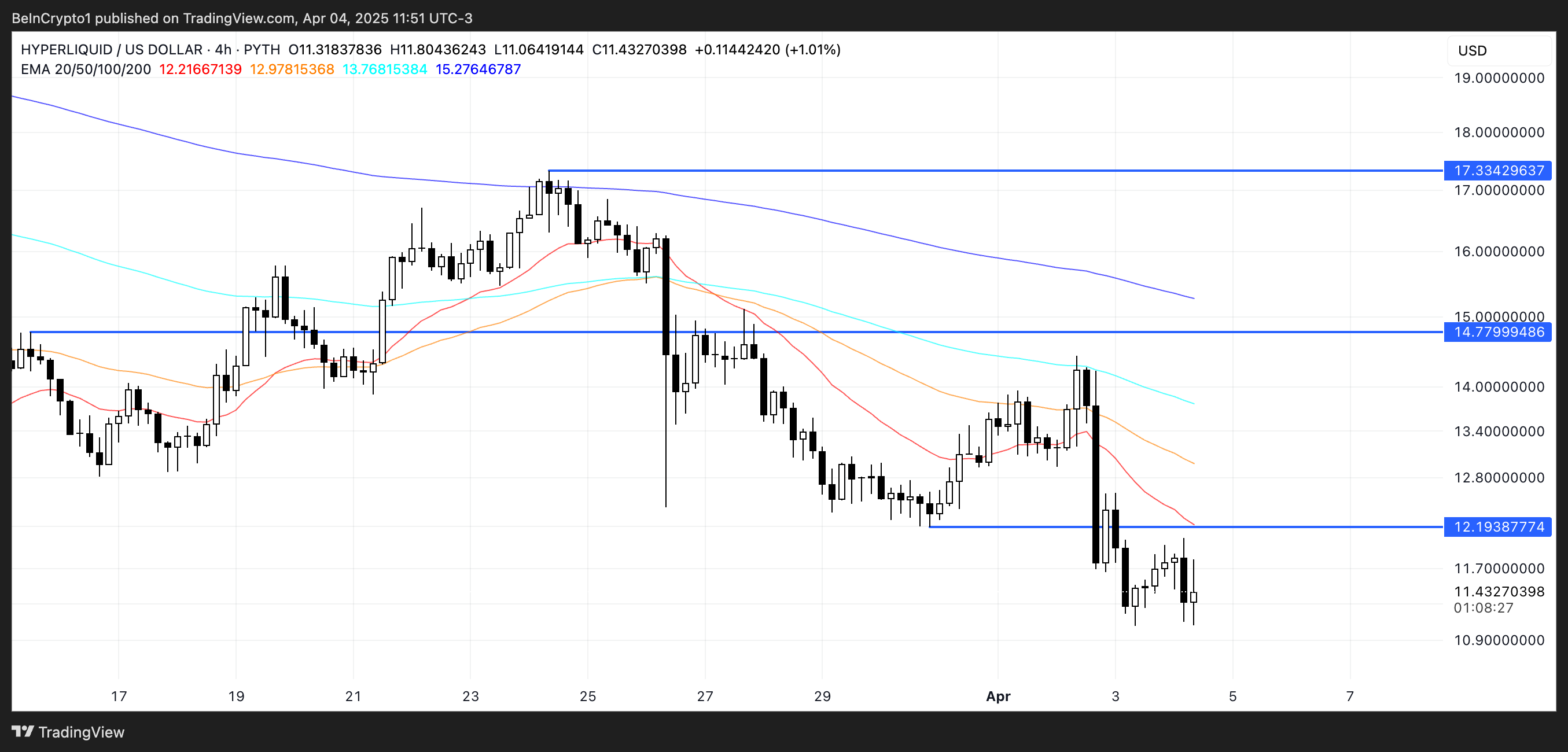
If the current downtrend continues, HYPE could soon dip below the $11 mark.
 HYPE Price Analysis. Source:
TradingView.
This would align with the recent drop in momentum indicators like the RSI and the growing bearish pressure seen in directional movement data.
However, if buyers manage to step in and shift momentum, HYPE could attempt to reclaim higher levels. A break above the immediate resistance at $12.19 would be the first sign of recovery, potentially opening the door for a move toward $14.77.
If bullish momentum accelerates, the rally could extend as far as $17.33, which would mark a full reversal of the current bearish structure.
Disclaimer: The content of this article solely reflects the author's opinion and does not represent the platform in any capacity. This article is not intended to serve as a reference for making investment decisions.
You may also like
If Jensen Huang resigns, who could take over Nvidia? AMD's Lisa Su included in media candidates
AMD CEO Lisa Su, who holds a Ph.D. from MIT and led AMD back to growth while rebuilding customer trust during a crisis, is seen as a potential candidate. However, the competitive relationship between AMD and NVIDIA adds complexity to the succession process. Arm CEO Rene Haas, who worked at NVIDIA for seven years, is considered a smoother option for succession.

SoftBank reports first quarterly loss in two years! $3.7 billion impairment in US data center project, AI investments face pressure
SoftBank Group reported a net loss of 1.12 trillion yen in its second fiscal quarter, marking its first quarterly loss in nearly two years. The main reasons are the write-off of nearly $3.7 billion in advance payments due to adjustments in the procurement of power supply equipment for its AI data center in Ohio, USA, a shift of the Vision Fund from profit to loss, and a surge in the cost of high-debt financing. Since the June peak, SoftBank's share price has fallen more than 50%.
Expanding computing power on one hand, grabbing spectrum on the other! Barclays optimistic about SpaceX (SPCX.US) acquiring T-Mobile: Complementary advantages of ground networks and Starlink
After Space's stock price rose for two consecutive days, Barclays stated that T-Mobile is the "cleanest" choice among SpaceX’s potential acquisition targets. Barclays considers Verizon a major unknown, while AT&T has the lowest strategic fit.
Will the Federal Reserve raise rates in December? Tonight's CPI will be the final verdict!
The October CPI data will be released tonight, with the market pricing in an 86% chance of a rate hike. Goldman Sachs predicts a core CPI month-on-month increase of only 0.16%, much lower than market expectations. However, statistical distortions in health insurance and declines in used car prices—these "soft factors"—are unlikely to be reflected in the core PCE, which the Federal Reserve places greater emphasis on. The data may trigger a relief rally, but it is unlikely to change the underlying hawkish sentiment.

Crypto prices
More


