
Research Report | StakeStone Project Overview & STO Market Cap Analysis
I. Project Introduction
StakeStone is a decentralized, omnichain liquid staking protocol designed to provide native staking yields and efficient liquidity for Layer 2s and emerging chains. When users deposit ETH into StakeStone, they receive a native LST asset called STONE. This asset not only represents staking rewards but can also be flexibly used across multi-chain DeFi, GameFi, and NFTFi scenarios, enabling asset reuse and yield maximization.
StakeStone features a proprietary OPAP (Optimized Portfolio Allocation Protocol) mechanism that intelligently allocates user assets across various ETH staking pools, restaking protocols, and yield platforms. This enhances yield efficiency while eliminating the need for manual operations. Built on the LayerZero architecture, STONE supports seamless cross-chain transfers and value alignment, and is currently deployed on Ethereum, Manta, Mantle, Base, BNB Chain, and Linea.
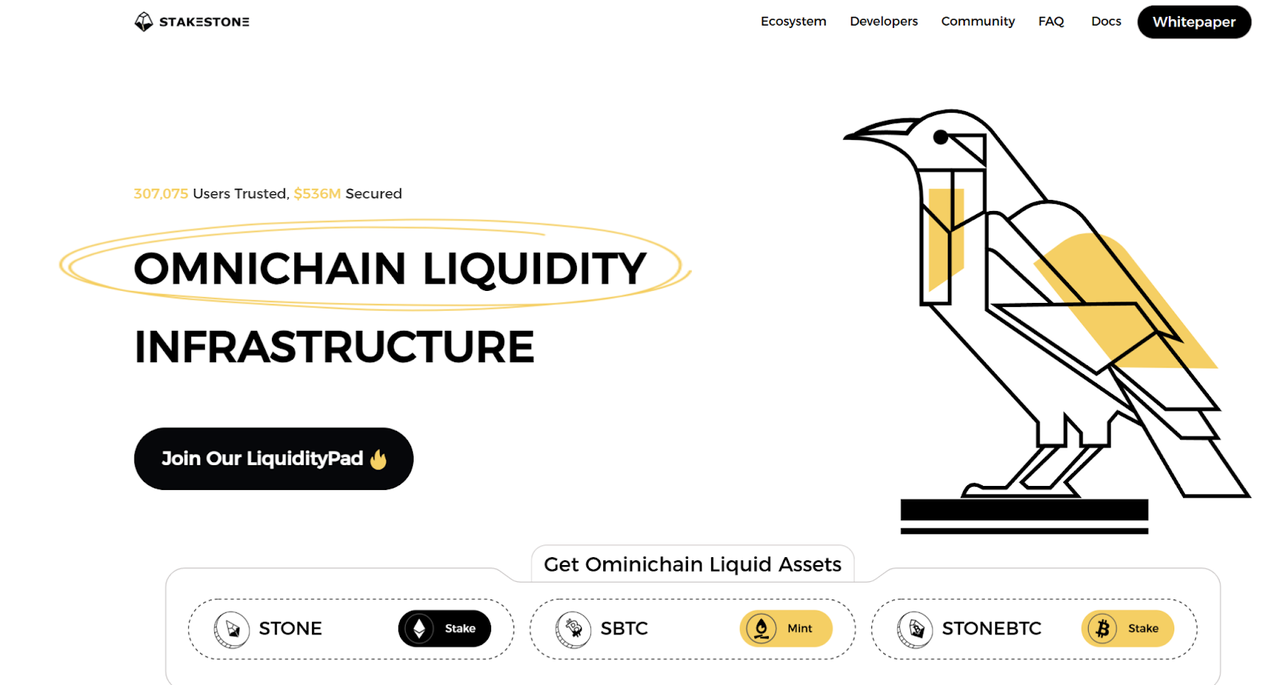
In terms of its product suite, StakeStone has launched STONE (liquid ETH), SBTC, and STONEBTC (liquid BTC) as yield-bearing assets, and developed LiquidityPad to provide customized liquidity vaults for emerging ecosystems. By bridging Ethereum with multi-chain ecosystems, StakeStone is building a highly scalable and sustainable cross-chain liquidity infrastructure.
The project has received dual support from top-tier centralized exchanges (CEXs) and is led by core members from leading institutions. StakeStone is rapidly becoming a key liquidity hub in the modular, multi-chain DeFi world, driving liquidity from isolated silos toward interconnected networks.
II. Project Highlights
Native Cross-Chain Liquidity Support
StakeStone leverages LayerZero to build STONE’s cross-chain transfer and price synchronization mechanism. It has already been deployed across Ethereum, Manta, Mantle, Base, BNB Chain, and Linea, allowing users to seamlessly access and utilize STONE on any supported chain—achieving true omnichain liquidity unification.
OPAP Smart Strategy System for Zero-Operation Yield Optimization
Through its independently developed OPAP mechanism, StakeStone automatically allocates user assets to a variety of high-quality staking and restaking protocols. This dynamically optimizes the underlying yield portfolio, enabling users to earn sustainable high-quality returns without frequent rebalancing.
Diverse Product Suite for Modular Liquidity Infrastructure
In addition to its core asset STONE, StakeStone has introduced SBTC and STONEBTC as BTC-based yield-bearing assets. It also developed LiquidityPad to tailor liquidity vaults for new chains, forming a comprehensive multi-asset, multi-scenario liquidity solution.
Backed by Top-Tier Resources with Strong Ecosystem Integration
StakeStone has received strategic support from leading CEXs such as Binance and OKX. Its core team comprises veterans from top Web3 institutions with extensive experience in product design and ecosystem expansion, and is rapidly building the foundational liquidity distribution layer of the omnichain DeFi world.
III. Market Cap Outlook
As an emerging liquid staking derivative (LSD) project, StakeStone shares core logic with leading Ethereum-based protocols like Lido, Rocket Pool, and SSV. It aims to unlock liquidity from staked assets and enhance on-chain capital efficiency. Currently, its circulating market cap remains small, but if it evolves into a mainstream staking protocol, it holds significant growth potential.

IV. Tokenomics
The total supply of STONE tokens is 1 billion, with 22.53% currently in circulation.
Token Allocation:
- Community: 17.87%
- Airdrops & Future Incentives: 7.85%
- Marketing & Partnerships: 9.13%
- Protocol Liquidity Support: 6%
- Investors: 21.5%
- Team Incentives: 15%
- Foundation Reserve: 18.65%
- Ecosystem & Treasury: 4%
Token Utility:
According to the StakeStone whitepaper, the protocol introduces STONE (yield-bearing ETH), SBTC, and STONEBTC (omnichain liquid BTC and yield-bearing BTC), along with LiquidityPad, enabling users to unlock omnichain liquidity while earning optimized and sustainable returns.
The governance token, STO, coordinates value flows across chains and facilitates decentralized protocol governance. StakeStone adopts a vote-escrow token model (veSTO) as the foundation of its governance system. By locking STO tokens, holders receive veSTO. Additionally, StakeStone implements multiple token burn mechanisms.

V. Team & Fundraising
Team:
StakeStone was initiated by a professional team focused on cross-chain infrastructure and liquid staking mechanisms. The core members have years of experience in DeFi, blockchain strategy, and cross-chain protocols. The team possesses strong multi-chain ecosystem integration capabilities and has already established deep integrations with Ethereum mainnet, LayerZero, Mantle, Base, and BNB Chain, balancing technical implementation with market expansion.
Fundraising:
StakeStone has completed two major funding rounds, raising a total of $22 million:
- On November 11, 2024, StakeStone announced the completion of a strategic round led by Polychain, Nomad Capital, HashKey Capital, Amber Group, SevenX Ventures, Bankless Ventures, Mask Network, and Symbolic Capital.
- On March 25, 2024, StakeStone received early-stage support from YZi Labs, OKX Ventures, and Skyland Ventures.
VI. Risk Warnings
-
StakeStone’s core yield logic depends on the healthy development of the Ethereum and restaking markets. If mainstream staking yields decline or restaking protocols are adopted slower than expected, this may impact demand for the STONE token and long-term returns.
-
As more institutions launch similar liquid staking solutions, competition in the multi-chain ecosystem will intensify. If other projects offer more attractive yields or technological innovations, StakeStone’s market share and user growth could be affected.
VII. Official Links
- Website: https://www.stakestone.io/#/home
- Twitter: https://x.com/Stake_Stone
- Telegram: https://t.me/+afYqz2KG_YNlNzNl
Disclaimer: The content of this article solely reflects the author's opinion and does not represent the platform in any capacity. This article is not intended to serve as a reference for making investment decisions.
You may also like
Expanding computing power on one hand, grabbing spectrum on the other! Barclays optimistic about SpaceX (SPCX.US) acquiring T-Mobile: Complementary advantages of ground networks and Starlink
After Space's stock price rose for two consecutive days, Barclays stated that T-Mobile is the "cleanest" choice among SpaceX’s potential acquisition targets. Barclays considers Verizon a major unknown, while AT&T has the lowest strategic fit.
Will the Federal Reserve raise rates in December? Tonight's CPI will be the final verdict!
The October CPI data will be released tonight, with the market pricing in an 86% chance of a rate hike. Goldman Sachs predicts a core CPI month-on-month increase of only 0.16%, much lower than market expectations. However, statistical distortions in health insurance and declines in used car prices—these "soft factors"—are unlikely to be reflected in the core PCE, which the Federal Reserve places greater emphasis on. The data may trigger a relief rally, but it is unlikely to change the underlying hawkish sentiment.

A 14x PE is not a bargain! Renowned wealth management CEO warns: If Nvidia (NVDA.US) earnings are revised down by 5%, its stock price could drop by 40%.
Ritholtz Wealth Management CEO Josh Brown questioned the idea that a 14x P/E ratio is a bargain and issued a warning: "If Nvidia's earnings over the next 12 months are revised down by 5% from our expectations, the stock could potentially drop by 40%."
Citibank: US beer sales will not bottom out by 2026, non-alcoholic beer is the only clear long-term growth track
Beer shipments in the United States have declined for the fifth consecutive year and are set to fall below 1980 levels. Citibank: Only non-alcoholic beer still has long-term growth potential.

Crypto prices
More


