
What To Expect From Pi Network (PI) in April

After Pi Network migrated to the mainnet, its PI token experienced significant price drops and weak market participation. As April begins, its future remains uncertain, with the potential for either a rebound or further decline depending on buyer interest and network developments.
Since the long-anticipated Pi Network migration deadline—requiring users to complete KYC verification and migrate their balances—concluded on March 14, 2025, its native PI token has faced significant sell-offs.
Eager holders, who had long awaited its exchange listing, have offloaded their assets heavily over the past month. With buying pressure fading, traders are questioning whether this downtrend will persist throughout April.
PI Faces Steep Decline as Bearish Pattern Takes Hold
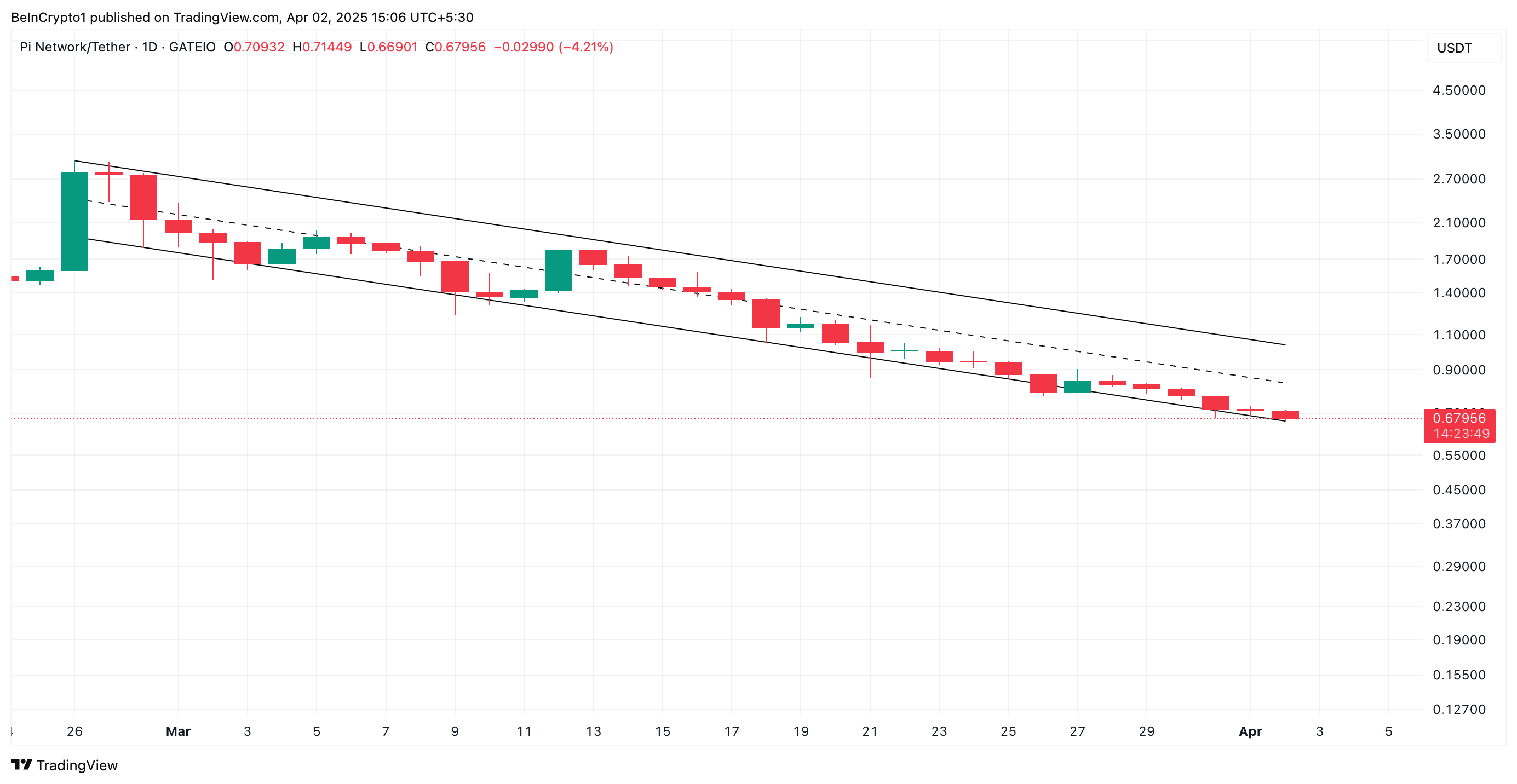
PI has trended within a descending parallel channel since climbing to an all-time high of $3 on February 26, reflecting its price decline. Currently standing at $0.67, the altcoin’s value has since plunged by 78%.
This channel is a bearish pattern formed when an asset’s price trends downward within two parallel trendlines, with lower highs and lower lows. It indicates a bearish market structure, suggesting continued downside unless a breakout above resistance occurs.
 PI Descending Parallel Channel. Source:
TradingView
With a strengthening bearish bias, PI is currently poised to break below this channel’s lower trend line, a move that hints at an extended decline in April.
In an exclusive interview with BeInCrypto, Alvin Kan, COO of Bitget Wallet, confirms the spike in post-mainnet migration selloffs.
“Pi Network is at a critical stage. The recent migration to (the) mainnet has triggered a wave of selling pressure as early holders begin to offload their tokens. On top of that, the pace of token unlocks raises real concerns around inflation and whether market demand can keep up. Onchain indicators continue to show weak accumulation and seller dominance, suggesting that downward pressure may persist unless fundamentals shift,” Kan noted.
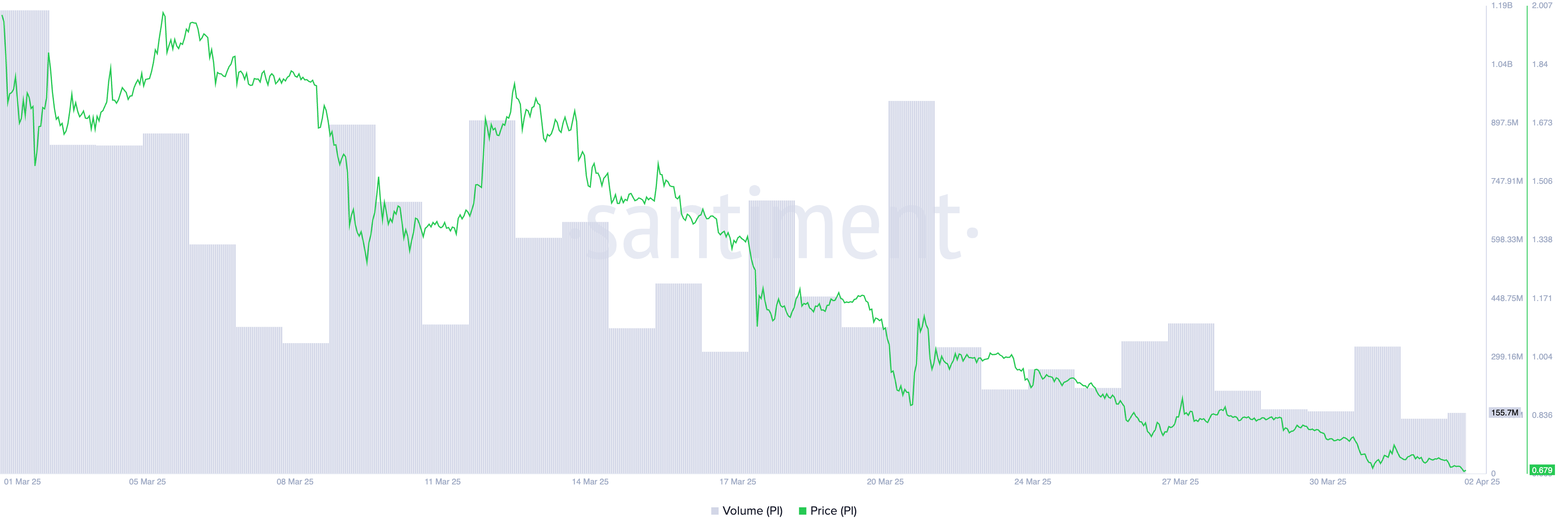
PI’s plummeting daily trading volume corroborates Kan’s position. As of today, it stands at $156 million, down 89% from the $1.38 billion recorded on March 2.
 PI Price and Trading Volume. Source:
Santiment
When an asset’s trading volume falls like this, it indicates reduced market participation and hints at a potential price drop if buying pressure weakens further.
Pi Network’s April Outlook: Uncertainty Looms Amid Selling Pressure
On what token holders should expect in April, Kan noted that “April’s outlook for Pi remains uncertain.”
“Some market watchers expect a short-term rebound if buyer interest returns, while others point to the risk of further downside if selling continues and momentum weakens,” Kan told BeInCrypto.
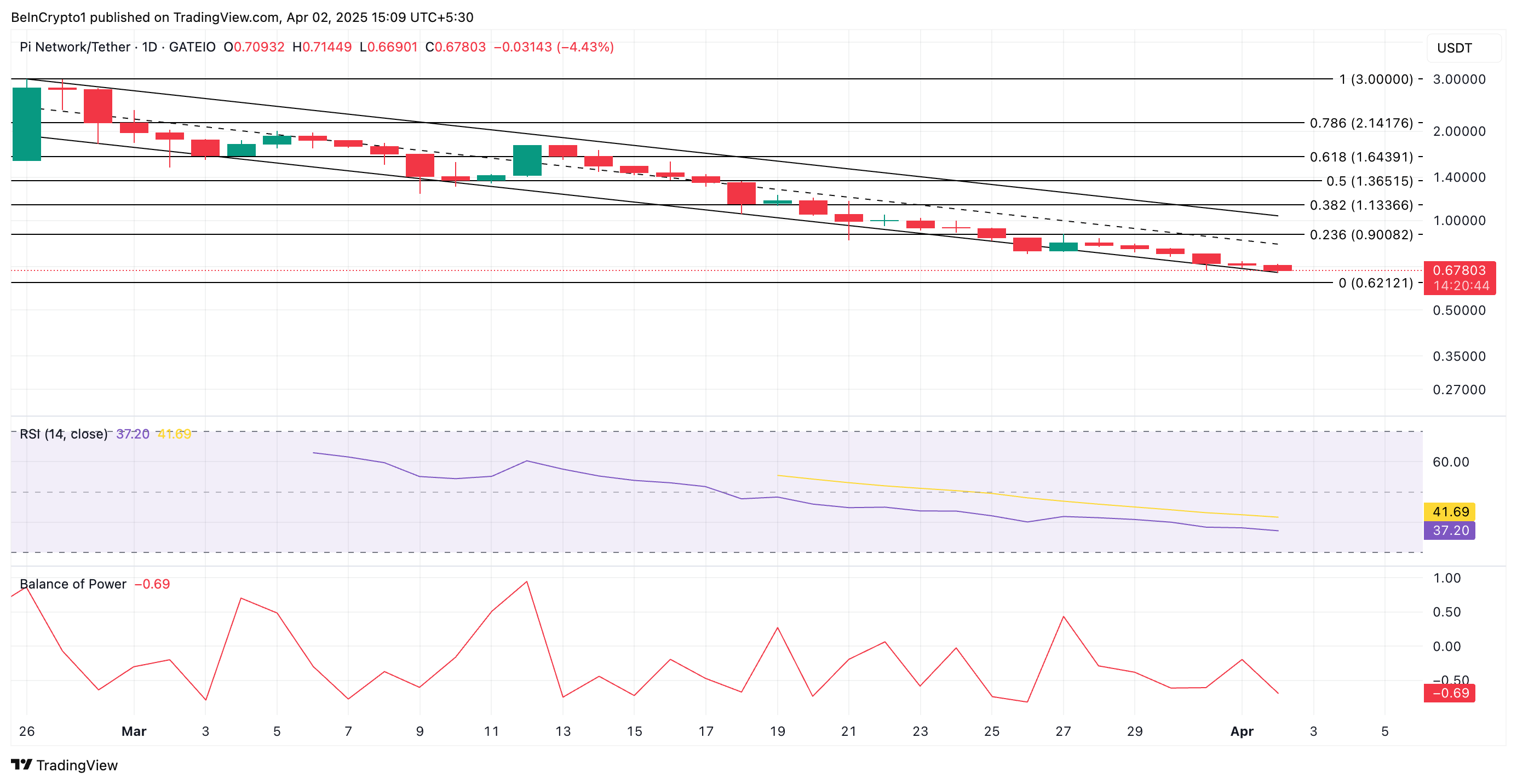
Readings from PI’s Relative Strength Index confirm the likelihood of a short-term rebound. At press time, this key momentum indicator is in a downtrend at 37.20. A drop below the 30 threshold would mean PI has become oversold and is due for a rebound.
Once seller exhaustion sets in, PI’s buying pressure gains momentum, triggering a short-term price rebound. In this case, its price could climb toward $0.90
On the other hand, its negative Balance of Power (BoP) reflects strong bearish pressure in the PI spot markets. This is currently at -0.69, indicating that bear power exceeds bull strength among PI investors.
 PI Price Analysis. Source:
TradingView
When an asset’s BoP is negative like this, sellers have more control over price action, suggesting a bearish trend and weakening buying pressure. If this persists, PI’s price could fall toward $0.62.
“There is still potential for recovery — if the network can address scalability issues, rebuild confidence, and demonstrate real utility for the token, sentiment could turn. Pi’s trajectory in April will depend on how well it can stabilize supply dynamics and re-engage its user base,” Kan noted.
Disclaimer: The content of this article solely reflects the author's opinion and does not represent the platform in any capacity. This article is not intended to serve as a reference for making investment decisions.
You may also like
Expanding computing power on one hand, grabbing spectrum on the other! Barclays optimistic about SpaceX (SPCX.US) acquiring T-Mobile: Complementary advantages of ground networks and Starlink
After Space's stock price rose for two consecutive days, Barclays stated that T-Mobile is the "cleanest" choice among SpaceX’s potential acquisition targets. Barclays considers Verizon a major unknown, while AT&T has the lowest strategic fit.
Will the Federal Reserve raise rates in December? Tonight's CPI will be the final verdict!
The October CPI data will be released tonight, with the market pricing in an 86% chance of a rate hike. Goldman Sachs predicts a core CPI month-on-month increase of only 0.16%, much lower than market expectations. However, statistical distortions in health insurance and declines in used car prices—these "soft factors"—are unlikely to be reflected in the core PCE, which the Federal Reserve places greater emphasis on. The data may trigger a relief rally, but it is unlikely to change the underlying hawkish sentiment.

A 14x PE is not a bargain! Renowned wealth management CEO warns: If Nvidia (NVDA.US) earnings are revised down by 5%, its stock price could drop by 40%.
Ritholtz Wealth Management CEO Josh Brown questioned the idea that a 14x P/E ratio is a bargain and issued a warning: "If Nvidia's earnings over the next 12 months are revised down by 5% from our expectations, the stock could potentially drop by 40%."
Citibank: US beer sales will not bottom out by 2026, non-alcoholic beer is the only clear long-term growth track
Beer shipments in the United States have declined for the fifth consecutive year and are set to fall below 1980 levels. Citibank: Only non-alcoholic beer still has long-term growth potential.

Crypto prices
More


