
XRP Could Unlock $1.5 Trillion in Liquidity for US, Proposal Claims

The document advocates classifying XRP as a payment asset rather than a security, urging regulatory changes and a presidential executive order to accelerate adoption.
A proposal suggesting XRP as a strategic financial asset has been submitted to the US Securities and Exchange Commission (SEC). The SEC often receives unsolicited proposals from individuals or entities, but these do not automatically lead to action.
The document outlines how the US could use XRP to unlock liquidity and potentially secure a substantial Bitcoin reserve.
XRP Suggested as Key Liquidity Tool For the US Crypto Reserve
The proposal’s author, Maximilian Staudinger, advocates for a structured approach to President Donald Trump’s crypto reserve initiative. Staudinger’s strategy places Bitcoin at the core of the US reserve while positioning Solana and Cardano within government applications.
He contends that while these blockchains enhance security and efficiency in state operations, XRP remains the key asset for financial transactions.
“Solana and Cardano should be integrated into US digital infrastructure, but not included in the reserve strategy. Instead, they enhance efficiency and security for state applications, while XRP remains the key asset for financial transactions,” Staudinger argued.
Considering this, Staudinger asserts that integrating XRP into the traditional financial system would release capital tied up in Nostro accounts. These accounts facilitate cross-border transactions and collectively hold $27 trillion worldwide.
He estimates that $5 trillion belongs to the US, with XRP potentially freeing up $1.5 trillion. This liquidity, he claims, could be redirected toward acquiring Bitcoin.
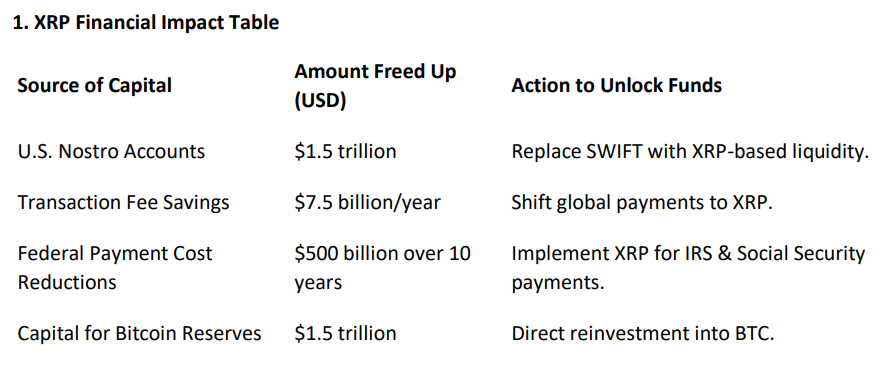 XRP’s Financial Impact as a Strategic Reserve Asset. Source:
Staudinger’s SEC Proposal
However, his suggestion that the US could secure 25 million BTC at a price of $60,000 per coin contradicts Bitcoin’s fixed 21 million supply cap.
Beyond liquidity, the proposal claims that shifting financial transactions to XRP could generate up to $7.5 billion in annual savings on transaction fees. It also suggests that XRP could streamline government payments, including IRS tax refunds and Social Security distributions
XRP’s Regulatory Uncertainty Poses Challenge
Despite its ambitious vision, the proposal acknowledges that XRP’s regulatory status remains a critical barrier.
Staudinger calls for the SEC to officially classify XRP as a payment asset rather than a security and urges a resolution in the agency’s ongoing legal battle with Ripple.
He also suggests that the Department of Justice (DOJ) lift restrictions preventing banks from utilizing XRP-based solutions. To fast-track adoption, he proposes a presidential executive order to override regulatory barriers.
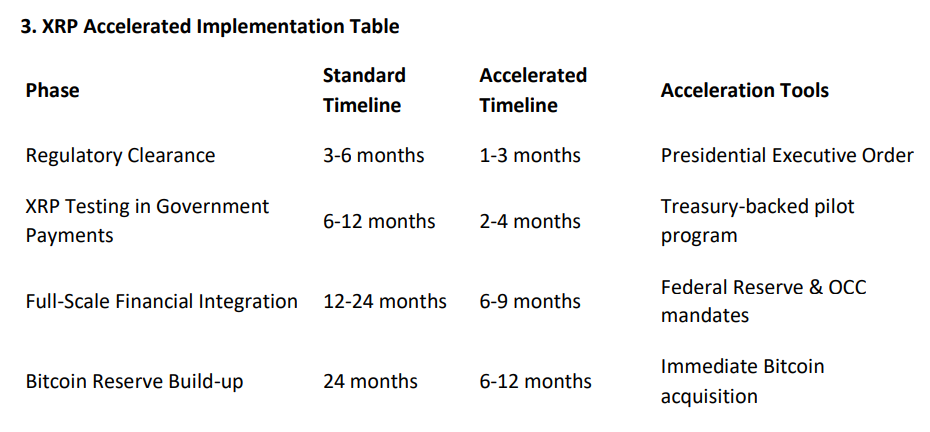 XRP’s Strategic Reserve Asset Implementation Timeline. Source:
Staudinger’s SEC Proposal
Meanwhile, the document outlines two potential timelines: a standard two-year implementation period and an expedited six- to twelve-month plan.
The latter would require immediate regulatory approvals, fast-tracked government XRP trials, and mandates for banks to integrate XRP as a liquidity tool.
It’s important to note that independent proposals, like Staudinger’s, generally have little weight unless backed by strong industry support or policy interest.
If a proposal comes from a major financial institution, regulatory body, or industry group, it is more likely to be reviewed seriously.
Disclaimer: The content of this article solely reflects the author's opinion and does not represent the platform in any capacity. This article is not intended to serve as a reference for making investment decisions.
You may also like
Morgan Stanley's "Memory Grim Reaper" Shawn Kim Issues Another Warning! The Real Bombshell Is the "2028 Earnings Cliff," Comprehensive Target Price Cuts for Memory Stocks
Shawn Kim has significantly lowered target prices for memory stocks, cutting SK Hynix's target price by 38% and Samsung Electronics' by 19%. He warns that the industry could face a "profit cliff" in 2028: new production capacity coming online at the end of 2027, data center construction delays, narrowing HBM premiums, and a roughly 20% drop in NAND spot prices over the past two weeks. With these four pressures combined, he has substantially reduced his long-term DRAM profit margin assumptions for both companies, bringing them closer to historical averages.

MARA Holdings (MARA.US) Q3 Earnings Call: Management Says Two AI/HPC Leasing Agreements Targeted for Signing This Year; Total Debt Reduced by 37% This Year
Bitcoin mining company MARA Holdings (MARA.US) released its Q3 2026 financial report. The report shows a rare split: while book profits have soared, operating income continues to shrink—indicating the company is at a critical juncture transitioning from "mining bitcoin" to "AI infrastructure."


Skydance (SKYD.US) Q3 Conference Call: Launching Paramount+ and HBO Max Bundle in Early 2027, Free Cash Flow Target of at Least $10 Billion by 2030
The streaming integration between Paramount and Warner now has a clear timeline. Skydance plans to launch a bundled package of Paramount+ and HBO Max in early 2027, aiming to unify the backend technology of both services within about a year.
Crypto prices
More


