
AI Agent Market Plunges 77%, but Could a Comeback Be Ahead?

AI agent tokens are facing a sharp market downturn, sparking concerns over long-term viability. Could innovation and investment fuel a comeback?
The artificial intelligence (AI) agents crypto sector is facing continued losses, with its total market capitalization dipping below $5 billion amid a broader decline.
The ongoing slump has raised concerns about the sector’s stability, sparking debate regarding its long-term potential.
AI Agents Face Major Market Slump
This downturn follows a period of rapid growth. The majority of the top AI agent tokens saw substantial gains, peaking between December and January. Nonetheless, that momentum has now reversed.
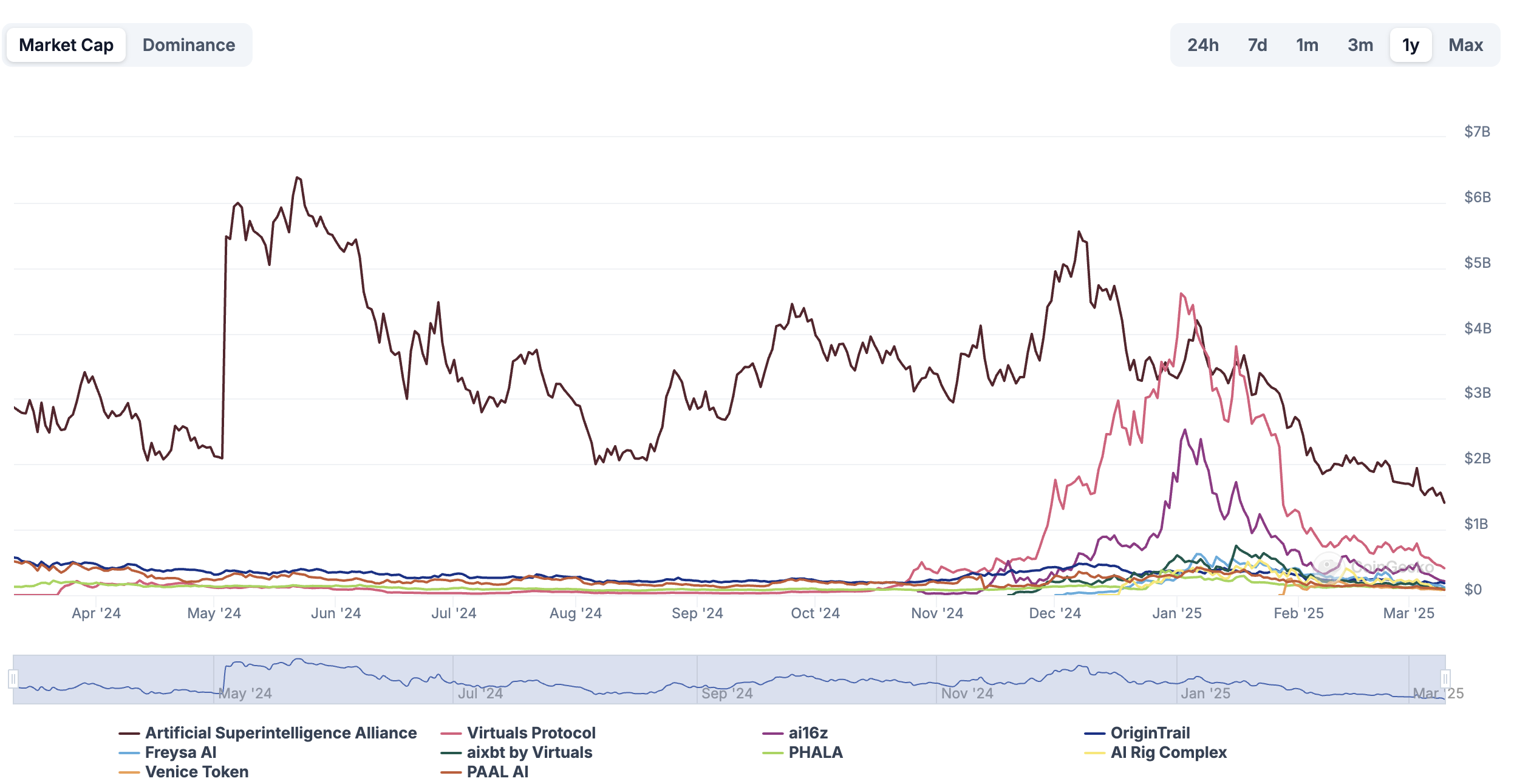 AI Agents Market Performance.
The decline has affected nearly all AI tokens, with most following a similar trajectory in the crypto market.
“The sector has declined 77.5% from its peak,” Whale Insider posted on X.
According to the latest data, the sector suffered a 6.8% loss in the past 24 hours alone, bringing its total market capitalization down to $4.4 billion. Additionally, all of the top 10 AI tokens have recorded double-digit losses over the past week, signaling a widespread correction.
Further insights from Cookie Fun reveal that the downturn is spread across multiple blockchains. Solana’s (SOL) AI Agents sector has seen a 4.3% decline over the past day. Its market capitalization stood at $1.1 billion.
Similarly, Base’s AI sector has dropped to $736.6 million, marking a 5.8% loss over the same period.
Other blockchain networks hosting AI-related tokens have been hit even harder, with their collective market cap shrinking to $722.2 million, down a staggering 15.2% in the last 24 hours.
The Future of AI Agents: Still a Game-Changer?
While the sector’s sharp decline has raised concerns about its long-term viability, Guy Turner, founder of Coin Bureau, argues that it is still too early to dismiss the potential of AI Agents.
“With the right catalyst, not only could it recover, but it could even surge to new heights,” Turner said.
He believes AI Agents could see renewed interest as AI technology advances, drawing fresh adoption. Turner pointed to retail engagement, regulatory clarity, and institutional investment as key growth drivers.
According to him, support from governments, tech firms, and financial institutions could legitimize the sector, shifting it from speculation to a major market force.
That’s not all. Turner also acknowledged the possibility of a meme coin resurgence acting as a short-term catalyst. While AI Agent tokens are sometimes dismissed as “meme coins with a chatbot attached,” he believes this perception oversimplifies their true potential.
“AI agents are clearly a disruptive force, and we don’t yet know exactly how much value they can provide but you can bet your bottom dollar that tech companies everywhere are going to do whatever it takes to find out,” he added.
Disclaimer: The content of this article solely reflects the author's opinion and does not represent the platform in any capacity. This article is not intended to serve as a reference for making investment decisions.
You may also like
After announcing its performance, AppLovin (APP.US), the leading player in "AI + digital advertising," surged 50%! Citigroup bets the rally isn't over, targeting $500 and new opportunities in e-commerce
While tech stocks faced sell-offs, AppLovin stood out by delivering profit-driven gains. On November 5, the Nasdaq 100 Index dropped 6.36% and the Philadelphia Semiconductor Index plunged 12.25%, yet AppLovin surged 31.04% after its earnings report. The stock continued to rise over the next two trading days, closing at $410 on November 9, marking an approximate 50.9% increase since its earnings announcement.

Confidence at Zero! Goldman Sachs Interprets Hedge Fund Positions: "Capitulation Liquidation," Largest Loss Since the Pandemic
Goldman Sachs' prime brokerage data reveals that hedge funds’ net leverage rate plummeted last week to the lowest percentile in five years, with the scale of deleveraging reaching the highest level since the March 2020 pandemic. The long-short ratio hit a five-year low. Tech stocks saw net selling of over $30 billion, far exceeding the turbulence in July. CTA quantitative strategies are expected to continue selling regardless of market movements in the coming week, with maximum selling pressure potentially reaching $48.7 billion. Currently, only mutual funds and corporate buybacks are providing counterflow liquidity, and a true market bottom may require further clearing of quantitative selling pressure.

New Zealand Dollar steadies as Iran talks fails to lift NZD/USD
Crypto prices
More


