
Tether Acquires Minority Stake in Juventus Football Club, Spiking Fan Token

Tether's Juventus stake fuels JUV token growth and signals a shift toward blockchain-powered sports investments amid regulatory challenges.
Tether acquired a minority stake in Juventus, a world-famous Italian football club, causing its JUV fan token to spike. Tether is investing in a team with a pre-existing Web3 presence, and it plans to bring more teams on-chain.
The company was recently ejected from the EU market due to stablecoin regulations, but it first took careful preparations to set up alternate revenue streams. This investment may be part of a similar strategy.
Tether Plays Hard with Juventus
Juventus FC is one of the world’s most popular football teams, and it’s been dabbling in Web3 sectors like crypto and NFTs for a few years now. In 2019, it launched the JUV fan token, and it also created a couple of NFT offerings. Tether’s CEO Paolo Ardoino announced today that it bought a minority stake in Juventus, furthering the team’s Web3 connection:
““Aligned with our strategic investment in Juve, Tether will be a pioneer in merging new technologies, such as digital assets, AI, and biotech, with the well-established sports industry to drive change globally. We will explore avenues for innovative collaborations and the potential to revolutionize the global sports landscape.” said Ardoino.
For world-famous football teams, a collaboration like this is fairly standard. In the last World Cup, Binance made a futures index for fan tokens and football-themed fan tokens like JUV have spiked all around the world. Juventus’ token has been inactive for several years, but it shot up today after the Tether announcement:
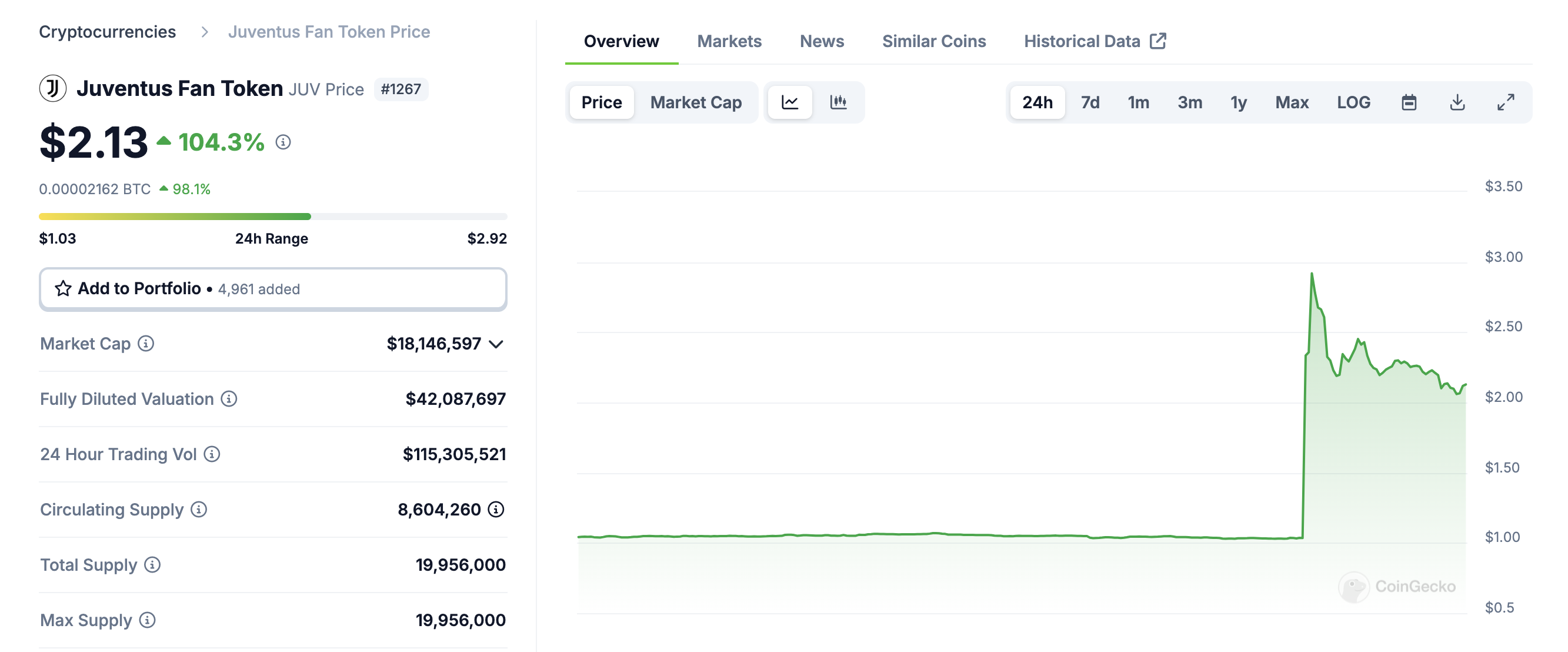 Juventus (JUV) Price Performance. Source:
CoinGecko.
A more pressing question is why Tether, the world’s leading stablecoin issuer, would substantially invest in Juventus in the first place. The firm has conducted international partnerships to bring value to completely different sectors, but it’s not shown much interest in a sports club like this. However, according to the announcement, this is going to change.
Technically, the firm indirectly invested in a Swiss football team last year. If that one is a small stepping stone, Juventus is the next step, as Tether plans to bring more sports organizations onto the blockchain in the future. This doesn’t just include tokenization or payment availability; Tether will leverage its research sectors like AI and biotech where it can.
Another clue could help explain why Tether is investing in Juventus. Last December, its stablecoin got kicked out of the EU due to MiCA regulations, but the firm’s bottom line stayed intact. Tether spent months preparing for this doomsday scenario, limiting EU operations and setting up new revenue streams. Juventus is a European team, so it also falls in this category.
Tether could afford to draw back operations in Europe, but it can’t afford to lose both it and the US in quick succession. Impending stablecoin regulations could have an apocalyptic impact on Tether, and US exchanges are already preparing to eject the firm if asked. In short, Juventus and other sporting opportunities may be another part of Tether’s doomsday preparation.
Disclaimer: The content of this article solely reflects the author's opinion and does not represent the platform in any capacity. This article is not intended to serve as a reference for making investment decisions.
You may also like
Overnight US stock market crash: A reflexivity storm triggered by a $100 billion “early exit”
A wave of $100 billion in mechanical selling pressure triggered a "head start" on Wall Street, but these early moves by smart money instead accelerated the sell-off: the Nasdaq fell 6.4% in a single day, semiconductors plunged 12%, and the “best of the year” AI and energy barbell trades collapsed within 48 hours. Even more dangerously, lagging selling pressure is still on its way. This reflexive storm demonstrates that when everyone knows the same script and acts on it simultaneously, the script itself stops working.
U.S. stocks plunge amid midterm election turbulence! Wall Street's bullish expectations dashed, short-term selling pressure may be hard to ease
For weeks, major Wall Street trading institutions have been saying that stock market gains would resume after the US midterm elections. However, Thursday's market performance brought a dramatic reversal to this prediction.
Bernstein Comments on Datadog (DDOG.US) Q3 Financial Report: Strong Performance but Guidance "Not Surprising", Lowers AI Business Revenue Expectations
Bernstein lowered Datadog's target price from $350 to $273, but maintained its "outperform" rating.
S&P evaporates 2.8 trillion in a single day, BTIG warns: This is not the bottom, the real sell-off has just begun
BTIG Chief Technical Strategist Krinsky warns that yesterday's sharp decline in the US stock market is not the bottom, but just the beginning. Nearly 70% of S&P 500 components are still trading above their 200-day moving average, and elevated breadth indicators suggest that the sell-off is far from over. If "defensive sectors" such as healthcare and consumer staples start to fall as well, the real "generals and soldiers falling together" will occur, and the S&P may head straight for 7000 points.
Crypto prices
More


