US Dollar Posts Its Biggest Weekly Gain Since September: How Can Traders Navigate Rising Fed Rate-Hike Expectations?
The US dollar has regained momentum as markets refocus on the outlook for US interest rates. Stronger-than-expected employment data and sticky consumer inflation have prompted investors to increase their bets on Federal Reserve rate hikes, pushing the US Dollar Index to a 19-month high.
For CFD traders, the key question is not simply whether the dollar will keep rising. It is: How much tightening is already priced in, and what new signals could drive further gains—or trigger a near-term pullback?
Dollar Gains 1.1% for the Week, Driven by Employment and Inflation
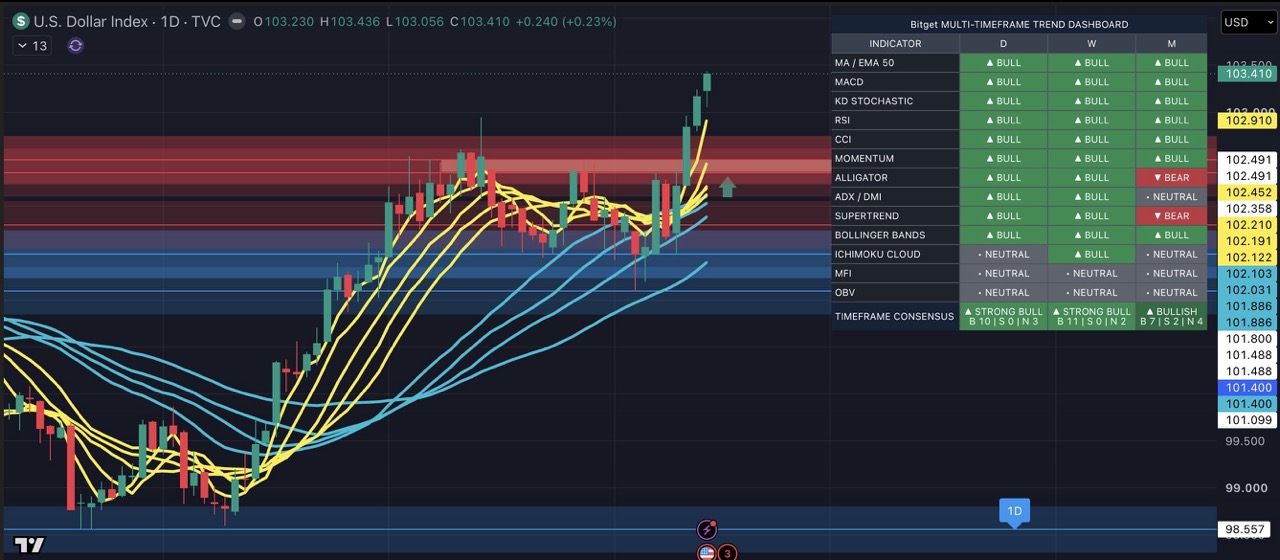
The US Dollar Index (DXY) rose 0.2% to 103.41 in late New York trading on Friday the 13th, reaching its highest level since April 2, 2025. The index gained 1.1% over the week, recording its strongest weekly performance since mid-September.
The rally began with a strong US employment report. October nonfarm payrolls increased by 165,000, well above the 65,000 expected, while employment figures for August and September were revised upward by a combined 84,000.
Labor-market resilience suggests the economy remains supported, reducing the urgency for the Fed to ease policy in response to economic weakness. Subsequent inflation figures further reinforced expectations of monetary tightening:
-
Headline CPI rose 0.4% month over month, above the 0.3% forecast.
-
Core CPI rose 0.3% month over month, exceeding expectations of 0.2%.
Although headline inflation slowed from the previous month, the pace of cooling fell short of market expectations. A strong labor market combined with persistent inflation can support the dollar through expectations of higher interest rates.
Hawkish Fed Signals Add Support, but a Rate Hike Is Not Guaranteed
The report cited hawkish comments from Fed Governor Christopher Waller, who said he would support a rate hike even if inflation came in below expectations. If the data proved hotter again, he suggested that a larger, 50-basis-point increase might be necessary.
According to the CME FedWatch figures cited in the report, markets assigned a probability of nearly 90% to a 25-basis-point increase in December, with approximately 10% odds of a 50-basis-point hike.
This suggests market pricing has shifted from “Will the Fed hike?” to “How large will the hike be?” However, market-implied probabilities are not a commitment from the Fed. Upcoming economic releases and policymakers’ comments could still reshape interest-rate expectations.
Higher expected interest rates generally enhance the relative appeal of dollar-denominated assets. However, exchange rates also depend on other central banks’ policies, risk sentiment, and capital flows—not solely on the Fed.
Why Has Cooling PPI Failed to Put the Brakes on Dollar Bulls?
October producer price data released on Friday showed a 0.3% monthly increase, below the 0.4% forecast and sharply lower than September’s 1.4% rise. This indicated some easing in producer-level price pressures.
Nevertheless, annual PPI inflation remained elevated at 6.5%, suggesting that inflationary pressures had not disappeared. The report also noted that food prices rose 1.3%, services prices increased for a fifth consecutive month, and transportation and warehousing costs climbed 2.0%.
The key concern is that inflation may be spreading beyond energy-price fluctuations into a broader range of economic sectors. A single month of softer PPI data may therefore be insufficient to reverse expectations of tight monetary policy, allowing interest-rate support for the dollar to persist.
CFD Trading Outlook: Focus on Surprises, Not Just Momentum
With the dollar already posting meaningful gains, traders need to distinguish between fresh bullish developments and positive news that markets have already priced in.
Scenario 1: Hotter Data Could Extend Dollar Strength
If upcoming employment and inflation figures continue to exceed expectations, or Fed officials support larger rate increases, markets could further raise their projected interest-rate path, supporting the dollar.
Forex traders can also monitor whether currency pairs such as EUR/USD and GBP/USD come under pressure. However, policy and economic developments in Europe and the UK remain important. A stronger dollar does not automatically mean every other currency will fall.
Scenario 2: An Expected Rate Hike Could Trigger Profit-Taking
When a rate hike is already heavily priced in, the Fed delivering that increase may not generate another dollar rally. If the accompanying policy statement or forward guidance is less hawkish than expected, the dollar could instead retreat.
Prices respond to the gap between expectations and reality—not just to headlines.
Scenario 3: Further Disinflation Could Put the Dollar Under Pressure
If upcoming inflation readings repeatedly undershoot forecasts, or employment momentum weakens, markets could scale back expectations for the size of rate hikes and how long rates will remain elevated, reducing support for the dollar.
Before entering a trade, consider defining an acceptable loss, controlling position size and leverage, and accounting for wider spreads and slippage around major economic releases. Stop-loss orders can help manage risk, but they do not guarantee execution at the specified price.
Navigating Dollar Volatility Starts With a Clear Trading Plan
The dollar’s latest rally reflects the combined effects of strong employment, sticky inflation, and hawkish policy expectations. Whether the trend continues will depend on whether new information exceeds the market’s already elevated expectations for rate hikes.
Ready to turn your dollar-market analysis into a trading plan? Visit Bitget CFD to explore the products available in your region, review fees and leverage rules, and participate according to your risk tolerance. Put risk management first as you assess trading opportunities.
All trading education provided by Bitget is for educational purposes only and should not be considered financial advice. The strategies and examples shared are for reference only and may not reflect actual market conditions. CFD trading involves significant risk, including the potential loss of capital. Past performance does not guarantee future results. Please conduct thorough research and ensure that you understand the risks involved. Bitget is not responsible for any trading decisions made by users.


- Dollar Gains 1.1% for the Week, Driven by Employment and Inflation
- Hawkish Fed Signals Add Support, but a Rate Hike Is Not Guaranteed
- Why Has Cooling PPI Failed to Put the Brakes on Dollar Bulls?
- CFD Trading Outlook: Focus on Surprises, Not Just Momentum
- Navigating Dollar Volatility Starts With a Clear Trading Plan