
Nonfarm Payrolls and Inflation Fuel Tightening Expectations: Focus on the Dollar, Key Gold Levels, and U.S. Equity Valuation Pressure
Weekly Market Overview
This week, market attention shifted from U.S. labor-market resilience to sticky inflation, prompting investors to reassess the Federal Reserve’s December policy path. The key trading question is not simply whether the Fed will raise rates, but how much is already priced in—and whether upcoming data will trigger further repricing.
According to the supplied material, U.S. nonfarm payrolls rose by 165,000 in October, exceeding expectations of 65,000, while the unemployment rate fell to 4.1%. Following the report, market-implied odds of a December rate hike of at least 25 basis points recovered to around 80%, lifting the dollar and U.S. Treasury yields.
The subsequent October CPI report showed headline prices rising 0.4% month over month and core prices increasing 0.3%, both above expectations. This fueled discussion of a possible 50-basis-point hike. However, the roughly 14% probability cited in the material does not make a 50-basis-point hike the base case. It also cannot be added directly to the probability of “at least a 25-basis-point hike” recorded at a different time.
Meanwhile, gold reclaimed $4,100 in the pre-CPI trading period described in the material. Whether the rebound can continue after the inflation release depends on the dollar, real yields, and overhead selling pressure.
Key Market Themes
1. Strong Payrolls Support the Dollar; Relative Rate Differentials Come Next
| Employment Indicator |
Result Cited in the Material |
| October nonfarm payroll growth |
165,000 versus 65,000 expected |
| September payroll growth |
Revised up to 60,000 |
| Unemployment rate |
Fell to 4.1% |
| Monthly wage growth |
0.4% versus 0.3% expected |
Stronger-than-expected employment reduces the urgency for the Fed to ease policy in response to economic weakness. It does not, however, guarantee a rate hike. Labor-force participation, hours worked, and subsequent revisions remain important.
DXY rose 0.77% to 102.26 on the day following the payroll release, while 2-year and 10-year Treasury yields climbed to 4.52% and 4.85%, respectively.
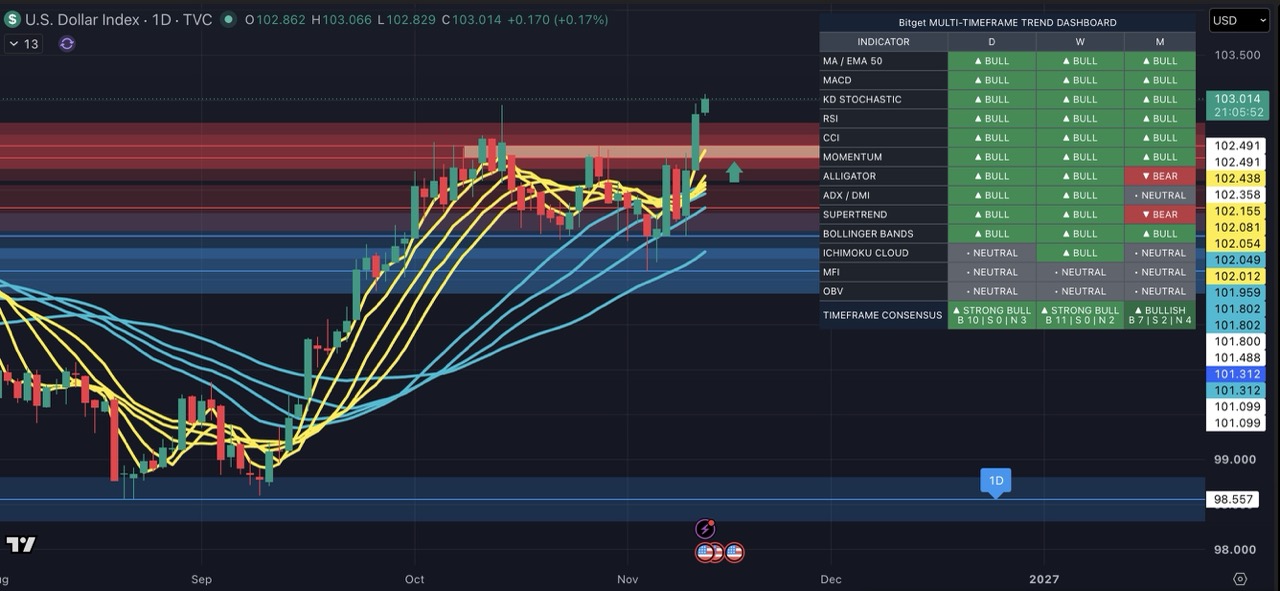
Whether the dollar can sustain its strength depends on the United States’ interest-rate and growth advantages relative to other economies. For EURUSD and GBPUSD, watch central-bank policy divergence. For USDJPY, monitor Bank of Japan signals and currency-intervention risk alongside the U.S.–Japan yield differential.
Markets and indicators to watch: DXY, EURUSD, GBPUSD, USDJPY, US02Y
2. An Upside CPI Surprise Does Not Guarantee a 50-Basis-Point Fed Hike
| Indicator |
Latest Monthly Change |
Market Expectation |
Previous Month |
| Headline CPI |
0.40% |
0.30% |
0.60% |
| Core CPI |
0.30% |
0.20% |
0.30% |
Slower headline CPI growth means prices are rising more slowly—not falling. Core CPI’s failure to cool as expected suggests that underlying price pressures remain sticky.
Key areas to monitor include:
-
Housing and services: Is inflation slowing enough to ease core price pressures?
-
Core goods: Are import costs, tariffs, and inventory changes continuing to push prices higher?
-
Household purchasing power: Are food and energy expenses crowding out discretionary spending?
Markets may be pricing “higher rates for longer,” a 25-basis-point hike, or more aggressive tightening. These are distinct scenarios. Conditional remarks from individual officials also do not represent a collective FOMC decision.
Markets and indicators to watch: DXY, US02Y, US10Y, XAUUSD, NAS100
3. Gold Reclaims $4,100, but the Rebound Still Needs Confirmation
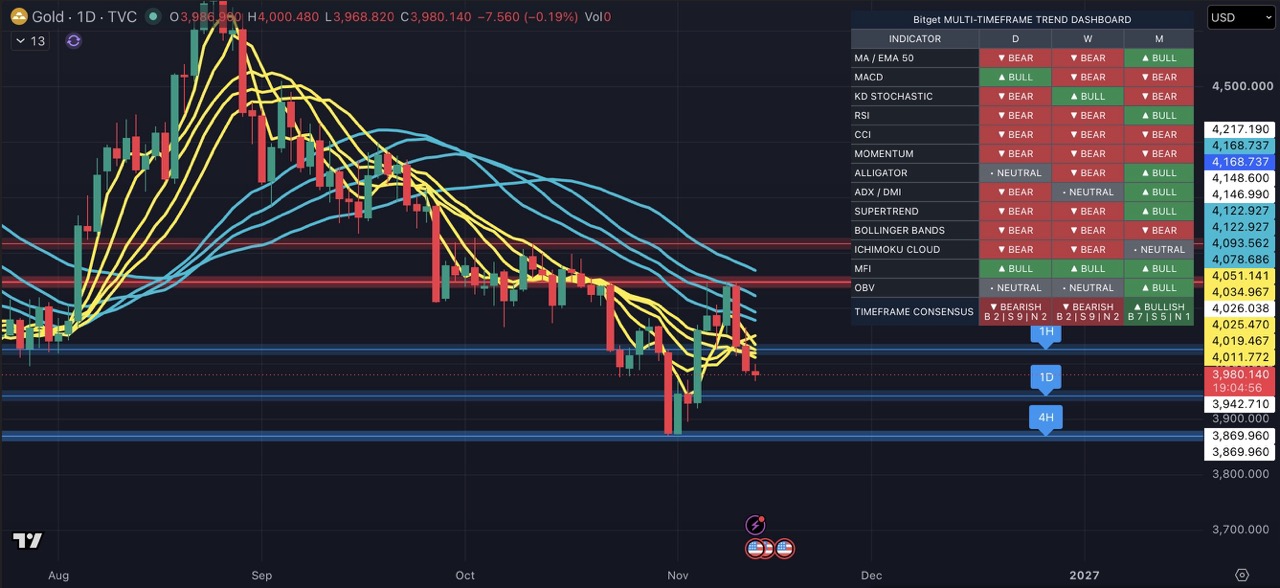
Pre-CPI price action showed gold gaining around 5% in the preceding week before reaching approximately $4,120. That rebound cannot simply be extrapolated into the post-CPI period.
Lower oil prices are not automatically bullish for gold. They may provide support if they ease tightening expectations and lower real yields. But if inflation expectations decline while nominal yields do not fall alongside them, real yields could rise instead.
| Price Zone |
Significance |
| $4,140 – $4,210 |
Major supply and resistance zone |
| $4,100 – $4,115 |
Near-term key pivot |
| $4,030 – $4,050 |
Intermediate support |
| $3,950 – $4,010 |
Major demand zone |
| $3,870 – $3,880 |
Recent swing-low zone |
-
Rebound continuation: If gold holds near $4,100 and establishes support above $4,140 – $4,150, watch $4,185 and $4,200 – $4,210. A break above the entire supply zone followed by a successful retest would provide a stronger continuation signal.
-
Rejection and pullback: If gold closes back below $4,100, watch $4,050 – $4,030 first, followed by the $4,010 – $3,950 demand zone.
Daily closes and subsequent follow-through are more informative than brief moves through a level immediately after a data release, but neither guarantees a valid breakout.
Markets and indicators to watch: XAUUSD, DXY, real yields
4. U.S. Equities Face a Dual Test of Valuations and Earnings
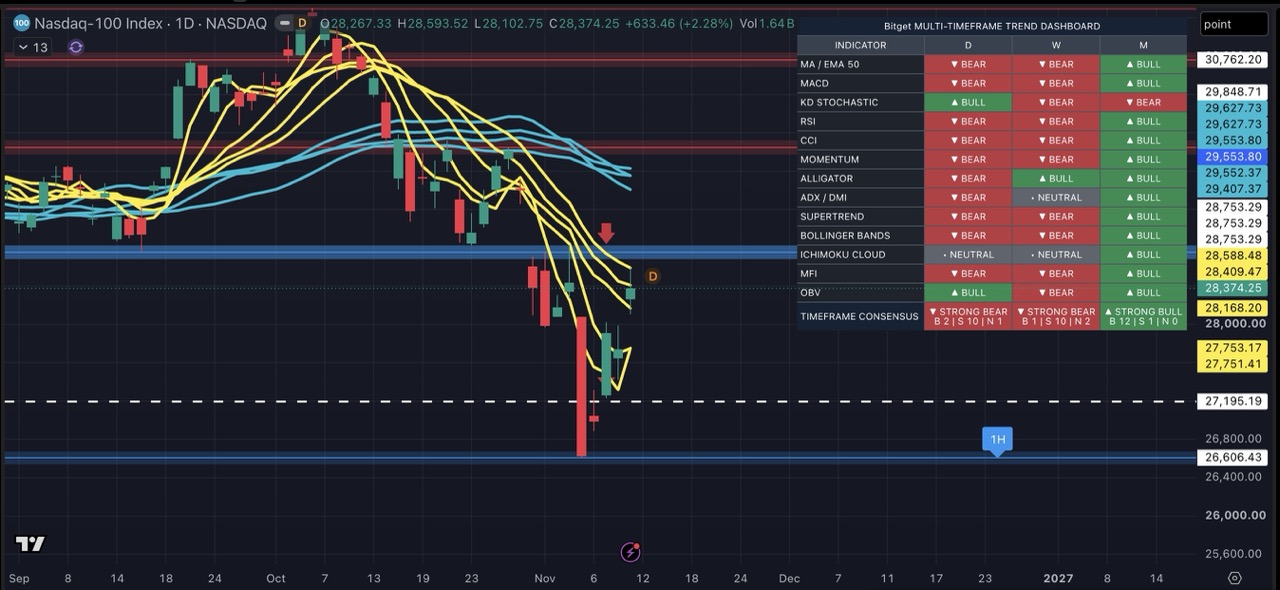
Strong employment supports consumption and revenue, but it may also prolong the high-rate environment. Elevated inflation can add to financing costs and margin pressure.
-
NAS100: Watch real interest rates, technology earnings, and returns on AI investment.
-
US500: Monitor whether earnings growth is broadening and market breadth is improving.
-
US30: Track economic resilience across industrials, financials, and domestically focused sectors.
AI regulatory concerns and a sharp technology-stock selloff. Specific policy developments still need to be verified, rather than attributing the entire decline to a single factor. A one-day rebound is also insufficient to confirm that a correction has ended.
Markets and indicators to watch: NAS100, US500, US30, US10Y
5. Why Oil Is Falling Matters More Than the Direction Alone
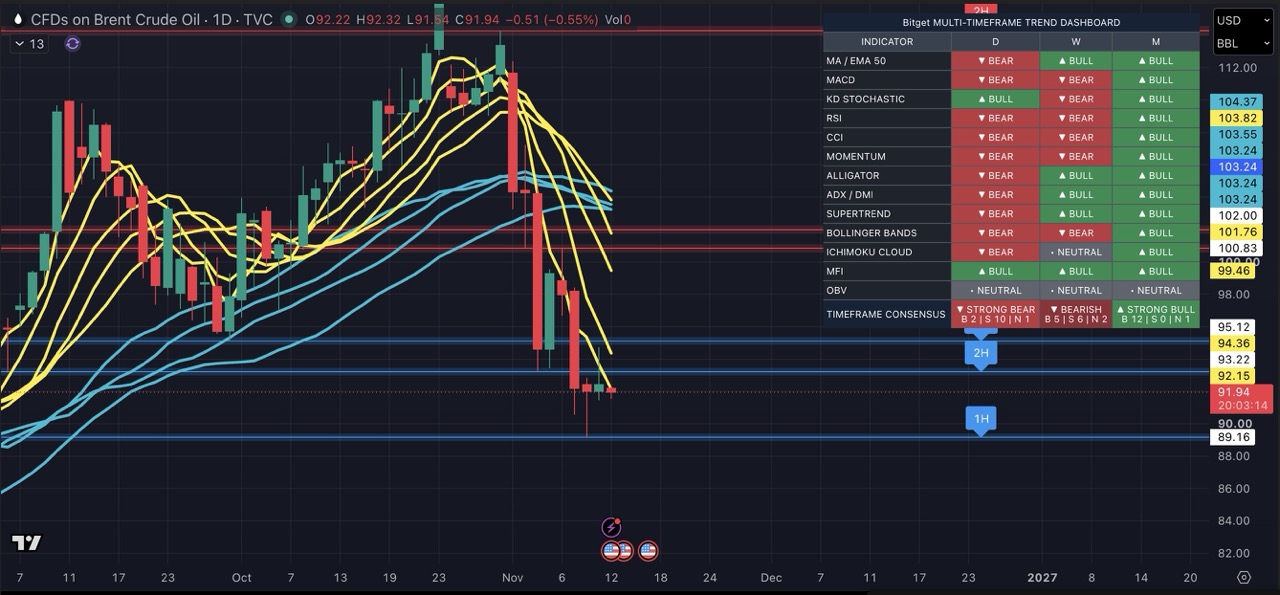
If oil prices fall because supply improves, inflation and corporate cost pressures may ease. If the decline reflects deteriorating demand, it may not benefit equities.
Geopolitical headlines should be assessed by distinguishing expectations of negotiations from implemented agreements, then checking them against exports, shipping activity, inventories, and OPEC+ policy. Even if energy inflation cools, housing and services inflation could keep the Fed’s policy stance restrictive.
Markets to watch: UKOUSD, USOUSD, DXY
Trading Framework for Major CFD Markets
| Market |
Potential Supportive Factors |
Main Risks / Confirmation Indicators |
| DXY |
Wider U.S. rate advantage; stronger tightening expectations |
Positive news already priced in; watch US02Y and central-bank policy divergence |
| EURUSD / GBPUSD |
Dollar weakness; relatively tighter local monetary policy |
Wider U.S. rate advantage; weaker local growth |
| USDJPY |
Wider U.S.–Japan yield differential |
A more hawkish BOJ, intervention, and carry-trade unwinding |
| XAUUSD |
Lower real rates, a weaker dollar, and safe-haven demand |
Watch $4,100 and the 4,140–4,210 zone |
| NAS100 |
Resilient technology earnings; easing rate pressure |
Valuation, regulatory, and AI investment-return concerns |
| US500 / US30 |
Labor-market resilience; broadening earnings growth |
Slower consumption, rising costs, and weakening market breadth |
| UKOUSD / USOUSD |
Tighter supply; improving demand |
Supply recovery and weak demand; track inventories and exports |
Key Focus Areas for the Week Ahead
1. Inflation persistence: Follow PPI, import prices, and subsequent PCE releases according to the official calendar. Avoid extrapolating directly from a single month’s data.
2. Persistence of Fed repricing: Verify officials’ original remarks and record the relevant FedWatch meeting date, data timestamp, and target-rate ranges.
3. Cross-asset confirmation: A simultaneous rise in the dollar and short-dated yields is more consistent with a tightening trade. If the dollar and gold rise together, examine safe-haven demand.
4. Validity of gold levels: If current prices have moved far from the zones in the material, reassess support and resistance.
5. Position correlation: Being long the dollar while short gold and technology stocks may concentrate exposure to the same policy risk.
Around data releases, monitor spreads, slippage, overnight financing charges, and margin buffers. Standard stop-loss orders do not guarantee execution at the specified price.
Weekly Conclusion
Labor-market resilience and sticky inflation increase the risk of tighter policy, but they do not mean the Fed has decided the size of a rate hike. Further dollar strength depends on relative rate differentials; gold’s rebound depends on real yields and key supply zones; and U.S. equities require confirmation from both valuations and earnings.
Three near-term scenarios are worth preparing for:
-
Tightening expectations rise: The dollar may benefit, while gold and richly valued technology stocks face pressure.
-
Data runs hot, but prices fail to follow through: Watch for expectations already being priced in and the risk of reversals.
-
Growth weakens and safe-haven demand increases: Yields may fall without benefiting equities, while the dollar and gold could rise together.
💡 The priority is not to chase the initial move, but to check whether expectations, prices, and fundamentals align—then size positions according to the loss you can afford to bear.
All trading education provided by Bitget is for educational purposes only and should not be considered financial advice. The strategies and examples shared are for reference only and may not reflect actual market conditions. CFD trading involves significant risk, including the potential loss of capital. Past performance does not guarantee future results. Please conduct thorough research and ensure that you understand the risks involved. Bitget is not responsible for any trading decisions made by users.


- Weekly Market Overview
- Key Market Themes
- Trading Framework for Major CFD Markets
- Key Focus Areas for the Week Ahead
- Weekly Conclusion