Circle Internet Group Stock Outlook 2026–2027: How to Trade CRCL on Bitget
Circle Internet Group (NYSE: CRCL) has become one of the most closely watched companies connecting traditional finance with the cryptocurrency industry. Best known as the issuer of USD Coin (USDC), Circle is building a broader financial infrastructure ecosystem around digital dollars, cross-border payments, institutional settlement, and blockchain technology. As stablecoins gain acceptance among banks, payment providers, and global businesses, Circle is positioning itself as a major player in the next phase of digital finance.
That expansion is already producing significant financial results. Circle reported $865 million in revenue and reserve income for the third quarter of 2026, up 17% year over year, while USDC on-chain transaction volume reached $13.9 trillion. However, CRCL stock has struggled despite growing institutional adoption. Shares closed at $62.20 on November 13, 2026, down 2.54% during the session and more than 55% below their May peak. Falling interest rates, increasing competition, and questions about recurring revenue have weighed on investor expectations.
Can Circle's USDC ecosystem, Arc blockchain, and expanding global payments network support stronger growth in 2027, or will lower reserve yields and rising competition continue pressuring its valuation? This article examines Circle's latest stock performance, financial results, growth drivers, analyst price targets, and major risks. It also explains how investors can trade CRCL on Bitget through Stock+, rCRCL tokenized stocks, perpetual futures, options, and other supported investment products.
Key Takeaways
-
Circle stock has experienced a substantial correction in 2026. CRCL closed at $62.20 on November 13, declining 2.54% during the session. Shares are down approximately 21.6% year to date and remain 55.6% below their 52-week high of $140.
-
Circle's Q3 2026 revenue increased 17% to $865 million. Net income reached $226 million, while adjusted EBITDA increased 85% to $317 million. However, $182 million of other revenue came from an ARC token presale, making revenue quality an important consideration.
-
USDC adoption, the GENIUS Act, and Circle's expanding payments network are major growth drivers. USDC on-chain transaction volume reached $13.9 trillion in Q3, while Circle Payments Network recorded $41.3 billion in annualized payment volume.
-
Wall Street remains optimistic but divided. Analysts have a Buy consensus and an average 12-month CRCL price target of $102.37, implying approximately 64.6% upside from the November 13 closing price. Interest rates, stablecoin competition, and regulatory developments remain major risks.
-
Bitget offers multiple ways to access Circle-related markets. Eligible users can buy CRCL shares through Stock+, trade rCRCL tokenized stocks and CRCLUSDT perpetual futures, and explore supported options, Stock Dual Investment, Auto-Invest+, UTA, Crypto Loans, and automated trading tools.
Circle Internet Group (CRCL) Stock Performance in 2026
Founded in 2013 and headquartered in New York, Circle Internet Group develops digital currency and blockchain-based financial infrastructure.
The company is best known for issuing USDC, a U.S. dollar-backed stablecoin designed to maintain a value of approximately $1.
Unlike Bitcoin or Ethereum, which experience significant market-price fluctuations, USDC is designed for payments, settlement, and transferring dollar-denominated value across blockchain networks.
Circle also issues EURC, a euro-backed stablecoin, and develops other financial products, including Circle Payments Network, Arc, and institutional blockchain services.
Its business model is closely connected to stablecoin adoption.
Circle earns a substantial portion of its revenue from interest and investment income generated by the reserve assets supporting USDC.
As more USDC enters circulation, Circle generally has more reserve assets generating income. However, profitability also depends on interest rates, distribution costs, and operating expenses.
This relationship makes Circle different from traditional software companies and crypto exchanges.
For investors, understanding USDC circulation and reserve yields is essential to evaluating CRCL stock.
CRCL Stock Price History: Why Has Circle Been Volatile in 2026?
Circle completed its initial public offering on June 5, 2025, listing on the New York Stock Exchange under the ticker CRCL.
The stock attracted substantial investor attention because of Circle's position in the growing stablecoin industry.
During 2026, regulatory developments, institutional partnerships, and expectations for stablecoin adoption continued influencing investor sentiment.
However, CRCL also became sensitive to changing interest-rate expectations.
The stock reached a 52-week low of $49.90 on February 5 before recovering during the spring.
Optimism surrounding digital-dollar adoption, payments infrastructure, and stablecoin regulations helped support the rally.
CRCL reached its 52-week high of $140 on May 12, 2026.
However, the stock subsequently reversed.
Investors became increasingly concerned about competition, future reserve income, and whether Circle could justify its valuation through recurring earnings growth.
By September 30, CRCL had declined to $82.17.
The weakness continued during October.
Shares closed at $89.71 on October 21 before falling to $79.99 on October 29 and $72.54 on October 30.
On November 4, Circle reported its third-quarter financial results.
Although the company delivered higher revenue and net income, its reserve income declined year over year, and USDC circulation was nearly unchanged compared with the previous year's quarter-end level.
The earnings report also revealed that a substantial portion of other revenue came from an ARC token presale.
Investors continued reassessing the sustainability of earnings growth.
CRCL fell to $69.48 on November 5 and declined further to $64.98 on November 10.
The stock rebounded 3.29% on November 11, closing at $67.12, but the recovery did not last.
Shares declined to $63.82 on November 12 and closed at $62.20 on November 13.
The recent correction illustrates an important distinction.
Stablecoin adoption can expand while Circle's stock struggles if reserve income, operating margins, or future earnings fall short of expectations.
For 2027, investors will need to evaluate both growth in the stablecoin economy and Circle's ability to capture that growth profitably.
Circle Internet Group (CRCL) Stock Performance Snapshot
| Metric |
Value |
| Company |
Circle Internet Group, Inc. |
| Stock ticker |
NYSE: CRCL |
| Closing price (November 13, 2026) |
$62.20 |
| Daily price change |
-2.54% |
| 52-week high |
$140.00 |
| 52-week low |
$49.90 |
| 2026 YTD price return |
Approximately -21.6% |
| Decline from 52-week high |
Approximately 55.6% |
| Market capitalization |
Approximately $16 billion |
| Analyst consensus |
Buy |
| Average 12-month analyst target |
$102.37 |
Sources: Stock Analysis CRCL, CRCL Historical Prices, and Circle Investor Relations. Figures reflect the November 13, 2026 regular U.S. trading session.
CRCL's recent price movements show the stock's downward trend.
| Date |
CRCL closing price |
Daily change |
| October 28, 2026 |
$81.71 |
+0.16% |
| October 29, 2026 |
$79.99 |
-2.11% |
| October 30, 2026 |
$72.54 |
-9.31% |
| November 2, 2026 |
$72.08 |
-0.63% |
| November 3, 2026 |
$75.22 |
+4.36% |
| November 4, 2026 |
$76.12 |
+1.20% |
| November 5, 2026 |
$69.48 |
-8.72% |
| November 6, 2026 |
$67.88 |
-2.30% |
| November 9, 2026 |
$67.56 |
-0.47% |
| November 10, 2026 |
$64.98 |
-3.82% |
| November 11, 2026 |
$67.12 |
+3.29% |
| November 12, 2026 |
$63.82 |
-4.92% |
| November 13, 2026 |
$62.20 |
-2.54% |
Source: CRCL Stock Price History.
Between October 28 and November 13, CRCL declined approximately 23.9%.
The correction suggests investors are becoming more cautious about stablecoin-related equities.
However, Circle's expanding network of institutional partnerships continues creating opportunities beyond its traditional reserve-income business.
Whether those opportunities can support a sustained stock recovery will depend on the company's financial execution in 2027.
Circle Q3 2026 Earnings: Revenue Rises 17%
On November 4, 2026, Circle released its third-quarter 2026 financial results.
The company reported total revenue and reserve income of approximately $865 million, increasing 17% year over year.
Net income from continuing operations reached $226 million, up 5%.
| Financial metric |
Q3 2026 result |
| Total revenue and reserve income |
$865 million |
| Revenue growth |
+17% YoY |
| Reserve income |
$658 million |
| Other revenue |
$207 million |
| Revenue less distribution costs |
$453 million |
| RLDC margin |
52% |
| Net income |
$226 million |
| Diluted EPS |
$0.84 |
| Adjusted EBITDA |
$317 million |
| Adjusted EBITDA growth |
+85% YoY |
Source: Circle Q3 2026 Financial Results.
The headline results appear strong.
Total revenue increased, distribution costs declined, and adjusted EBITDA grew substantially.
However, a closer examination reveals that different revenue sources performed very differently.
Reserve income declined 8% year over year, while other revenue increased sharply.
This distinction is important because Circle's traditional stablecoin business depends heavily on reserve income.
Why Circle's Reserve Income Declined Despite USDC Growth
Circle generates reserve income from assets held to back USDC.
These reserves are primarily invested in highly liquid, dollar-denominated assets under the applicable reserve framework.
The amount Circle earns depends on two important variables:
-
Average USDC circulation: More USDC generally means a larger reserve base.
-
Reserve yield: Higher interest rates generally increase the income earned on reserve assets.
During Q3 2026, average USDC circulation reached $73.3 billion, increasing 8% year over year.
However, Circle's reserve return rate declined to 3.5%, approximately 61 basis points below the previous year's level.
As a result, reserve income fell from approximately $711 million to $658 million.
The decline demonstrates how sensitive Circle's business is to U.S. interest rates.
Even if USDC circulation increases, lower reserve yields can offset the financial benefits.
For 2027, the Federal Reserve's interest-rate decisions could significantly influence Circle's earnings outlook.
ARC Token Presale Revenue: An Important Detail Behind Q3 Earnings
Another important development was Circle's other revenue.
The company reported $207 million in other revenue during Q3, compared with approximately $29 million a year earlier.
However, $182 million came from the ARC token presale.
This represented approximately 88% of the quarter's other revenue and about 21% of total reported revenue and reserve income.
The contribution also supported adjusted EBITDA growth.
This does not mean Circle's earnings growth was entirely dependent on the token presale.
Lower distribution costs also improved financial performance.
However, ARC token presale revenue should not automatically be treated as a recurring quarterly revenue stream.
Investors should distinguish reserve income, ongoing subscription and services revenue, payment-related activity, and revenue from token sales.
For 2027, one of Circle's key challenges will be demonstrating that Arc and its other new products can create sustainable revenue beyond initial token-related transactions.
USDC Circulation and Transaction Volume Continue Expanding
Circle's latest operating results provide a clearer picture of stablecoin adoption.
| USDC metric |
Q3 2026 |
YoY change |
| Quarter-end USDC circulation |
$73.9 billion |
Approximately 0% |
| Average USDC circulation |
$73.3 billion |
+8% |
| On-chain transaction volume |
$13.9 trillion |
+49% |
| USDC on platform |
$13.9 billion |
+36% |
| Meaningful USDC wallets |
7.3 million |
+16% |
| Stablecoin market share |
27% |
-1.83 percentage points |
Source: Circle Q3 2026 Results.
USDC on-chain transaction volume reached $13.9 trillion during the quarter.
This reflects substantial activity across cryptocurrency markets, decentralized finance, payments, and other blockchain applications.
However, quarter-end USDC circulation was approximately flat year over year.
Circle's stablecoin market share also declined by 1.83 percentage points.
These figures suggest that transaction activity is increasing faster than the total amount of USDC outstanding.
For investors, that creates an important question.
Can Circle convert growing USDC transaction activity into additional recurring revenue, even when circulation growth is slower?
Its payments network, institutional services, and Arc blockchain could become increasingly important in answering that question.
Circle's Full-Year 2026 Financial Guidance
Circle also provided updated operating guidance following its Q3 results.
| Metric |
Guidance |
| Multi-year USDC circulation growth target |
40% CAGR through the cycle |
| FY2026 other revenue |
310 million-330 million |
| FY2026 RLDC margin |
41.7%–43.7% |
| FY2026 adjusted operating expenses |
570 million-585 million |
Source: Circle Q3 2026 Earnings Release. The other-revenue guidance includes ARC token presale revenue.
Circle continues targeting strong multi-year USDC circulation growth.
However, the 40% compound annual growth rate is a management expectation across a longer period, not a guaranteed annual increase in 2027.
Actual results will depend on market conditions, interest rates, competition, and institutional adoption.
Circle Stock Outlook 2026–2027: Key Growth Drivers
Circle's long-term opportunities extend beyond earning interest on USDC reserves.
The company is building a broader infrastructure ecosystem around digital currencies, payments, blockchain settlement, and institutional financial services.
Several developments could shape its performance in 2027.
1. USDC Adoption Could Support Long-Term Revenue Growth
USDC remains Circle's most important product.
The stablecoin is widely used across centralized cryptocurrency exchanges, decentralized finance platforms, payment networks, and institutional blockchain applications.
Unlike traditional bank transfers, stablecoin transactions can operate across supported blockchain networks without relying on conventional banking hours.
This makes USDC useful for cross-border payments, trading settlement, digital asset transfers, and programmable financial applications.
As more businesses adopt stablecoins, demand for regulated digital-dollar infrastructure could increase.
For example, an international company may use USDC to transfer funds between subsidiaries or settle payments with overseas partners.
A financial institution may use USDC to facilitate digital asset transactions or settlement.
In both cases, stablecoin adoption could increase demand for Circle's infrastructure.
However, higher transaction volume does not necessarily mean higher USDC circulation.
Stablecoins can move between users many times without increasing the total supply.
For Circle's reserve-income business, the amount of USDC outstanding remains particularly important.
For 2027, investors should monitor both circulation growth and transaction activity.
2. The GENIUS Act Could Accelerate Institutional Stablecoin Adoption
One of the most important developments for Circle is the evolving U.S. regulatory framework for payment stablecoins.
The GENIUS Act, enacted on July 18, 2025, establishes a federal framework for payment stablecoin activities.
On October 21, 2026, the Office of the Comptroller of the Currency issued its final implementing rule.
The rule takes effect on January 18, 2027.
The framework introduces requirements covering reserve assets, redemption, risk management, reporting, custody, and issuer supervision.
For Circle, clearer regulation could create opportunities.
Banks, payment providers, and institutional investors may become more comfortable integrating regulated stablecoins into their operations.
Circle's existing infrastructure and compliance capabilities could support its competitive position.
However, regulation also creates additional costs and competition.
Banks and other licensed financial institutions may enter the stablecoin market with their own products.
The GENIUS Act therefore creates both growth opportunities and competitive challenges.
For 2027, investors should monitor how the new framework affects USDC adoption, issuer approvals, and Circle's operating expenses.
3. Circle Payments Network Is Expanding Into Global Payments
Circle is increasingly focused on using USDC for real-world payments.
Its Circle Payments Network (CPN) is designed to connect financial institutions, payment providers, and businesses through blockchain-based settlement infrastructure.
During Q3 2026, CPN reached approximately $41.3 billion in annualized total payment volume.
This is an annualized activity measure, not the amount of payments completed during the quarter.
The network is intended to support cross-border transactions, payment settlement, and transfers between digital and traditional financial systems.
For example, a payment company may use stablecoins to move funds internationally and then deliver local currency to recipients through connected financial institutions.
Such infrastructure could potentially reduce settlement delays and improve payment flexibility.
However, transaction volume is not equivalent to revenue.
Circle must develop commercial arrangements that generate sustainable fees or other recurring income from network activity.
For investors, CPN's long-term value will depend on payment volume, customer adoption, economics, and profitability.
4. Circle's Tazapay Acquisition Could Strengthen Cross-Border Payments
Circle also announced a definitive agreement to acquire Tazapay, a Singapore-based cross-border payments company.
According to Circle's Q3 earnings announcement, Tazapay processes more than $25 billion in annualized payment volume.
It also has relationships with more than 60 banking and fintech partners and local payment capabilities across over 100 markets.
Approximately 60% of its transaction volume already involves stablecoins.
The acquisition could help Circle expand its payment infrastructure across Asia-Pacific, Latin America, and other emerging markets.
For example, Circle may be able to combine USDC settlement with Tazapay's local payment relationships to support additional business transactions.
This could improve the reach of Circle Payments Network.
However, the acquisition has not yet closed.
Circle expects the transaction to complete in 2027, subject to regulatory approvals and other conditions.
The financial benefits will depend on successful integration, customer adoption, and transaction economics.
5. Arc Blockchain Could Expand Circle Beyond Stablecoin Issuance
Another major development is Arc, Circle's blockchain network designed for financial applications and on-chain economic activity.
Circle launched the Arc public mainnet on September 16, 2026.
The network attracted more than 100 institutional and ecosystem builders at launch.
Arc is designed to support stablecoin-based payments, financial applications, institutional settlement, and programmable transactions.
The network integrates USDC and is intended to provide infrastructure suitable for financial institutions and developers.
Circle also completed the genesis mint of ARC, with an initial supply of 10 billion tokens.
The token is intended to support network coordination, security, utility, and governance as Arc evolves toward proof of stake in 2027.
For Circle, Arc could create additional opportunities beyond reserve income.
The company may benefit from wider USDC adoption, network services, developer activity, and related financial infrastructure.
However, investors should distinguish between three different assets:
-
CRCL: Shares of Circle Internet Group listed on the NYSE.
-
USDC: A dollar-backed stablecoin issued within Circle's digital currency infrastructure.
-
ARC: A separate blockchain network token associated with Arc.
Holding ARC or USDC does not represent ownership of Circle shares.
Likewise, owning CRCL stock does not automatically give investors rights to ARC tokens.
For 2027, Arc adoption and the transition toward proof of stake will be important developments to monitor.
6. Partnerships With Visa, Samsung, and Binance Could Expand USDC Distribution
Circle continues developing partnerships with technology companies, payment providers, and financial institutions.
Several developments announced during Q3 demonstrate this strategy.
-
Visa: Visa expanded its Visa Direct stablecoin-prefunding service from pilots to commercial deployment. The initiative allows eligible clients to use USDC to support cross-border payouts.
-
Samsung Wallet: Eligible Galaxy users in the United States can use USDC-powered services to send money to qualifying bank accounts in more than 60 countries.
-
Binance: Binance announced a $100 million equity investment in Circle alongside an expanded strategic partnership designed to increase USDC adoption.
-
Volante Technologies: Circle partnered with Volante to help financial institutions integrate stablecoin payments and settlement into existing operations.
-
Tereina: Circle announced an integration involving USDC and EURC within enterprise payment workflows connected to the SAP ecosystem.
These partnerships could expand Circle's reach beyond cryptocurrency trading.
However, the financial benefits will depend on adoption, commercial arrangements, and transaction economics.
For investors, partnership announcements are useful indicators of market interest, but actual revenue contributions matter more.
7. EURC and Institutional Digital Assets Provide Additional Opportunities
Circle's ecosystem also includes EURC, a euro-backed stablecoin.
While USDC remains its main product, EURC provides exposure to demand for euro-denominated digital settlement.
This could become increasingly relevant as European financial institutions adopt blockchain-based payment infrastructure.
Circle also offers digital asset and institutional services, including USYC, a tokenized money-market fund product.
These products support Circle's broader strategy of bringing traditional financial instruments and settlement activities onto blockchain networks.
The opportunity extends beyond stablecoin issuance.
For example, financial institutions may use tokenized assets for treasury management, settlement, or collateral operations.
However, the economics of these products differ.
Tokenized fund assets, stablecoins, and payment services do not necessarily generate the same revenue or margin characteristics.
For 2027, investors should monitor how these businesses contribute to Circle's financial performance.
8. AI Agents and Programmable Payments Could Create New Use Cases
Artificial intelligence may also create opportunities for blockchain-based payments.
As AI agents become capable of performing commercial tasks, some applications may require automated payment and settlement capabilities.
For example, an AI system could pay for cloud services, software access, or digital resources through predefined rules.
Stablecoins could provide one way to transfer value between these systems.
Circle is developing infrastructure intended to support programmable financial applications and automated transactions.
Arc and Circle's stablecoin services could play a role in this market.
However, AI-agent payments remain an emerging use case.
Investors should avoid assuming that widespread adoption is guaranteed.
The financial contribution will depend on technological development, security, regulation, and real-world customer demand.
What Are the Biggest Risks for Circle Stock in 2027?
Circle has significant long-term opportunities, but its business remains exposed to several important risks.
1. Lower Interest Rates Could Continue Pressuring Reserve Income
Circle's financial performance is highly sensitive to interest rates.
The company earns substantial income from the assets backing USDC.
When short-term U.S. interest rates decline, the yield on reserve assets can fall.
This reduces the amount Circle earns from a given level of USDC circulation.
During Q3 2026, reserve income declined 8% despite average USDC circulation increasing 8%.
If interest rates continue falling in 2027, Circle may need stronger circulation growth or additional revenue sources to offset lower reserve yields.
Investors should monitor Federal Reserve policy and Circle's reported reserve return rate.
2. Competition From Tether and Traditional Financial Institutions
Circle operates in an increasingly competitive stablecoin market.
Tether's USDT remains a major competitor, particularly in cryptocurrency trading and international digital asset markets.
At the same time, traditional financial institutions are developing stablecoin products and blockchain-based payment services.
The GENIUS Act could encourage additional regulated issuers to enter the market.
Competition may affect Circle's market share, distribution costs, and commercial relationships.
Circle reported a 27% share of the relevant fiat-backed stablecoin market at the end of Q3 2026, down 1.83 percentage points year over year.
Maintaining USDC's competitive position will therefore remain important.
3. Distribution Costs Could Limit Profitability
Circle relies on partners to help distribute USDC and expand adoption.
These arrangements may involve revenue sharing and other commercial payments.
For example, some exchanges and distribution partners receive compensation linked to USDC balances or related business activity.
During Q3, Circle reported approximately $412 million in distribution, transaction, and other costs.
Although these costs declined year over year, they remain substantial relative to total revenue.
For investors, USDC circulation growth is only part of the story.
The amount Circle retains after distribution costs is equally important.
4. Revenue From Arc and New Products May Be Uneven
Circle is expanding into blockchain infrastructure and payment services.
However, these products are at different stages of commercialization.
The ARC token presale contributed $182 million to Q3 other revenue.
That makes reported earnings sensitive to revenue sources that may not repeat every quarter.
Likewise, payment network volume does not automatically translate into recurring fee income.
For 2027, Circle must demonstrate that its new businesses can generate sustainable revenue beyond initial launches and transactions.
5. Stablecoin Regulation Creates Costs and New Responsibilities
Regulatory clarity can support adoption, but it also increases operational requirements.
Circle must comply with applicable rules covering reserve management, redemptions, financial reporting, anti-money laundering, and other obligations.
Different jurisdictions may impose different requirements.
Changes in stablecoin laws could affect Circle's products, partnerships, and international expansion.
For investors, regulatory compliance remains both a competitive advantage and an ongoing financial responsibility.
6. Cybersecurity, Reserve, and Depegging Risks
Stablecoin issuers face operational and financial risks that differ from those of traditional software businesses.
These include cybersecurity incidents, failures involving banking partners or custody providers, blockchain vulnerabilities, and disruptions to redemption systems.
USDC is designed to maintain a value near $1, but market prices may deviate from that level during periods of stress.
Loss of confidence could lead to substantial redemption requests.
Circle's reputation and financial performance depend heavily on maintaining confidence in USDC's backing and redemption arrangements.
7. CRCL Valuation Remains Sensitive to Growth Expectations
CRCL has already experienced substantial price volatility since its public listing.
The stock's valuation depends partly on expectations for future stablecoin adoption and new financial infrastructure businesses.
However, investor enthusiasm may change quickly if financial performance disappoints.
Even strong growth in payment activity may not support a higher valuation if reserve income falls or operating costs rise.
For 2027, Circle must demonstrate that adoption translates into durable earnings growth.
Circle Internet Group (CRCL) Stock Price Prediction for 2026–2027
Wall Street analysts remain broadly optimistic about Circle's long-term opportunities, although expectations vary significantly.
According to Stock Analysis, using S&P Global analyst data, 29 analysts covering CRCL have a Buy consensus.
The average 12-month price target is $102.37.
Circle Internet Group Analyst Price Targets
| Analyst metric |
Value |
| Lowest price target |
$34 |
| Average price target |
$102.37 |
| Median price target |
$100 |
| Highest price target |
$243 |
| November 13 closing price |
$62.20 |
| Implied upside to average target |
Approximately 64.6% |
| Analyst consensus |
Buy |
Source: CRCL Stock Forecast, checked November 2026. These are rolling 12-month analyst targets, not guaranteed prices for December 2027.
The average target suggests analysts see significant recovery potential from CRCL's recent correction.
However, the range of forecasts is unusually wide.
The lowest target of $34 reflects a cautious outlook, while the highest target of $243 assumes much stronger financial performance and valuation.
The difference reflects uncertainty surrounding Circle's long-term earnings model.
Recent Wall Street Analyst Price Targets
Several analysts updated their CRCL forecasts following the company's November earnings report.
| Analyst firm |
Price target |
Rating |
| Monness |
$175 |
Buy |
| Bernstein |
$145 |
Buy |
| TD Cowen |
$87 |
Buy |
| Mizuho Securities |
$46 |
Sell |
| Morgan Stanley |
$34 |
Sell |
Source: Circle Analyst Ratings. Analyst targets and recommendations may change.
On November 12, Monness reiterated its $175 price target.
Meanwhile, Mizuho raised its target from $43 to $46 while maintaining a negative recommendation.
TD Cowen lowered its target from $92 to $87 but maintained a Buy rating.
Morgan Stanley maintained its $34 target.
These differences show that analysts have very different expectations for Circle's future profitability.
Optimistic analysts emphasize stablecoin adoption, institutional payments, and the company's expanding infrastructure ecosystem.
More cautious analysts focus on reserve-income sensitivity, competition, and the economics of new products.
CRCL Stock Outlook: Bull, Base, and Bear Scenarios for 2027
Rather than relying on one exact stock price prediction, investors can consider three possible scenarios.
| Scenario |
Key assumptions |
Potential stock impact |
| Bull case |
USDC circulation accelerates, payment revenue grows, and new products gain traction |
CRCL could recover toward higher analyst targets |
| Base case |
Stablecoin adoption expands, but lower reserve yields offset part of the growth |
Gradual recovery with continued volatility |
| Bear case |
USDC market share weakens, interest rates decline, and competition increases |
Earnings expectations and valuation could fall further |
-
Bull case: The GENIUS Act encourages broader institutional stablecoin adoption, USDC circulation accelerates, and Circle Payments Network gains additional commercial customers. Arc develops a stronger ecosystem, while new services generate recurring revenue. Investors become more confident in Circle's earnings outlook.
-
Base case: USDC adoption continues expanding, but reserve yields remain under pressure. Payments and blockchain services contribute additional activity, although their revenue impact develops gradually. CRCL experiences moderate recovery with periods of volatility.
-
Bear case: Lower interest rates reduce reserve income, competing stablecoins gain market share, and newer products struggle to generate sufficient recurring revenue. Earnings expectations decline, placing additional pressure on CRCL's valuation.
These scenarios are illustrative and should not be treated as guaranteed stock prices.
Circle's 2027 Revenue and Earnings Forecast
Wall Street also expects Circle's business to expand during 2027.
Stock Analysis currently reports an average 2026 revenue forecast of approximately $3.0 billion and a 2027 forecast of around $3.72 billion.
This implies revenue growth of approximately 24%.
Analysts also project adjusted EPS increasing from approximately $1.20 in 2026 to $1.42 in 2027.
These are consensus estimates, not management guarantees.
They may change following interest-rate decisions, USDC circulation developments, regulatory changes, and quarterly earnings.
Should You Buy CRCL Stock in 2026 or Wait Until 2027?
Circle offers exposure to the growth of stablecoins and blockchain-based financial infrastructure.
Its expanding payments network, institutional partnerships, and regulatory positioning provide long-term opportunities.
However, the company remains sensitive to reserve yields and competition.
CRCL's recent decline may attract investors looking for exposure to digital finance at a lower valuation than earlier in 2026.
Others may prefer to monitor additional earnings reports, USDC circulation, and the impact of the GENIUS Act before increasing exposure.
Active traders may focus on Federal Reserve decisions, regulatory announcements, earnings releases, and developments involving USDC adoption.
For investors interested in Circle-related markets, Bitget provides several products designed for different investment and trading strategies.
How to Trade Circle Internet Group (CRCL) on Bitget
Circle's position in stablecoins, digital payments, and blockchain infrastructure makes it relevant to both traditional equity investors and cryptocurrency traders.
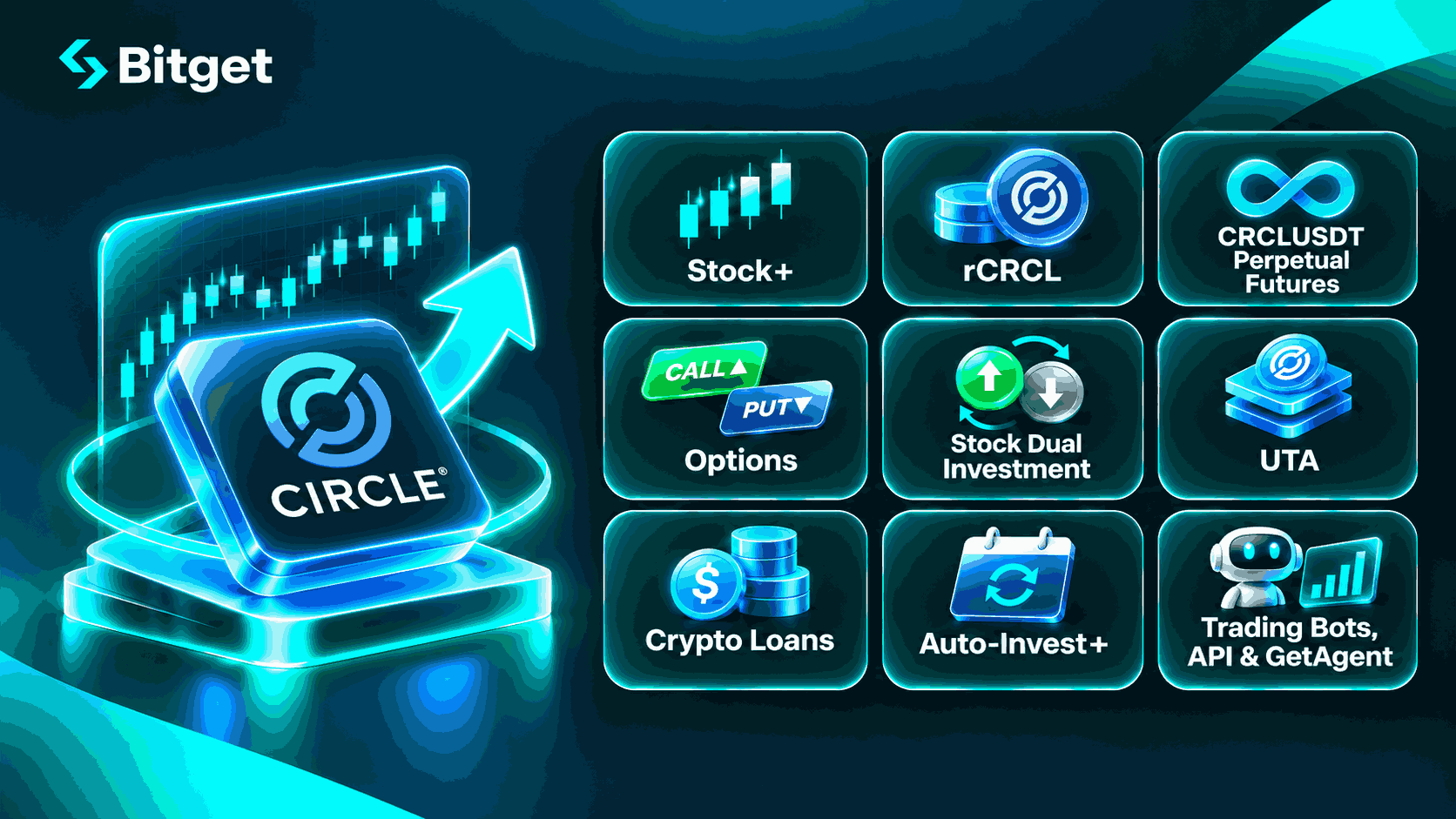
Bitget offers several ways to access CRCL-related markets, including brokerage-based U.S. stock trading, Reality-issued tokenized stocks, perpetual futures, and stock options.
Eligible users can also explore structured investment strategies, recurring purchases, margin collateral, borrowing services, and automated trading tools.
1. Buy Real Circle Internet Group (CRCL) Shares With Bitget Stock+
Bitget Stock+ allows eligible users to access real U.S.-listed stocks and ETFs through brokerage and custody partners.
Circle Internet Group trades on the New York Stock Exchange under the ticker CRCL.
For investors seeking conventional equity ownership, Stock+ provides an alternative to managing a separate traditional brokerage account.
Key features include:
-
Access to more than 10,000 supported U.S. stocks and ETFs.
-
Brokerage-based ownership of eligible securities.
-
Fractional trading starting from 0.0001 shares where supported.
-
USDC funding with USD-denominated stock transactions.
-
Pre-market, regular, after-hours, and supported overnight sessions.
-
No management fees, with applicable transaction charges.
-
Real-time market data and advanced order tools.
-
Eligible shareholder rights and corporate-action processing.
For example, an investor who believes USDC adoption and Circle's payments business will support long-term earnings growth could purchase CRCL shares through Stock+, where available.
Fractional trading may also allow users to build positions gradually rather than committing the full amount at once.
Unlike leveraged derivatives, direct stock purchases do not automatically create a leveraged trading position.
However, investors remain exposed to changes in CRCL's share price.
Availability depends on account eligibility, jurisdiction, and the supported securities list.
Explore CRCL Stock Trading With Bitget Stock+
2. Trade Circle Tokenized Stock (rCRCL) on Bitget
For investors who prefer using cryptocurrency, Bitget rCRCL/USDT Spot Trading offers another way to access Circle-related market movements.
rCRCL is a tokenized stock issued by Reality and designed to provide economic exposure to underlying Circle shares.
The framework uses brokerage and custody arrangements intended to maintain 1:1 backing by the underlying securities.
Eligible users can trade rCRCL using USDT.
Key features include:
-
1:1 underlying stock backing under the Reality tokenization framework.
-
Fractional tokenized stock trading.
-
USDT-denominated trading and settlement.
-
Supported 24/7 trading.
-
Access to U.S. stock market liquidity during supported sessions.
-
Corporate-action adjustments under applicable token rules.
-
Integration with selected Bitget investment and collateral products.
-
Reserve-verification arrangements under the rToken framework.
For example, an investor holding 500 USDT who expects Circle's payments business to expand could use part of those funds to purchase rCRCL.
The position can then be monitored alongside cryptocurrencies and other tokenized stocks within Bitget.
This may appeal to users who prefer managing crypto and stock-linked exposure on one platform.
However, rCRCL is not the same as directly owning registered CRCL shares.
Token holders do not receive conventional shareholder voting rights.
Token prices and liquidity may also differ from the underlying shares, especially outside regular U.S. market hours.
Circle does not currently pay regular cash dividends, so investors should not assume that holding rCRCL generates dividend income.
3. Trade CRCLUSDT Perpetual Futures on Bitget
For active traders, Bitget CRCLUSDT Perpetual Futures provide a way to trade Circle-related price movements without purchasing the underlying shares.
The contract is settled in USDT and supports both long and short positions.
Key features include:
-
USDT-margined perpetual futures.
-
Long and short trading.
-
Supported 24/7 trading.
-
Maximum displayed leverage of up to 50x, subject to applicable limits.
-
Stop-loss and take-profit functionality.
-
Advanced order types and risk-management tools.
-
Periodic funding payments between long and short positions.
For example, suppose a trader expects Circle shares to recover following stronger-than-expected earnings.
The trader opens a $2,000 CRCLUSDT long position using $400 in margin, representing 5x leverage.
If the contract price increases by 5%, the position would generate approximately $100 in profit before trading fees and funding payments.
However, a 5% decline would create an approximately $100 loss under the same assumptions.
Traders expecting further downside could consider short positions.
This flexibility may be useful around Federal Reserve announcements, regulatory developments, or Circle earnings releases.
However, leverage magnifies both gains and losses and introduces liquidation risk.
Perpetual futures may also trade at prices different from the underlying CRCL shares, particularly outside U.S. stock market hours.
Trade CRCLUSDT Perpetual Futures on Bitget
4. Trade Circle Stock Options on Bitget
Investors interested in options strategies can explore Bitget U.S. Stock Options.
CRCL is explicitly included among the 45 U.S. stocks and ETFs supported by Bitget's published pre-market options trading service.
Options provide additional ways to manage directional exposure and market risk.
For example:
-
Call options: May appeal to traders expecting CRCL to rise.
-
Put options: May appeal to investors anticipating further downside.
-
Hedging strategies: May help manage existing CRCL exposure.
-
Event-driven strategies: May be considered around interest-rate decisions or earnings announcements.
Bitget introduced pre-market options trading in July 2026.
The supported pre-market session runs from 4:00 AM to 9:30 AM Eastern Time on U.S. trading days.
The service uses market-maker quotations and matching arrangements, rather than the regular exchange options session.
This may help eligible users react to developments before the U.S. stock market opens.
However, opening short options positions is not supported during the published pre-market session.
Options also involve risks related to expiration dates, strike prices, implied volatility, liquidity, and potential losses.
Explore CRCL Stock Options on Bitget
5. Use rCRCL With Bitget Stock Dual Investment
For investors interested in target-price strategies, Bitget Stock Dual Investment provides another way to manage supported stock tokens.
Bitget officially included rCRCL among the underlying assets supported by its Stock Dual Investment service.
The product offers two main strategies.
-
Buy Low: Allows eligible users to subscribe to a product based on a target purchase price.
-
Sell High: Allows eligible token holders to subscribe to a product based on a target selling price.
For example, suppose an investor believes CRCL has long-term potential but prefers purchasing exposure near $55 instead of immediately buying around $62.
The investor could explore an available rCRCL Buy Low product with an appropriate target price.
An investor already holding rCRCL could instead consider a Sell High strategy.
Depending on the product conditions and settlement price, the investor may receive settlement in the relevant stock token or stablecoin.
This offers an alternative to simply placing spot orders and waiting for a preferred price.
However, Dual Investment is not principal-protected.
The settlement asset may decline in value, and annualized percentage rates, available targets, and subscription conditions can change.
Users should verify that a suitable rCRCL offering is available before subscribing.
Explore rCRCL Stock Dual Investment on Bitget
6. Build CRCL Exposure With Bitget Auto-Invest+
For investors interested in gradual accumulation, Bitget rToken Auto-Invest+ provides recurring investment functionality for supported tokenized stocks.
The service allows users to schedule automatic purchases rather than manually placing every order.
Available frequencies can include daily, weekly, or monthly investments.
For example, an investor who believes Circle will benefit from long-term stablecoin adoption could consider purchasing a fixed USDT amount of rCRCL every week, subject to its current Auto-Invest+ eligibility.
This follows a dollar-cost averaging strategy.
Instead of investing the full amount at one price, purchases are spread across different market conditions.
For a stock that has experienced significant volatility, recurring purchases may reduce dependence on selecting one entry point.
However, Auto-Invest does not eliminate market risk or guarantee profits.
Users should check the current supported-asset list and execution rules before creating a plan.
Explore Bitget rToken Auto-Invest+
7. Use rCRCL as Collateral With Bitget Unified Trading Account
For experienced traders, Bitget Unified Trading Account (UTA) provides additional capital-management flexibility.
Bitget officially added rCRCL as an eligible UTA margin coin effective June 26, 2026.
This allows qualified users to incorporate supported rCRCL holdings into eligible cross-asset margin arrangements.
For example, an investor holding rCRCL may be able to use its collateral-adjusted value to support other permitted positions without immediately selling the tokens.
This can be useful for users managing portfolios containing cryptocurrencies, tokenized stocks, and derivatives.
Bitget's UTA framework is designed to improve capital efficiency by recognizing multiple eligible assets within a unified system.
However, collateral value is subject to the applicable recognition ratio, account settings, and risk parameters.
If CRCL falls sharply, the recognized collateral value of rCRCL may decline.
This could increase margin requirements or trigger liquidation.
Explore rCRCL Margin Trading With Bitget UTA
8. Borrow Against rCRCL With Bitget Crypto Loans
Eligible rCRCL holders can also explore Bitget Crypto Loans.
Bitget officially added rCRCL as supported collateral within its Crypto Loans service.
This allows qualified users to pledge eligible tokenized-stock holdings when borrowing supported digital assets.
The published launch parameters included:
| Parameter |
Published value |
| Individual collateral limit |
360,000 USDT |
| Initial LTV |
78% |
| Margin-call LTV |
85% |
| Liquidation LTV |
91% |
These are historical published parameters and may change. Users should check the current Crypto Loans interface before borrowing.
For example, an investor holding rCRCL who needs temporary liquidity could consider borrowing against the tokens instead of immediately selling them.
This may provide additional flexibility for managing cash requirements or other investments.
However, borrowing introduces interest expenses and liquidation risk.
If rCRCL declines significantly, the loan-to-value ratio can increase, potentially requiring additional collateral or partial repayment.
Explore rCRCL Crypto Loans on Bitget
9. Use rCRCL in Bitget Institutional Lending Arrangements
Bitget also recognizes rCRCL as collateral within selected institutional lending services.
According to Bitget's Institutional Loan Collateral Rules, rCRCL is classified as a Tier 2 stock-token collateral asset.
Under the published framework, eligible rCRCL balances held within supported risk units may contribute to institutional borrowing capacity.
For Tier 2 stock tokens, the first $200,000 of eligible collateral value is recognized at 100%, with lower recognition ratios applying to larger amounts.
For example, an institutional client holding rCRCL may be able to incorporate those assets into a broader financing strategy without immediately liquidating them.
This could provide additional flexibility for professional investors managing crypto and tokenized-stock portfolios.
However, institutional lending is separate from standard retail UTA and Crypto Loans services.
Eligibility, collateral ratios, borrowing limits, and risk requirements depend on the specific institutional arrangement.
Explore Bitget Institutional Loan Collateral Rules
10. Automate rCRCL Trading With Bitget Trading Bots and API
For investors interested in systematic strategies, Bitget provides dedicated rCRCL Spot Position Grid and rCRCL Trend-Following Bot interfaces.
These tools allow eligible users to automate selected trading activities according to predefined parameters.
For example:
-
Spot Position Grid: Uses predefined price levels to manage a grid strategy around an existing position.
-
Trend-Following Bot: Uses selected technical indicators to identify potential directional opportunities.
-
Recurring investment tools: Help users build supported stock-token positions over time.
-
API trading: Supports programmatic order management for eligible markets.
For rCRCL, these tools may be relevant because the underlying stock has experienced substantial volatility.
A trader expecting price fluctuations within a defined range could evaluate a grid strategy.
A trader following a sustained price trend could consider a trend-following approach.
However, automated trading does not guarantee profits.
Grid strategies can struggle during strong directional movements, while trend-following strategies may generate losses in sideways markets.
Bitget also provides Reality Stock Spot API trading for eligible markets.
Users can explore programmatic order placement and portfolio monitoring, subject to current permissions and instrument support.
Bitget's GetAgent tools may also support selected AI-assisted market research, technical analysis, and strategy evaluation.
For CRCL, these tools can help investors follow earnings reports, USDC circulation developments, and broader stablecoin market trends.
However, trading execution through GetAgent depends on the supported product and account configuration.
Explore rCRCL Trading Bots on Bitget
Which CRCL Trading Product Should You Choose on Bitget?
Bitget provides several ways to access Circle-related markets depending on investment objectives, risk tolerance, and experience.
| Bitget product |
Main feature |
Potential use case |
| Stock+ |
Real CRCL equity exposure |
Long-term stock investing |
| rCRCL Spot |
Tokenized CRCL exposure using USDT |
Crypto-native stock trading |
| CRCLUSDT Futures |
Leveraged long and short positions |
Active directional strategies |
| Stock Options |
Calls, puts, and hedging |
Event-driven trading |
| Stock Dual Investment |
Buy Low and Sell High strategies |
Target-price investing |
| Auto-Invest+ |
Recurring purchases of eligible rTokens |
Dollar-cost averaging |
| Unified Trading Account |
Eligible rCRCL margin collateral |
Cross-asset capital management |
| Crypto Loans |
Borrowing against rCRCL |
Liquidity management |
| Institutional Loans |
Tier-based rCRCL collateral recognition |
Institutional capital efficiency |
| Trading Bots and API |
Automated trading and execution |
Systematic strategies |
Product availability depends on jurisdiction, account eligibility, current instrument support, and platform rules.
For investors seeking direct equity ownership, Stock+ provides a brokerage-based approach to purchasing CRCL shares.
Crypto-native investors may prefer rCRCL because it allows USDT-denominated stock-linked trading.
Active traders can explore CRCLUSDT perpetual futures or supported U.S. stock options.
Longer-term investors may evaluate recurring investment tools or Stock Dual Investment strategies.
Experienced users can also explore rCRCL collateral, borrowing, and automated trading tools.
By bringing traditional stock access, tokenized assets, derivatives, and capital-management services into its broader ecosystem, Bitget provides multiple ways to manage Circle-related exposure alongside cryptocurrencies and other financial assets.
What Should Circle Investors Watch in 2027?
Circle's performance in 2027 will depend on whether the company can convert growing stablecoin adoption into sustainable revenue and stronger earnings.
Several developments deserve attention.
1. USDC Circulation and Market Share
USDC circulation is one of Circle's most important business indicators.
Investors should monitor whether average and quarter-end circulation increase during 2027.
Stablecoin market share will also matter as competition intensifies.
2. Federal Reserve Interest-Rate Decisions
Circle's reserve income is sensitive to short-term interest rates.
If the Federal Reserve lowers rates further, reserve yields may decline.
Investors should monitor whether USDC circulation growth can offset lower returns on reserve assets.
3. The GENIUS Act's January 2027 Implementation
The GENIUS Act's implementation begins on January 18, 2027.
Investors should follow issuer approvals, compliance requirements, and the entry of additional regulated stablecoin providers.
The framework could support institutional adoption while increasing competition.
4. Circle Payments Network Growth
CPN reached $41.3 billion in annualized payment volume during Q3 2026.
Investors should monitor payment activity, customer adoption, and whether the network generates meaningful recurring revenue.
5. Tazapay Acquisition Progress
Circle expects its Tazapay acquisition to close in 2027, subject to approvals.
Investors should monitor transaction completion, integration, and growth in cross-border payment services.
6. Arc Blockchain and ARC Token Adoption
Arc entered public mainnet operation in September 2026.
Investors should monitor developer activity, institutional adoption, token-related developments, and progress toward proof of stake.
It will be important to distinguish network activity from recurring revenue earned by Circle shareholders.
7. Institutional Partnerships and New Stablecoin Competition
Circle continues expanding partnerships with banks, payment providers, and technology companies.
However, competing stablecoins may also gain distribution.
Investors should monitor whether partnerships translate into sustainable USDC circulation and revenue growth.
8. Revenue Quality and Operating Margins
Circle's Q3 results included a substantial contribution from ARC token presale revenue.
Investors should monitor whether recurring revenue expands through reserve income, payments, subscriptions, and other services.
Distribution costs and operating margins will remain important.
9. Analyst Revisions and Stock Valuation
CRCL's recent correction shows that market expectations can shift quickly.
Analyst price targets may change following interest-rate decisions, quarterly earnings, regulatory developments, and stablecoin market trends.
A sustained recovery will likely depend on Circle demonstrating that its financial infrastructure strategy can generate durable earnings growth.
Final Thoughts
Circle Internet Group enters 2027 with a growing presence in the global stablecoin and digital payments industry. USDC remains one of the most widely used dollar-backed stablecoins, while Circle Payments Network, Arc, EURC, and expanding institutional partnerships provide opportunities beyond traditional reserve income. The GENIUS Act could further accelerate institutional adoption by establishing clearer rules for payment stablecoins. However, CRCL's substantial correction in 2026 highlights the challenges facing its business model. Lower interest rates, competition, distribution costs, and the uncertain recurring contribution of newer products will remain important considerations. The next several quarters will help determine whether Circle can turn increasing blockchain-based financial activity into sustainable revenue and shareholder returns.
For investors looking to participate in Circle's next market moves, Bitget offers multiple ways to access CRCL-related opportunities. Eligible users can purchase real CRCL shares through Stock+, trade rCRCL tokenized stocks using USDT, take long or short positions through CRCLUSDT perpetual futures, or explore supported stock options, Stock Dual Investment, recurring investments, collateral-management services, and automated trading tools. With traditional equity access, tokenized stocks, derivatives, and advanced portfolio features available within its broader ecosystem, Bitget provides flexible ways to manage Circle exposure alongside cryptocurrencies and other financial assets.
Frequently Asked Questions
1. What is Circle Internet Group's stock price in November 2026?
Circle Internet Group (CRCL) closed at $62.20 on November 13, 2026, declining 2.54% during the session. The stock was down approximately 21.6% year to date and remained 55.6% below its 52-week high of $140.
2. Is CRCL stock a good investment for 2027?
Circle offers exposure to stablecoin adoption, blockchain payments, and institutional digital finance. Its expanding ecosystem provides long-term opportunities, although lower reserve yields, competition, regulation, and valuation risks remain important considerations.
3. What is the CRCL stock price prediction for 2027?
According to S&P Global analyst data reported by Stock Analysis, CRCL has an average 12-month price target of $102.37, with forecasts ranging from $34 to $243. These are rolling analyst forecasts rather than guaranteed prices for December 2027.
4. Can Circle stock reach $100 in 2027?
A $100 share price is close to the current median analyst target. However, reaching that level would depend on USDC growth, reserve income, institutional adoption, and Circle's ability to generate sustainable earnings. There is no guarantee CRCL will reach $100.
5. How does Circle make money from USDC?
Circle earns substantial revenue from the reserve assets backing USDC. It also develops payment infrastructure, digital asset services, and blockchain products. Its profitability depends on USDC circulation, reserve yields, distribution costs, and other operating expenses.
6. Will lower interest rates hurt Circle stock?
Lower interest rates can reduce the income generated by USDC reserve assets. During Q3 2026, Circle's reserve income declined 8% despite higher average circulation. However, stronger USDC adoption and growth in other revenue sources could offset some of this pressure.
7. What is the difference between CRCL stock, USDC, and ARC?
CRCL represents equity ownership in Circle Internet Group. USDC is a dollar-backed stablecoin issued through Circle's ecosystem. ARC is a separate network token associated with the Arc blockchain. Holding USDC or ARC does not represent ownership of Circle shares.
8. Does Circle Internet Group pay dividends?
Circle does not currently pay regular cash dividends. Its investment case is primarily based on business growth, profitability, and expansion into stablecoin and blockchain-based financial services.
9. Can I trade CRCL stock and perpetual futures on Bitget?
Eligible users can access CRCL shares through Stock+, trade rCRCL tokenized stocks on Bitget's spot market, and trade CRCLUSDT perpetual futures with leverage of up to 50x, subject to applicable limits. The products have different ownership structures and risks.
10. Does Bitget support rCRCL options, Dual Investment, and Crypto Loans?
Bitget supports CRCL stock options, while rCRCL is among the tokenized stocks supported by Stock Dual Investment, UTA margin collateral, Crypto Loans, and institutional lending. Eligibility and current product terms vary. The options are contracts linked to CRCL stock, not options on the rCRCL token itself.
Ready to explore Circle stock trading? Get started on Bitget and choose the CRCL-related product that fits your investment or trading strategy.
Disclaimer: This article is for educational purposes only and does not constitute financial advice. Stock prices, analyst forecasts, regulations, and product availability may change. Tokenized stocks, derivatives, structured investments, and collateralized borrowing involve risks, including potential loss of capital. Conduct your own research before trading.


- Key Takeaways
- Circle Internet Group (CRCL) Stock Performance in 2026
- Circle Stock Outlook 2026–2027: Key Growth Drivers
- What Are the Biggest Risks for Circle Stock in 2027?
- Circle Internet Group (CRCL) Stock Price Prediction for 2026–2027
- How to Trade Circle Internet Group (CRCL) on Bitget
- What Should Circle Investors Watch in 2027?
- Final Thoughts
- Frequently Asked Questions